Basics
Private Jets: Speed and Efficiency
Private jets are built not just for convenience, but for efficiency and speed.
 Israel SlodowitzFounder & CEOUpdated April 13, 2026 · Published April 7, 2026 · 6 min read
Private jets are built not just for convenience, but for efficiency and speed. The idea is to ensure that, in every possible way, the experience is smoother, faster, and more effective than airline travel.
A typical business jet will travel at approximately 610 miles per hour. Naturally, there are variations. Altitude plays a big role—higher altitudes generally result in faster speeds by reducing wind drag, but not all aircraft can access them.
The fastest certified business jet can move almost at the speed of sound. Below, we provide a wide range of statistics concerning the private jet market.
Fastest Private Jet Speeds
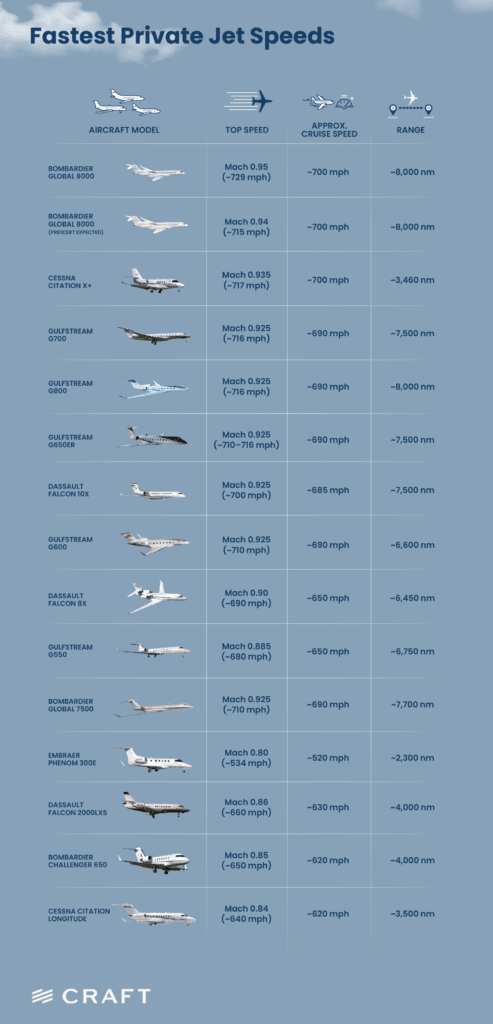
- The fastest certified production business jet has a Mach 0.935 rating, which translates into 717 miles per hour.
- For reference, sound travels at approximately 767 miles per hour.
- It is now reasonably common for ultra long-range business jets to reach speeds in this range.
- High-speed cruise for modern jets typically starts at Mach 0.85, but can reach Mach 0.9 at cruising altitude.
- Mach 0.9 is approximately 690 miles per hour for a typical flight.
Private Jets by Aircraft Class
- Light private jets typically cruise between 400 and 460 miles per hour.
- Their maximum speed can be closer to 500 miles per hour.
- The flight range for light jets is generally 1,200 to 2,000 miles, which means they are typically in the air for 3 to 5 hours at a time.
- Midsize private jets can cruise faster, reaching speeds of up to 500 miles per hour.
- Some midsize jets can reach 520 miles per hour.
- A midsize jet typically takes about 3 hours to fly 1,500 miles.
- Ultra-long-range jets can cruise at 600 miles per hour.
- A private jet in this category can travel 3,000 miles in roughly 5 hours.
Private Jet Altitude and Performance Statistics
Altitude is important because it influences how dense the air is. The higher a plane gets in the sky, the thinner the air becomes.
This can significantly reduce drag on the aircraft, allowing jets to operate more efficiently and achieve higher speeds.
There are also practical limitations at lower altitudes. Planes are generally expected to fly at approximately 300 miles per hour in low-altitude regions to avoid birds and other potential traffic issues.
For these reasons, jets perform at their best the higher they get in the sky. That said, there are limitations: smaller planes sometimes struggle to reach higher altitudes.
Altitude is particularly important when evaluating jet performance statistics.
- A typical private jet will fly at 40,000 to 50,000 feet.
- Commercial airlines usually cruise between 35,000 and 39,000 feet.
- Some business jets are certified to fly at altitudes above 50,000 feet.
- Flying 10,000 feet higher than typical airline traffic maximizes private jet efficiency.
- It typically takes a private jet about 25 minutes to reach 43,000 feet, making such altitudes less practical for shorter flights.
- At 45,000 feet, the air is thin enough for jets to maintain true airspeed more easily.
Average Private Jet Flight Time Statistics
- A private jet operating at standard cruise speeds can complete a 500-mile flight in under 1 hour.
- A 1,000-mile flight can be completed in under 2 hours.
- Cross-country flights across the United States are possible in 4–5 hours, depending on the aircraft and flight conditions.
Boarding and Airport Time Statistics
It’s not just the time spent in the air that makes private jets more efficient. Arguably, the biggest benefit—speed completely aside—is the logistical reality of navigating a private boarding scenario compared to a commercial airport experience.
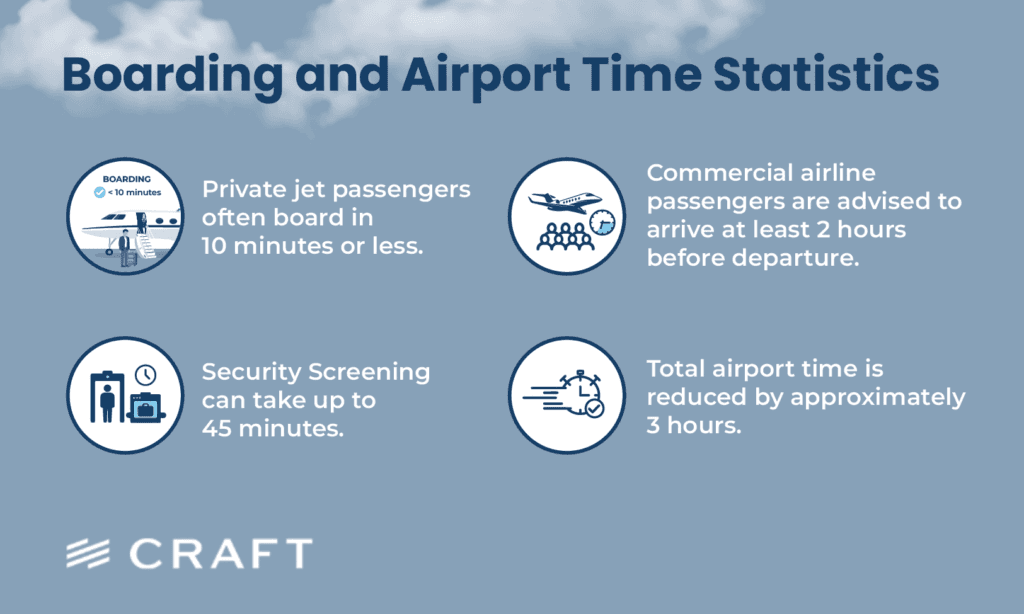
- Private jet passengers often board in 10 minutes or less after arriving at the terminal.
- Commercial airline passengers are typically advised to arrive at least 2 hours before departure.
- TSA security screening at major airports can take up to 45 minutes during busy periods.
- Private jet terminals can process passengers in moments, including luggage handling.
- These factors can reduce total airport time by approximately 3 hours, from check-in to luggage retrieval.
Total Travel Efficiency Statistics
| Route | Distance (miles) | Private Jet Cruise Time | Private Jet Boarding/Prep | Private Jet Total Time | Commercial Flight Time (Gate-to-Gate) | TSA/Pre-Flight Time | Commercial Total Time | Time Saved with Private Jet |
| New York (JFK) – Miami (MIA) | 1,090 | 2 hrs | 0.25 hrs | 2.25 hrs | 3 hrs | 1.5 hrs | 4.5 hrs | 2.25 hrs |
| Los Angeles (LAX) – Chicago (ORD) | 1,745 | 3 hrs 10 min | 0.25 hrs | 3 hrs 35 min | 4 hrs | 1.5 hrs | 5.5 hrs | 2 hrs 15 min |
| Dallas (DFW) – New York (JFK) | 1,370 | 2 hrs 30 min | 0.25 hrs | 2 hrs 55 min | 3 hrs | 1.5 hrs | 4.5 hrs | 1 hr 55 min |
| San Francisco (SFO) – New York (JFK) | 2,570 | 4 hrs 30 min | 0.25 hrs | 4 hrs 55 min | 5 hrs | 2 hrs | 7 hrs | 2 hrs 5 min |
| Boston (BOS) – Miami (MIA) | 1,500 | 2 hrs 45 min | 0.25 hrs | 3 hrs 10 min | 3 hrs 15 min | 1.5 hrs | 4 hrs 45 min | 1 hr 35 min |
| Atlanta (ATL) – Los Angeles (LAX) | 1,950 | 3 hrs 30 min | 0.25 hrs | 3 hrs 55 min | 4 hrs 15 min | 1.5 hrs | 5 hrs 45 min | 1 hr 50 min |
| Seattle (SEA) – New York (JFK) | 2,400 | 4 hrs 15 min | 0.25 hrs | 4 hrs 40 min | 5 hrs | 2 hrs | 7 hrs | 2 hrs 20 min |
| Chicago (ORD) – Miami (MIA) | 1,190 | 2 hrs 10 min | 0.25 hrs | 2 hrs 35 min | 3 hrs | 1.5 hrs | 4.5 hrs |
- Private aircraft can access more than 5,000 public-use airports in the United States.
- Commercial airlines operate scheduled service at roughly 500 U.S. airports.
- Access to smaller airports can shorten ground travel by 30–60 miles in many regions.
- Avoiding airline hubs can eliminate 1–3 hours of layover time.
- Door-to-door private travel can reduce overall trip time by roughly 30–50% on many domestic routes.
- Long-range business jets can remain airborne for 12–14 hours nonstop depending on fuel load.
The Glamour of Private Jet Speed
There is a glamorous quality to the speed of a plane, particularly a private plane. It’s astounding to imagine that a business or even an individual can own something that moves almost at the speed of sound. That said, commercial planes fly quickly, too. It’s not uncommon for them to reach speeds of 600 miles per hour, and outliers can go even faster. Boeing 747s, for example, are known for fast cruising speeds, which can reach as high as 614 miles per hour.
Side by side, the comparison does skew in favor of private jets, but speed alone is not the most influential factor when determining the private versus commercial experience. Saving three hours per flight on logistics is just as valuable, if not more so, than faster airspeed. Overall, private travel not only cuts hours off the journey but also provides a significantly more satisfying experience.
Private Aviation That Works for You
There are many options when it comes to private aviation. Total plane ownership provides the maximum level of access, but it is primarily attainable only for individuals with a net worth around $190 million, which excludes most high-income or high-net-worth individuals.
Other options widen access considerably. Chartering a plane is the most affordable option, while jet cards and fractional jet ownership models provide more regular access for those able to pay a higher upfront fee.
The Craft Experience
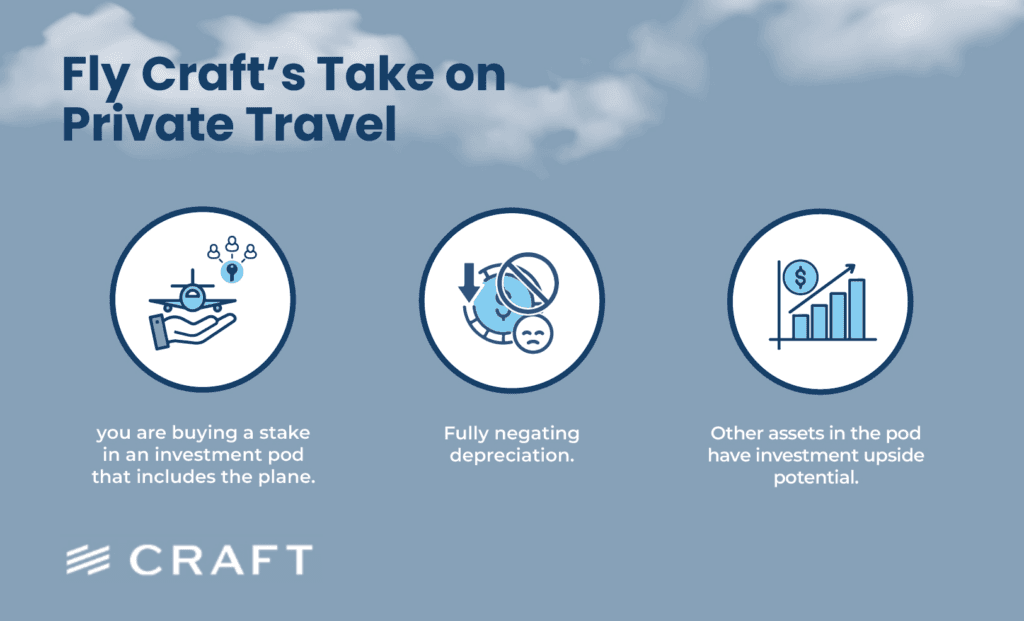
At Craft, we approach private aviation differently. Our model most closely resembles fractional ownership, but with a unique twist. You make a deposit, which buys you equity in a real plane—but rather than directly purchasing a portion of the aircraft, you are buying a stake in an investment pod that includes the plane.
This distinction is important because other assets in the pod have investment upside potential. While the plane may depreciate, typically around 15% per year, the other assets may increase in value, potentially offsetting or even fully negating depreciation.
The Craft model also provides capital gains tax advantages. If you’re interested in learning more or discussing private aviation opportunities, you can book a call today.
Related
Related guides
Routes and cities
Read next
How Fast Do Planes Fly? Airliners vs Private Jets
Airliners cruise at about 515 to 560 mph; the fastest private jets top 600 mph. Cruise, takeoff and landing speeds for every kind of plane, with a chart.
October 5, 2026 · 4 min read
The 10 Most Expensive New Private Jets
Everything you need to know about the most expensive private jets. From Gulfstream to Bombardier, here are the most expensive ways to fly.
October 5, 2026 · 8 min read
Here’s How Much it Costs to Fuel a Private Jet
Fuel is a necessary part of flying. It is also one of the largest variable costs. So, how much does it really cost to fuel a private jet?
October 5, 2026 · 7 min read


Charter Sales
Tell us the trip. We'll tell you the number.
Route, dates, rough timing, how many people. That is enough to start, and you get a firm price for that specific trip rather than a range.
Text us and you'll get a reply within 60 seconds, any hour.