
Basics
Your Guide to Business Travel Tax Deductions
Maximize your business travel tax deductions with our complete guide. Learn IRS rules, recordkeeping, and advanced strategies for corporate travel.
 BenedictPrivate Aviation ConsultantUpdated January 21, 2026 · Published January 18, 2026 · 20 min read
When you travel for work, the IRS allows you to subtract a whole range of ordinary and necessary costs from your taxable income. For an expense to count, it just needs to be both common in your industry and helpful for your business. This isn't just a minor tax break; it's a critical financial tool that directly lowers your tax bill and frees up cash flow, something every entrepreneur and executive needs to master.
Decoding Your Business Travel Tax Deductions

Getting a handle on business travel deductions isn't about memorizing the tax code. It's about understanding one core principle: the IRS lets you deduct expenses that are both "ordinary" and "necessary" for doing business away from your main place of work, what they call your "tax home."
So, what does that really mean? An ordinary expense is just something that's standard practice in your line of work. If you're a software consultant, flying out to a client's office for a project launch is completely ordinary. A necessary expense is one that's helpful and appropriate for your business. Renting a car to get to that client meeting is necessary. Upgrading to a Lamborghini for the trip? Probably not so much.
Why Mastering These Deductions Matters
For entrepreneurs, executives, and anyone self-employed, these deductions are a powerful lever. When you manage them right, you directly lower your taxable income. That means you pay less to the government and keep more capital to reinvest in your business or yourself. This becomes absolutely crucial as your travel schedule picks up.
The numbers tell the story. Global business travel spending is expected to hit a staggering $1.57 trillion in 2025, with the U.S. market alone making up over $395 billion of that. With the cost of flights and hotels climbing, squeezing every last dollar out of your available deductions is no longer just good practice—it's a core financial strategy. You can see the full forecast in the GBTA's latest report.
This isn't just about stuffing receipts in a shoebox. It's about proactively structuring your travel to align with tax advantages, turning a major cost center into a strategic financial benefit.
Advanced Planning for High-Value Travel
Once you move past commercial flights and standard hotels, things get even more interesting. High-value travel, especially private aviation, opens up a new layer of strategic planning. For high-net-worth individuals, the ability to deduct these substantial costs can be a game-changer. For example, understanding the tax benefits of private jets can unlock opportunities like bonus depreciation that simply don't exist with commercial travel. We'll start with the foundational rules here and build our way up to these more sophisticated strategies.
While this guide is designed to give you a comprehensive overview, remember that complex situations often require tailored advice. For specific questions about your circumstances, it's always a good idea to seek out general tax law insights or professional tax consultation. In the sections ahead, we’ll dive into the nitty-gritty of recordkeeping, different deduction methods, and key planning considerations to help you manage your travel expenses with total confidence.
What Travel Expenses Can You Actually Deduct?

Before you can even think about deducting a single expense, your trip has to pass a fundamental test from the IRS: the "away from home" rule. It’s a simple but firm line in the sand. Your business trip must be long enough or far enough from your primary place of business that you need to stop for sleep or rest to do your job properly.
Your daily commute, no matter how grueling, will never count. Think of it like this—driving across town for a two-hour client meeting isn't "travel" in the eyes of the IRS. But flying to another state for a two-day conference? That absolutely is, because there’s no way you could reasonably do it without staying overnight. This simple distinction is the gatekeeper for every deduction that follows.
Another key piece of the puzzle is your "tax home." This isn't necessarily where you live; it's the entire city or general area of your main place of business. To qualify for deductions, your travel has to take you substantially away from this area.
Core Categories of Deductible Expenses
Once you've cleared the "away from home" hurdle, you can start looking at what you can actually write off. The IRS lets you deduct the ordinary and necessary expenses of traveling for your business.
These costs fall into a few main buckets:
- Transportation: This is all about getting to your destination and back. It covers everything from plane tickets and train fares to the costs of driving your own car or a rental.
- Lodging: Your hotel, motel, or other short-term accommodation costs are deductible for the business portion of your trip.
- Meals: You can deduct the cost of your meals, but here's a crucial catch—the deduction is generally limited to 50% of the actual cost.
- Incidental Expenses: This covers the small stuff that adds up, like tips you give for services, laundry, and dry cleaning while on the road.
Getting these categories right is the first step. Nail this, and you’re well on your way to accurately calculating your deductions and trimming your tax bill.
Transportation Costs In Detail
Transportation is often the single biggest line item on a business trip. The great news is that you can typically deduct the full cost of getting to your business destination and back, whether you’re flying commercial or chartering a private plane. The only condition is that the primary purpose of the trip must be business.
For example, let's say you fly to Chicago for a five-day industry conference but decide to stay two extra days to see the sights. Because the main reason for your trip was business, your round-trip airfare is 100% deductible. The IRS cares about what prompted the journey. For those who use private aviation, understanding the full cost to own a private jet is critical, as it shows how these same deduction principles apply on a much larger scale.
The IRS focuses on the primary purpose of your trip when it comes to transportation. If business is the main driver, your travel costs to and from the location are fully deductible, even with some personal time mixed in.
Drawing the Line Between Business and Personal
This is where things can get tricky—and where many people make costly mistakes. You have to be diligent about separating legitimate business costs from non-deductible personal expenses. The IRS is a stickler for this.
What You CANNOT Deduct:
- Personal Sightseeing: That museum ticket or city tour? Not deductible.
- Lavish Entertainment: While business meals are 50% deductible, taking a client to a concert or a ballgame is generally considered non-deductible entertainment.
- Travel for Your Family: You can't deduct the travel costs for a spouse, partner, or friend tagging along unless they are a legitimate employee and their presence on the trip serves a real business purpose.
On trips that mix business with pleasure, you have to allocate your expenses with precision. While your flight might be fully deductible, you can only write off lodging and meals for the days you are actually conducting business. Meticulous records aren't just a good idea here; they're your best defense in an audit.
Creating an Audit-Proof Recordkeeping System
A tax deduction is only as good as the proof you have to back it up. Let's be blunt: without solid documentation, even the most legitimate business travel expenses can be thrown out by an IRS auditor. This is where your recordkeeping system stops being a chore and becomes your most important financial tool.

Think of it like being a detective for your own finances. Your job is to collect and organize the evidence that proves every single expense was real, necessary, and directly tied to your business. A shoebox full of crumpled receipts at the end of the year just won't cut it. You need a consistent, methodical approach from day one.
The system doesn't need to be complex, but it absolutely must be complete. For every expense you claim, you have to be ready to answer the fundamental questions an auditor is trained to ask.
The Five Pillars of IRS Substantiation
The IRS is very clear on this. To prove an expense is valid, you need to document five key pieces of information. Miss just one, and you put the entire deduction at risk.
- Amount: What was the exact cost? A receipt showing the total is your best evidence.
- Time: When did you pay for it? The date on the receipt establishes the timeline of your business trip.
- Place: Where did the transaction happen? This means the name and city of the hotel, restaurant, or airline.
- Business Purpose: This is the crucial "why." You have to explain how this expense helped your business. A simple note like, "Client meeting to discuss Q4 project proposal," is perfect.
- Business Relationship: If you're deducting a meal or event, who was there? Note their names and their business connection to you (e.g., "John Doe, CEO of ABC Corp").
Getting these five points right is the bedrock of an audit-proof system. It turns a simple receipt into a complete piece of evidence that tells the story of your business activity.
With travel costs on the rise, this level of detail is more critical than ever. We've seen the average U.S. and Canada airfare climb to $701 in 2024, and hotel rates are following suit. IRS Section 274(d) lays out these strict substantiation rules, and following them is the only way to ensure you can deduct these escalating costs.
Modern Tools Versus Traditional Methods
In the past, audit-proof records meant file cabinets overflowing with paper and logbooks filled out by hand. While that old-school method can still work, technology offers a much smarter path.
Digital tools can do the heavy lifting for you. For instance, by leveraging text reader image tools, you can scan, categorize, and store your receipts with just a few clicks, saving you a massive amount of time.
IRS Documentation Checklist for Business Travel Expenses
Different expenses tell different stories, so your records need to match. A plane ticket receipt contains different information than a dinner bill, and the IRS expects you to capture the right details for each.
Here's a straightforward checklist breaking down exactly what the IRS wants to see for the most common travel expenses. Following this table is the simplest way to ensure you have what you need for an audit.
| Expense Category | Required Documentation Elements | Best Practice Example |
|---|---|---|
| Airfare & Transportation | Ticket receipt or e-ticket showing passenger name, travel dates, itinerary, and cost. | Save the email confirmation and boarding pass PDF in a digital folder labeled with the trip name and date. |
| Lodging | The itemized hotel bill (folio) showing your name, check-in/check-out dates, and a breakdown of charges (room rate, taxes, incidentals). | Ask for an email copy of the final folio at checkout and immediately save it to your expense tracking software. |
| Meals | A receipt showing the restaurant name, date, and amount. For meals over $75, an itemized receipt is strongly recommended. | Snap a picture of the receipt with your phone and add a note: "Dinner with Jane Smith (potential client) to discuss partnership." |
| Car Rental | The rental agreement and the final receipt showing the rental period and total cost. | Keep the full contract and final invoice. Note the business miles driven if you used it for mixed purposes. |
By building your system around these principles, you shift from simply spending money to strategically documenting investments in your business. This disciplined approach not only makes tax time less stressful but also gives you a powerful defense in the unlikely event of an audit.
Choosing Between Actual Expenses and Per Diem Rates
When it comes to deducting the cost of your lodging, meals, and incidentals on a business trip, the IRS gives you a choice. You can go one of two routes: the Actual Expense Method or the Per Diem Method. This isn't just a matter of paperwork; it's a strategic decision that can have a real impact on your bottom-line tax savings.
Think of it as the difference between itemizing every single purchase and taking a standard allowance. The Actual Expense Method is exactly what it sounds like. You diligently save every receipt for your hotel, your meals, your tips—everything—and then you tally it all up. It takes a lot more effort, but if your spending outpaces the standard government rates, you could end up with a much larger deduction.
The per diem method, on the other hand, is a fantastic shortcut. Instead of wrestling with a pocketful of crumpled receipts for every coffee or sandwich, you simply use a fixed daily allowance set by the government. This allowance is meant to cover your lodging, meals, and incidental expenses, and it changes depending on where you are.
The Big Advantage of Per Diem: Simplicity
Let's be honest, the main draw of the per diem method is how easy it is. The U.S. General Services Administration (GSA) publishes standard rates for different cities and regions all over the country. As you'd expect, a major hub like San Francisco or New York City will have a much higher daily rate than a small town in the Midwest.
Using this method means you can claim a standard amount without having to prove the exact cost of every meal. This drastically cuts down on your recordkeeping. You still have to document the basics—the who, what, when, where, and why of your trip—but you can kiss that overflowing envelope of food receipts goodbye.
The per diem method isn't about cutting corners; it's about being efficient. For anyone who travels frequently, the time saved by not tracking every minor expense can be far more valuable than the few extra dollars you might get by itemizing.
A couple of crucial things to keep in mind here:
- If You're Self-Employed: You can use the per diem rates for your meals and incidental expenses (M&IE), but you must still keep the actual receipts for your lodging. You can't use the lodging portion of the per diem rate.
- For Employers: Businesses have it a bit easier. They can use the full per diem rates—lodging plus M&IE—to reimburse employees through what's called an accountable plan. This makes the entire expense reporting process much simpler for everyone involved.
Actual Expense vs. Per Diem Method: A Comparison
So, which method should you choose? It really depends on your travel patterns, where you're going, and how much you can tolerate tracking little details. Neither one is universally "better"; the right choice is completely situational.
To make it clearer, let's put them side-by-side. This table breaks down the key differences to help you decide which approach is the best fit for your next trip.
| Feature | Actual Expense Method | Per Diem Method |
|---|---|---|
| Recordkeeping | Demands you save every receipt for lodging, meals, and all incidental costs. High effort. | You only need proof of the trip itself (time, place, business purpose). No meal receipts are required. Low effort. |
| Deduction Amount | Your deduction is based on the actual dollars you spent. It can be higher if you spend more than the standard rate. | You get a fixed daily allowance set by the GSA for your specific location. It's predictable but might be less than your actual spending. |
| Simplicity | Can be complex and very time-consuming. You're tracking every penny. | Incredibly simple and fast. It significantly reduces the administrative burden of business travel. |
| Best For | Trips to high-cost cities where your actual spending is very likely to exceed the per diem rates. | Frequent travelers who value convenience, predictability, and saving time over squeezing out every last possible dollar. |
Ultimately, the decision rests on a simple cost-benefit analysis. Is the extra time and effort required to track every expense worth the potentially larger deduction? Sometimes the answer is yes, but for many busy professionals, the simplicity of per diem wins out.
Putting It Into Practice: A Quick Example
Let's run the numbers on a hypothetical three-day business trip to Chicago to see how this plays out.
The Scenario:
- Trip Length: 3 days
- Location: Chicago, IL
- GSA Per Diem Rate (Meals & Incidentals): Let's say it's $79 for our dates.
With the Actual Expense Method: You meticulously save every receipt for your meals.
- Day 1 Meals: $95
- Day 2 Meals: $110
- Day 3 Meals: $80
- Total Meal Cost: $285
- After the 50% limitation: $285 x 0.50 = $142.50 Deduction
With the Per Diem Method: You don't need a single meal receipt.
- Per Diem Rate: $79/day
- Total Allowance: $79 x 3 days = $237
- After the 50% limitation: $237 x 0.50 = $118.50 Deduction
In this particular instance, taking the time to track your actual spending paid off with a slightly larger deduction. But if you had been more frugal, or if the per diem rate for Chicago had been higher that week, the tables could have easily turned. The smartest approach is to know your spending habits and check the GSA per diem rates for your destination before you travel. That way, you can make an informed choice every single time.
Advanced Tax Strategies for Private Aviation
For many high-net-worth entrepreneurs and business leaders, standard travel deductions are just scratching the surface. Once private aviation enters the conversation, travel stops being a simple expense line and becomes a key part of a much larger wealth management strategy. This is where we move past basic deductions and into high-impact financial planning.
The foundational rule is still simple: if a private flight is an ordinary and necessary business expense, its cost is generally 100% deductible. The real magic, however, lies in how you access the aircraft. The tax implications of chartering on-demand, entering a fractional ownership program, or owning an aircraft outright are worlds apart, each with its own set of advantages and challenges.
Moving Beyond Simple Chartering
Chartering a jet for a last-minute client meeting is straightforward enough to deduct. But more sophisticated structures offer benefits that can compound over years. The most forward-thinking strategies don't treat private aviation as a sunk cost, but as an asset class with some truly powerful tax advantages. This is where innovative models are changing the game.
Imagine a structure where instead of paying for flights with cash, you contribute appreciated assets, like company stock, into a professionally managed fund. This single move can unlock several layers of financial efficiency. You get access to a fleet of private jets while simultaneously deferring the capital gains tax you would have paid on that stock, letting your original investment continue to grow.
This approach cleverly separates the act of flying from the direct purchase of a depreciating asset—the airplane itself. You're holding a stake in a diversified fund while enjoying all the perks of on-demand private travel. You can find a deeper dive on these models in our guide covering the benefits of private jet ownership.
Bonus Depreciation and Offsetting Income
Here's where it gets really compelling: the interplay with depreciation rules. When the fund you’ve invested in acquires aircraft, it can often take advantage of bonus depreciation. This tax provision allows the fund to write off a huge percentage of an aircraft's cost in the very first year.
As an investor in the fund, a share of this "paper loss" can flow through to you. You can then use this loss to offset other active income on your personal tax return.
This is the critical shift in thinking. You're not just deducting the cost of your flights. You're using the fund's asset depreciation to generate a massive tax deduction that can shield income from your other business ventures, turning your travel solution into a powerful tax shield.
While advanced aviation strategies build on basic deduction principles, it helps to remember the two foundational methods. The flowchart below compares tracking every single receipt (the actual expense method) versus using a standardized allowance (the per diem method).
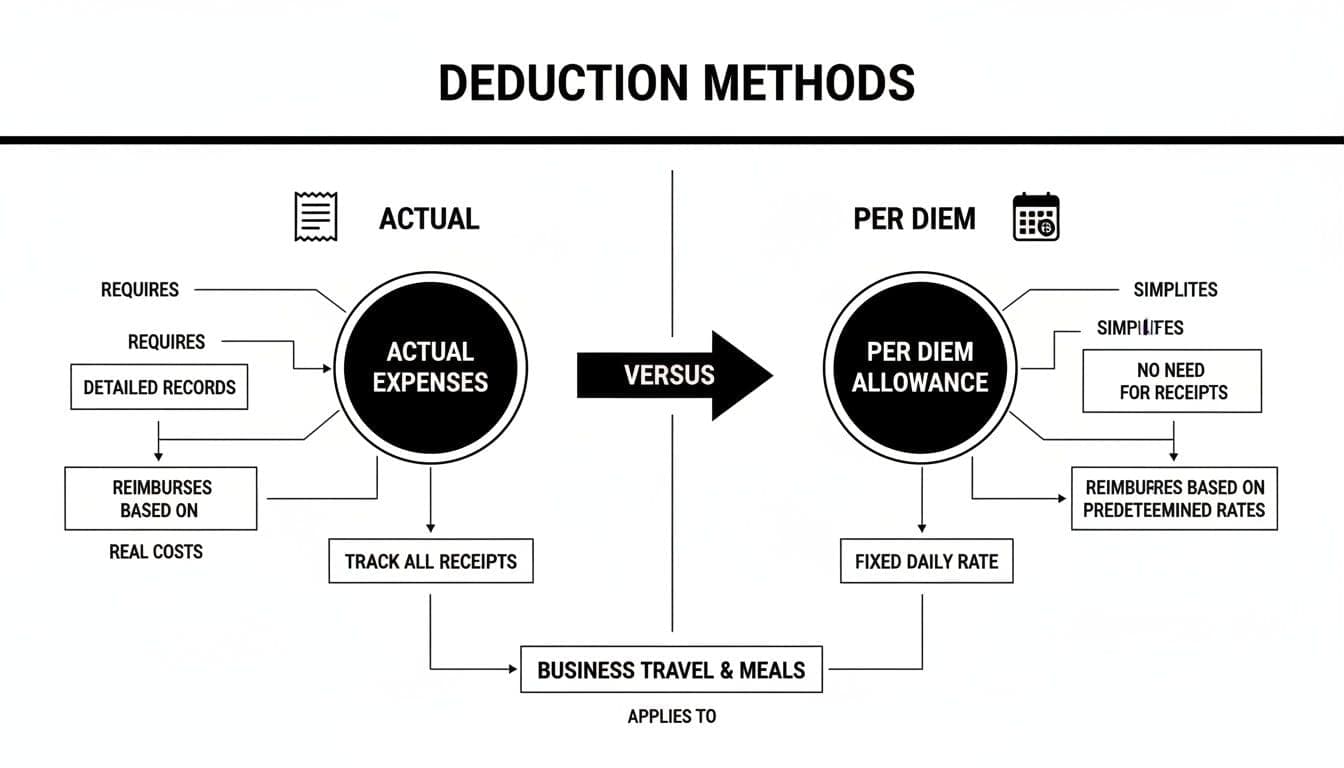
This foundational choice is important, but it’s the larger structures layered on top that create truly outsized tax efficiencies.
The current economic climate actually makes these strategies more relevant than ever. A recent survey found that while 89% of business travelers expect their budgets to hold steady or increase, 87% also report cuts to perks like flying first class. This "yes-but" reality—more spending, but with more scrutiny—puts a premium on tax-efficient travel solutions.
Savvy investors can use exchange funds like Glidepath to contribute stock, defer gains, and use bonus depreciation to offset other income, effectively navigating these corporate restrictions without giving up access or convenience.
A Holistic Wealth Management Approach
Ultimately, looking at private aviation this way changes its role entirely. It's no longer just a way to get from point A to point B. It becomes an integrated piece of your financial ecosystem, working in concert with your investment portfolio to boost tax efficiency and preserve your capital.
- Capital Gains Deferral: By contributing appreciated stock instead of selling it, you sidestep a major tax bill that would otherwise be due.
- Bonus Depreciation Pass-Through: You can receive significant paper losses to offset income from other active business activities.
- Asset Diversification: Your investment is in a managed fund, not tied up in a single, depreciating aircraft.
Putting these strategies into practice demands careful planning and close coordination with your tax and legal advisors. The rules are complex, but for the right person, the financial upside is enormous. It's a perfect example of how business travel deductions can evolve from a simple accounting chore into a cornerstone of sophisticated financial engineering.
Common Questions About Travel Deductions
Once you get the basics down, the real world throws curveballs. Knowing the rules is one thing, but applying them to your specific trips is where things can get tricky. Let's tackle some of the most common questions that pop up, clearing the fog around those gray areas that trip up even seasoned travelers.
The goal here is to move from theory to practice. We'll look at mixing work with play, how your company's reimbursement policy changes things, and the critical differences between flying commercial and flying private.
Can I Deduct Expenses If I Combine Business and Leisure Travel?
Absolutely, but you have to be meticulous about how you split the costs. The IRS's entire focus is on the primary purpose of your trip. Did you travel mainly for work, with a little fun on the side, or was it a vacation with a few work emails sprinkled in? They'll look at the facts, especially how many days you spent on business versus personal activities.
If the trip is primarily for business, the big win is that you can generally deduct 100% of your transportation costs—the flight, the train ticket, whatever it took to get you there and back.
But once you’re on the ground, the rules tighten up. You can only deduct costs like your hotel and 50% of your meals on the days you were actually working.
- Here’s a real-world example: You fly to Denver for a five-day trip. Monday through Wednesday are packed with client meetings. You decide to stay Thursday and Friday to hit the slopes.
- How the deduction works: Since the primary reason for the trip was business (three work days vs. two personal days), your entire round-trip flight to Denver is deductible. You can also deduct your hotel bill and 50% of your meal costs for Monday, Tuesday, and Wednesday. The hotel, lift tickets, and meals for Thursday and Friday? Those are on you—they are personal and not deductible.
How Do Employer Reimbursements Affect My Deductions?
This all comes down to what kind of reimbursement plan your employer has. Most companies use what the IRS calls an accountable plan. It’s a straightforward system: you submit your expenses with proof, and the company pays you back. Any excess cash you were given has to be returned.
Under an accountable plan, the money you get back isn't considered taxable income. Since you were made whole by your employer and didn't pay tax on the reimbursement, you cannot deduct those same expenses on your personal return. That would be double-dipping, and the IRS is not a fan.
However, there are a couple of exceptions where you might still get a deduction:
- Non-Accountable Plan: If your company just gives you a flat travel stipend and doesn't require receipts (a non-accountable plan), that money is treated as taxable income. Because you're paying tax on it, you can then deduct your actual qualified business travel expenses on your tax return.
- Expenses Exceed Reimbursement: Let's say your actual business expenses were more than what your boss reimbursed you under an accountable plan. You might be able to deduct the difference that came out of your own pocket.
What Are the Most Common Mistakes to Avoid?
Staying out of trouble with the IRS often just means sidestepping a few common, costly blunders. Keep these pitfalls in mind, and you'll be on much safer ground.
- Sloppy Recordkeeping: This is, without a doubt, the #1 reason travel deductions get thrown out during an audit. If you can't produce receipts and logs proving the amount, time, place, and business purpose for each expense, you have no leg to stand on.
- Mixing in Personal Expenses: Trying to write off a museum ticket, a Broadway show, or the flight for your spouse who tagged along is a massive red flag. Keep it strictly business.
- Ignoring the "Away from Home" Rule: Your daily commute to the office is not business travel. Neither is the lunch you grab near your office. The deduction is for travel that requires you to be away from your tax home overnight.
- Forgetting to Allocate Costs: When you mix business and pleasure, you can't just deduct everything. You have to be diligent about separating the costs for your business days from your personal days.
How Do Private Jet Deductions Compare to Commercial Flights?
On the surface, both are just transportation costs. A commercial flight deduction is simple: you write off the cost of the ticket. But with private aviation, the story gets far more interesting and strategic.
When you fly private for business, 100% of the flight cost is generally deductible, whether you're chartering a plane or using a fractional program. The real game-changer, though, isn't the flight itself but the sophisticated structures behind it.
For high-net-worth individuals, private aviation shifts from being a mere travel expense to a component of a sophisticated tax and wealth management strategy.
For instance, certain investment fund models can unlock powerful benefits like bonus depreciation on the aircraft. This can create a substantial "paper loss" that flows through to you, which you can then use to offset other active income from your business or investments. A first-class ticket on Delta simply can't do that. These structures can even allow you to fund your travel by contributing appreciated assets, giving you the dual benefit of flying private while deferring a big capital gains tax bill.
At Craft, we transform private jet access from a simple expense into a strategic investment. Our unique exchange-fund model allows you to contribute cash or appreciated stock, deferring capital gains while unlocking on-demand access to a fleet of super-midsize jets. Discover a smarter way to fly and invest by exploring our tax-efficient aviation solutions.
Related
Related guides
Routes and cities
Read next
10 Advanced Tax Strategies for High Net Worth Individuals in 2026
Discover 10 powerful tax strategies for high net worth individuals. Learn to defer gains, reduce estate taxes, and optimize your wealth with expert insights.
January 21, 2026 · 23 min read
Tax Efficient Investing Strategies: 10 Expert Tips for Savvy Investors
Explore tax efficient investing strategies to boost after-tax returns with actionable tips for smarter portfolios.
January 21, 2026 · 24 min read
How to Optimize Productivity on Business Private Jet Trips
Travel takes time, of course, which can be detrimental to your busy work or personal schedule.
May 30, 2025 · 6 min read


Charter Sales
Tell us the trip. We'll tell you the number.
Route, dates, rough timing, how many people. That is enough to start, and you get a firm price for that specific trip rather than a range.
Text us and you'll get a reply within 60 seconds, any hour.