
In brief
A maintenance entry under 14 CFR 43.9 needs a description of the work (or a reference to acceptable data), the completion date, the name of the person who did it if different, and the signature, certificate number and kind of certificate of the person approving it. An inspection entry under 14 CFR 43.11 needs the type and extent of the inspection, the date, the aircraft total time in service, the signer's certificate details and the prescribed airworthy or discrepancy statement. The examples below use fictional aircraft and people; write your own entry from the actual work.
Tools for this decision
Run the numbers while you read.

A good logbook entry lets someone who was not there tell what was done, to which aircraft, using what data, when, and who approved it. The rules for that are short: 14 CFR 43.9 for maintenance and alterations, and 14 CFR 43.11 for inspections.
Below are six complete example entries for the work that fills most logbooks, each followed by the regulation behind its lines. Every aircraft, person and certificate number on this page is fictional. The AD in example 4 is real; check its current status in the FAA's Dynamic Regulatory System before you rely on it.
What every entry needs
| Entry type | Rule | Required content |
|---|---|---|
| Maintenance, preventive maintenance, rebuilding, alteration | 14 CFR 43.9(a) | Description of the work (or reference to acceptable data); date completed; name of the person who did it, if not the approver; approver's signature, certificate number and kind of certificate |
| Inspection under Part 91, 125, 135.411(a)(1) or 135.419 | 14 CFR 43.11(a) | Type of inspection and brief description of its extent; date; aircraft total time in service; signature, certificate number and kind of certificate; the airworthy or discrepancy statement |
| Major repair or major alteration | 14 CFR 43.9(d) and Part 43 Appendix B | The logbook entry plus FAA Form 337, with a copy to the owner and one to the FAA within 48 hours |
| AD status | 14 CFR 91.417(a)(2)(v) | AD number and revision date, method of compliance, and for recurring ADs the time and date of the next action |
Under 43.9(a)(4), the signature on a maintenance entry is the approval for return to service, but only for the work in that entry.
Example 1: annual inspection
An annual inspection on a Part 91 airplane, signed by a mechanic with an inspection authorization. This one goes in the airframe logbook; the engine and propeller logbooks get their own entries for the same inspection.
March 14, 2026
Aircraft total time in service: 4,712.6 hrs

Cessna 172S, N123RX, S/N 172S10456

Performed an annual inspection in accordance with the scope and detail of 14 CFR Part 43, Appendix D, using the Cessna 172 series service manual inspection checklist. Reviewed AD compliance for the airframe, engine, propeller and appliances; status recorded on the AD compliance record dated March 14, 2026. Discrepancies found during the inspection were corrected and are recorded in separate entries of this date.

I certify that this aircraft has been inspected in accordance with an annual inspection and was determined to be in airworthy condition.

[signature]  Maria Ortiz  A&P 3456789  IA
What makes it complete: the inspection type and its extent (Appendix D, manufacturer's checklist), the date, the aircraft total time in service, the 43.11(a)(4) statement in the regulation's words, and the signer's certificate number and kind. An annual must be signed by an IA, a rated repair station or the manufacturer (14 CFR 65.95).
If the aircraft does not pass, the entry ends with the 43.11(a)(5) statement instead, and the owner gets a signed, dated list under 43.11(b):
I certify that this aircraft has been inspected in accordance with an annual inspection and a list of discrepancies and unairworthy items dated March 14, 2026 has been provided for the aircraft owner or operator.

[signature]  Maria Ortiz  A&P 3456789  IA
Example 2: 100-hour inspection
Required by 14 CFR 91.409(b) for an aircraft that carries any person other than a crewmember for hire, or that the instructor provides for flight instruction for hire. A certificated A&P mechanic can sign it; no IA is needed.
August 3, 2026
Aircraft total time in service: 6,218.4 hrs
Engine time since major overhaul: 1,412.9 hrs

Piper PA-28-181, N456RX, S/N 28-8090123
Engine: Lycoming O-360-A4M, S/N L-31234-36A

Performed a 100-hour inspection of the engine in accordance with 14 CFR Part 43, Appendix D, and the Piper PA-28-181 maintenance manual inspection report. Compression: 78/80, 76/80, 77/80, 78/80. Changed oil and filter; filter element opened and inspected, no metal found. Cleaned and gapped spark plugs. Ground run, no leaks.

I certify that this aircraft has been inspected in accordance with a 100-hour inspection and was determined to be in airworthy condition.

[signature]  David Chen  A&P 2345678
The same statement goes in the airframe and propeller logbooks with their own descriptions. Record what you measured, such as compressions, rather than "checked OK".
Example 3: oil change by the owner
An oil and filter change done as preventive maintenance by the owner, who holds a private pilot certificate. 14 CFR 43.3(g) allows this on an aircraft the pilot owns or operates that is not used under Part 121, 129 or 135. Part 43 Appendix A lists lubrication and replacing oil filter elements as preventive maintenance.
June 2, 2026
Engine time since major overhaul: 1,204.3 hrs
Tach: 2,368.9

Cessna 172S, N123RX. Engine: Lycoming IO-360-L2A, S/N L-12345-51A

Drained engine oil. Removed oil filter, cut open and inspected the element: no metal found. Installed new oil filter, P/N CH48110-1, torqued and safety-wired per the filter manufacturer's instructions. Serviced with 8 qts Aeroshell W100 Plus. Ground run, checked filter and drain plug for leaks: none.

[signature]  Pat Lee  Private Pilot 4567890
The pilot signs with the certificate they actually hold. A pilot cannot sign for preventive maintenance on an aircraft used in Part 135 operations, and cannot approve anything beyond preventive maintenance.
Example 4: AD compliance (recurring)
AD 2011-10-09 (Amendment 39-16690, effective June 17, 2011) requires repeated inspections of the pilot and copilot seat rails, rollers and lock pins on many Cessna single-engine models, at intervals of not more than 100 hours time in service or 12 months, whichever occurs first. It applies to the Cessna 182P below; check the AD's applicability list for any other model.
September 8, 2026
Aircraft total time in service: 3,904.7 hrs

Cessna 182P, N789RX, S/N 18263998

Complied with AD 2011-10-09, Amendment 39-16690, seat rails, rollers and lock pins, by accomplishing the inspections in paragraph (g) of the AD. Seat rails, rail holes, rollers, washers, axle bolts, roller housings, tangs and lock pin springs inspected: within limits, no cracks. Seat rails cleaned of debris. Seats reinstalled and lock pin engagement verified.
Method of compliance: inspection per AD paragraph (g). Recurring.
Next due: 4,004.7 hrs total time or September 8, 2027, whichever occurs first.

[signature]  Maria Ortiz  A&P 3456789
The matching line on the AD status record, which 91.417(a)(2)(v) requires the owner to keep and transfer with the aircraft:
| AD number and revision date | Subject | Method of compliance | Last done | Recurring interval | Next due |
|---|---|---|---|---|---|
| 2011-10-09, Amdt 39-16690, effective June 17, 2011 | Seat rails, rollers, lock pins | Inspection, paragraph (g) | September 8, 2026 at 3,904.7 hrs | 100 hrs or 12 months, whichever first | 4,004.7 hrs or September 8, 2027 |
Example 5: return to service after maintenance
A failed dry air pump replaced by an A&P. The signature on a 43.9 entry is the approval for return to service for that work; many shops write the statement out as well.
November 19, 2026
Engine time since major overhaul: 1,288.0 hrs
Aircraft total time in service: 4,796.2 hrs

Cessna 172S, N123RX. Engine: Lycoming IO-360-L2A, S/N L-12345-51A

Pilot reported low suction. Confirmed suction 3.2 in. Hg at cruise RPM. Removed dry air pump, S/N 0412873. Installed new dry air pump, same part number, S/N 1185520 (8130-3 on file), with new gasket, in accordance with the pump manufacturer's installation instructions and the Cessna 172 series service manual. Ground run: suction 5.0 in. Hg, within limits. No leaks.

The work described above was performed in accordance with current regulations and approved data, and the engine is approved for return to service for this work.

[signature]  David Chen  A&P 2345678
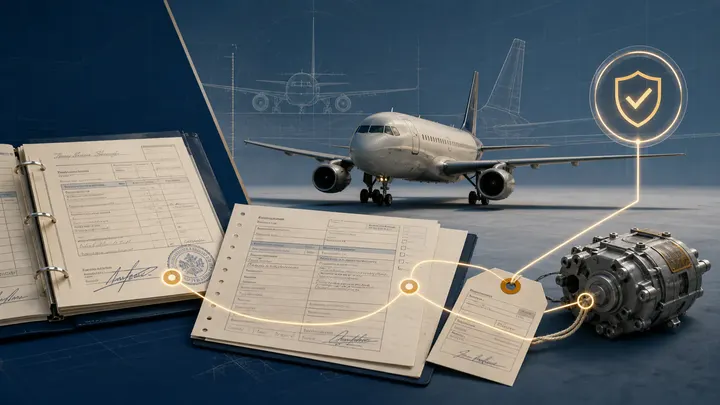
Keep the removed part's tag and the new part's 8130-3 with the record. A buyer's inspector will look for both.
Example 6: major alteration with Form 337
A major alteration needs the logbook entry and an FAA Form 337 (14 CFR 43.9(d) and Part 43 Appendix B). The person performing the work gives the owner a signed copy and sends one to the FAA within 48 hours of return to service.
April 22, 2026
Aircraft total time in service: 4,744.1 hrs

Cessna 172S, N123RX, S/N 172S10456

Installed GPS/NAV/COM navigator in accordance with STC [number] and the manufacturer's installation manual [document number and revision].
Removed: COM 2 radio, P/N and S/N as listed on the equipment list. Ground and flight tests completed per the installation manual: satisfactory. Weight and balance revised: new empty weight 1,688.4 lbs, CG 41.2 in. Equipment list updated. Airplane Flight Manual Supplement inserted in the POH. See FAA Form 337 dated April 22, 2026, for the description of the alteration.

[signature]  Maria Ortiz  A&P 3456789  IA
On a Part 91 aircraft, the return to service in block 7 of a 337 for a major alteration is signed by an IA, a repair station or another person the FAA authorizes. See the FAA Form 337 guide for the form itself.
Correcting an entry
Do not erase, overwrite or backdate a signed entry. A correction should leave the original readable and add:
- What is being corrected.
- The corrected fact and why.
- The supporting evidence.
- The name, certificate and date of the person correcting it.
If a scanned copy is wrong but the paper original is right, fix the scan or its index, never the original.
Electronic entries
FAA AC 120-78B covers electronic signatures and recordkeeping. An electronic entry needs the same content as a paper one, plus a signature that identifies the signer, cannot be copied to another entry, and shows any later change. Part 135 operators need OpSpec A025 to keep records and signatures electronically (our A025 guide).
Entry review checklist
- The right aircraft, engine, propeller or appliance is identified.
- The work description matches what was actually done.
- The data used is named, with its revision.
- Part numbers and serial numbers of removed and installed parts are recorded.
- The completion date is present.
- Inspection entries carry the aircraft total time in service.
- The person who did the work is named, if not the signer.
- Signature, certificate number and kind of certificate are present.
- Inspection statements use the 43.11 wording or a similarly worded statement.
- AD entries name the AD, amendment, paragraph, method and next due.
- Major repairs and alterations reference their Form 337.
- The AD status record, component status and weight and balance were updated.
Where Radar fits
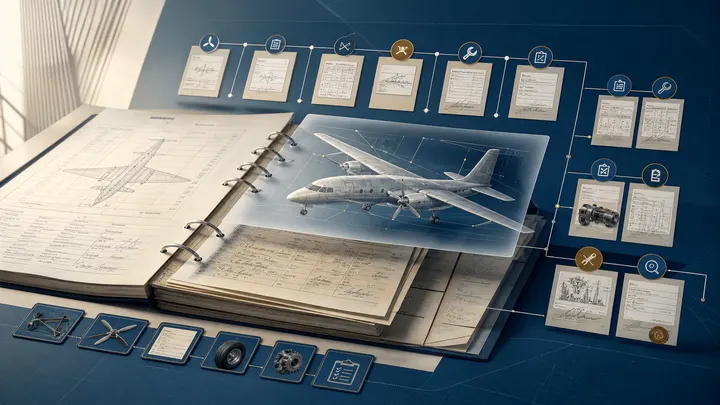
Radar reads every logbook back to birth, typed or handwritten, and turns each entry into data: the date, the times, the tasks, the parts by part and serial number, the ADs and SBs complied with, and who signed, with their certificate. Every value opens the region of the page it came from. Radar Maintenance Tracking then builds the due list from those signed entries, so the next due for a recurring AD like the one in example 4 comes from the entry itself. See the live logbook demo or get a demo with one of your own aircraft.
Sources and further reading
- 14 CFR 43.9, Content, form, and disposition of maintenance records
- 14 CFR 43.11, Content, form, and disposition of records for inspections
- 14 CFR 43.3, Persons authorized to perform maintenance
- 14 CFR Part 43, Appendix A (preventive maintenance) and Appendix B (major repairs and alterations)
- 14 CFR 91.409, Inspections
- 14 CFR 91.417, Maintenance records
- 14 CFR 65.95, Inspection authorization: privileges and limitations
- FAA AC 43-9D, Maintenance Records
- FAA Airworthiness Directives (search AD 2011-10-09 in the Dynamic Regulatory System for the current text)
- FAA AC 120-78B, Electronic Signatures, Electronic Recordkeeping, and Electronic Manuals
Common questions
Frequently asked questions
What must an aircraft logbook entry include?
For maintenance, preventive maintenance, rebuilding and alterations, 14 CFR 43.9(a) requires a description of the work or a reference to acceptable data, the date the work was completed, the name of the person who did it if different from the approver, and the approver's signature, certificate number and kind of certificate. Inspection entries under 14 CFR 43.11 also need the type and extent of the inspection, the aircraft total time in service and the prescribed statement.
What is the wording for an annual inspection logbook entry?
14 CFR 43.11(a)(4) gives the statement for an aircraft found airworthy: “I certify that this aircraft has been inspected in accordance with an annual inspection and was determined to be in airworthy condition.” If it is not approved, 43.11(a)(5) gives the statement that a list of discrepancies and unairworthy items, dated, has been provided to the owner or operator.
Who can sign off an annual or a 100-hour inspection?
An annual inspection must be performed and signed by a mechanic holding an inspection authorization (IA), a certificated repair station appropriately rated, or the manufacturer. A 100-hour inspection can be signed by a certificated mechanic with airframe and powerplant ratings. See 14 CFR 65.85, 65.87 and 65.95.
Can a pilot make a logbook entry for an oil change?
Yes, if the pilot owns or operates the aircraft and it is not used under Part 121, 129 or 135. 14 CFR 43.3(g) lets a certificated pilot perform preventive maintenance, which includes cleaning or replacing oil filter elements and lubrication under Part 43 Appendix A. The pilot makes the 43.9 entry and signs with their pilot certificate number and kind.
How do you record AD compliance in a logbook?
Make a 43.9 entry describing the work and naming the AD, its amendment number and the paragraph complied with, and record the method of compliance. Under 14 CFR 91.417(a)(2)(v), the AD status record must show the AD number and revision date, the method of compliance and, for a recurring AD, the time and date the next action is due.
Do the engine and propeller need their own entries?
The owner must keep records for the airframe and for each engine, propeller, rotor and appliance under 14 CFR 91.417(a)(1). Most aircraft have separate airframe, engine and propeller logbooks, so an annual inspection usually gets an entry in each.
Can I copy these examples into my logbook?
Use them as a pattern, not as text to sign. The entry must describe the actual work on the actual aircraft, the data actually used, the actual times and dates, and the actual approving person. The aircraft, names and certificate numbers on this page are fictional.
Keep researching
Related aircraft guides

Run maintenance from connected evidence
Know what is due, and open the record that proves it.
Radar reads every logbook back to birth and builds the due list from the signed entries, with the page behind every line.