
Charter
How to Charter a Private Jet The Ultimate Guide for First-Time Flyers
Thinking about how to charter a private jet? This guide demystifies the process, covering costs, aircraft choice, safety, and booking for discerning travelers.
 BenedictPrivate Aviation ConsultantUpdated January 23, 2026 · Published January 7, 2026 · 16 min read
When you charter a private jet, you're essentially renting the entire aircraft for a specific trip. This gives you an incredible amount of flexibility, privacy, and efficiency that you just can't get with commercial airlines or even some of the more structured private aviation programs.
Put simply, the plane operates on your schedule, flying to the destinations you choose.
Is Chartering a Private Jet Right for You?

Deciding whether to charter a private jet really comes down to weighing convenience against cost and how often you fly. It's often the perfect solution for those who fly privately only occasionally but need total control over their travel plans.
Think about it: a last-minute business trip from San Francisco to a remote facility in Montana is a logistical nightmare on commercial flights. With a charter, it’s simple. The same goes for a family planning a multi-stop European vacation—you can completely bypass the headaches of layovers and rigid airline schedules.
The on-demand nature of chartering gives you all the perks of private aviation without the long-term financial strings attached.
When On-Demand Charter Makes Perfect Sense
The biggest advantage of on-demand charter is its straightforward, pay-as-you-go model. You aren't locked into massive upfront investments or long-term contracts. This makes it a great fit for a few common scenarios:
- Infrequent Private Flyers: If you fly privately fewer than 25 hours per year, chartering is almost always the most economical choice.
- Complex Itineraries: When your trip involves hopping between multiple cities in a short timeframe, a charter flight waits for you. It turns what would be a stressful ordeal into an efficient, seamless tour.
- Testing the Waters: For anyone new to private aviation, chartering is the best way to experience the benefits firsthand before considering more committed options like jet cards or ownership.
This kind of flexibility has fueled incredible growth in the industry. The global private jet market is on track to hit $35-38 billion in 2025—a massive jump of nearly 50% from its $25.87 billion valuation back in 2021. This boom underscores a clear demand for premium, efficient travel.
Exploring Alternatives: Jet Cards and Fractional Ownership
While chartering offers fantastic freedom, it's not the only private aviation game in town. As your travel patterns change, it’s smart to understand the other options available.
Here’s a quick breakdown of how the most common private aviation models stack up, so you can see where charter fits in.
Comparing Private Aviation Models
| Model | Best For | Commitment | Pricing Structure | Key Advantage |
|---|---|---|---|---|
| On-Demand Charter | Flying under 25 hrs/year; one-off or complex trips | Trip-by-trip | Pay-per-flight (variable) | Maximum flexibility, no long-term ties |
| Jet Card | Flying 25-50 hrs/year; predictable costs are a priority | Prepaid hours (e.g., 25-hour card) | Fixed hourly rates | Guaranteed availability & predictable pricing |
| Fractional Ownership | Flying 50+ hrs/year; desire for asset ownership | Multi-year share purchase | Hourly rate + monthly management fees | Tax benefits, consistent aircraft access |
As you can see, each model serves a different need.
Jet cards are basically prepaid blocks of flight hours on a certain type of aircraft. They come with fixed hourly rates and guaranteed availability, which is great for people flying between 25 and 50 hours annually who really value cost predictability.
Fractional ownership is a much bigger step, similar to buying a deeded share in a specific aircraft. This model is built for individuals or companies flying more than 50 hours per year. It provides many of the perks of full ownership, like tax advantages and asset depreciation, but you don't have to carry the entire burden of management and operations.
The core difference really boils down to commitment versus flexibility. Chartering is purely transactional, giving you freedom for each individual trip. Jet cards and fractional ownership, on the other hand, are about building a longer-term relationship with a provider for more consistent, predictable access.
For many, a truly seamless travel experience means coordinating every detail from door to door. This often involves arranging for top-tier ground transportation, like VIP chauffeur services, to complete the journey. Ultimately, the right choice depends entirely on how often you fly, your budget, and whether you value spontaneity or predictability more.
Choosing the Right Aircraft and Operator
Once you’ve decided that chartering is the way to go, you’re faced with two crucial decisions: picking the right aircraft and, just as important, the right operator. This isn't just about logistics; these choices will define the cost, comfort, and ultimate safety of your entire trip.
Picking a jet isn't about what looks best on the tarmac. It’s a practical exercise in matching the machine's capabilities to your exact needs.
Flying a couple of colleagues from New York to Boston for a quick day trip? A nimble and cost-effective light jet like a Phenom 300 makes perfect sense. But if you’re taking a team of six from Los Angeles to a board meeting in Chicago, you’ll need the range, cabin space, and amenities of a super-midsize jet like a Challenger 350. The goal is to find that sweet spot—balancing passenger count, luggage, and flight distance without overpaying for a plane you don't need.
Matching the Jet to Your Journey
The best way to narrow your options is to think through the practical details of your flight. Don't just focus on the destination; map out the whole experience you want.
- Light Jets (e.g., Citation CJ3, Phenom 300): These are your workhorses for shorter trips, typically up to 3 hours with 4-6 passengers. They're efficient and have the advantage of being able to access smaller, more convenient airports that larger jets can't.
- Midsize Jets (e.g., Learjet 60, Hawker 800XP): A step up in comfort. They offer a more spacious cabin and can easily handle cross-country flights for 6-8 people. You'll usually find an enclosed lavatory and more generous baggage capacity here.
- Super-Midsize & Heavy Jets (e.g., Challenger 350, Gulfstream G550): These are built for the long haul. Think international travel, larger groups, and premium amenities like a flight attendant, a full galley for hot meals, and even sleeping configurations for overnight flights.
Choosing a massive jet for a short hop is just burning money. On the flip side, trying to push a light jet beyond its range simply isn't an option.
How to Vet a Charter Operator
This is, without a doubt, the most critical safety decision you will make. The private charter market is a sprawling $40.3 billion industry in the U.S. alone, and that scale brings a massive spectrum of quality. Not all operators are created equal.
Your main focus here should be on third-party safety audits. These aren't internal reviews; they are unbiased, deep-dive assessments of an operator's maintenance programs, pilot training, and overall safety culture.
Look for operators who hold top-tier safety ratings. An ARGUS Platinum or Wyvern Wingman certification isn't just a badge they put on their website. It signals a serious, ongoing commitment to operating at a level that far exceeds the FAA’s baseline requirements.
When you're talking to a potential broker or directly with an operator, be direct. Ask tough questions. How many hours do the pilots have in this specific aircraft model? What are your insurance liability limits? Can you share your safety record?
A reputable, high-quality operator will not only expect these questions but will welcome them. They'll have clear, verifiable answers ready, giving you the confidence you need to fly with genuine peace of mind.
Understanding the True Cost of Your Charter
When you get a quote for a private jet, that big hourly rate is really just the starting point. To avoid sticker shock later on, you need to understand the full financial picture—what you’re quoted should be what you actually pay. The final invoice is always a mix of flight time, operational fees, and taxes.
A classic mistake is thinking an $8,000 per hour jet will cost exactly $24,000 for a three-hour flight. That number only covers the time you're in the air, wheels up to wheels down. The reality is, a handful of other necessary charges will always be part of the final cost.
Private flights are split pretty evenly between getting business done and getting away from it all, both of which keep the charter market humming.
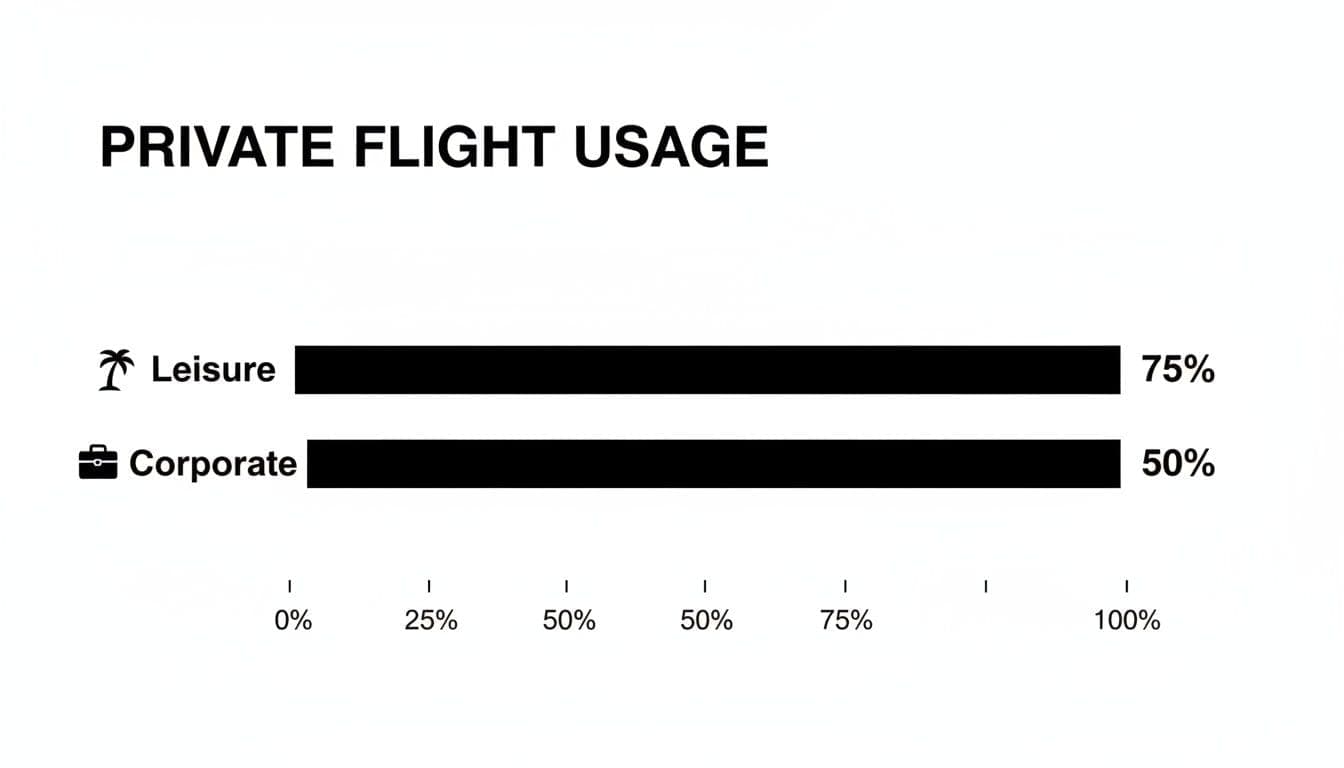
As you can see, the demand from both leisure and corporate flyers is what drives the industry.
Decoding Your Charter Quote
A good, transparent quote will break everything down for you. Beyond that base hourly rate, you should see a few standard line items that are essential for any safe, legal flight.
Here’s what to look for:
- Federal Excise Tax (FET): This is a mandatory 7.5% tax on all domestic flight segments. It's non-negotiable, and if it's not on your quote, you should ask why.
- Fuel Surcharge: Jet fuel prices are all over the place, so operators use this fee to manage that volatility. It might be a percentage of the flight cost or a fixed hourly rate.
- Landing and Handling Fees: Airports charge for everything—using the runway, parking the jet on the ramp, and coordinating ground services. These fees can swing wildly from a few hundred dollars at a quiet regional airport to thousands at a major hub like Teterboro (TEB) or London Luton (LTN).
- Crew Expenses: If your trip involves an overnight stay, you'll be covering the crew's hotel, meals, and local transport. It’s standard practice and ensures your pilots are rested and ready to fly you home safely.
Getting a handle on the moving parts is key. For a deeper dive, you can explore the typical cost to charter a private jet to see how different routes and aircraft sizes stack up.
Let’s walk through a real-world example. Say you're booking a one-way flight from New York to Miami on a super-midsize jet. The flight time might be quoted at $25,000, but once you add FET ($1,875), a fuel surcharge ($3,000), and airport fees ($2,500), your all-in price is suddenly $32,375. That’s the real number.
To give you a clearer picture, here’s how the costs for that NYC to MIA trip might look on a formal quote.
Sample Charter Cost Breakdown NYC to MIA
| Cost Component | Estimated Cost | Description |
|---|---|---|
| Aircraft Hourly Rate | $25,000 | 2.5 hours of flight time on a super-midsize jet. |
| Federal Excise Tax (FET) | $1,875 | 7.5% tax on the flight cost for domestic travel. |
| Fuel Surcharge | $3,000 | A variable fee to cover fluctuating jet fuel prices. |
| Airport & Handling Fees | $2,500 | Includes landing, ramp parking, and FBO service charges. |
| Crew Overnight Expenses | $1,500 | Covers hotel, meals, and transport for a two-person crew. |
| Total Estimated Cost | $33,875 | The all-inclusive price before any optional add-ons. |
This kind of itemized breakdown is exactly what you want to see from a reputable broker or operator. It leaves no room for surprises.
Exposing Common Fee Traps
While most fees are standard procedure, a few "gotchas" can trip up less experienced flyers. Knowing what to look out for can save you a serious headache and a lot of money.
The big one is de-icing. If you're flying out of Aspen in January, de-icing isn't optional—it's a critical safety measure. Depending on the jet's size and the weather, it can cost anywhere from $2,000 to over $10,000. Always ask your broker if this is included or if it will be a separate, post-flight charge.
International trips are another area to watch closely. Things like international handling fees, customs bonds, and flight permits can be complex and costly. A good provider will give you a clear estimate upfront, but you should always double-check that these are explicitly included in your contract.
The bottom line? Always insist on a fully transparent, all-inclusive quote. It’s the best way to protect yourself and ensure a smooth experience.
From Quote to Takeoff: Nailing Down Your Charter
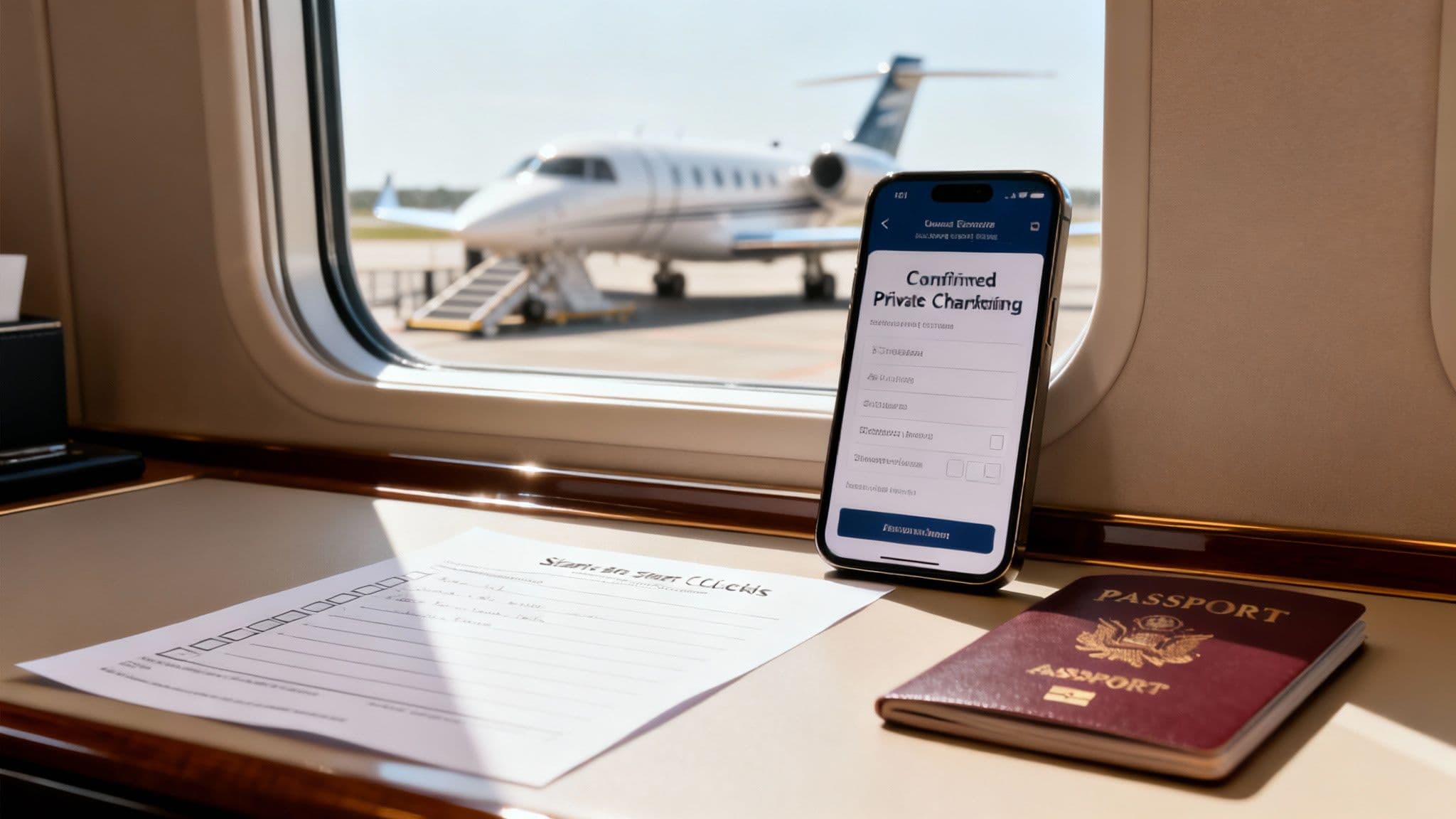
Once you've gotten a solid quote, the path to booking your flight is pretty straightforward. The key to getting a fast, accurate quote right from the jump is having your details ready. This isn't just busywork; it's the foundation of your entire trip.
Your broker will need the basics: your ideal itinerary, the exact number of passengers, and whether you have any wiggle room on dates or times. The more you can share upfront, the better your broker can zero in on the perfect aircraft, which can often save you a good bit of time and money.
Don't Skim the Charter Agreement
This is it—the single most important document you’ll sign. Think of the charter agreement as more than a formality; it's a legally binding contract that spells out every single detail of your flight. You absolutely need to go through it with a fine-toothed comb before you commit.
Pay special attention to a couple of key areas. First, get a firm grip on the cancellation policy. These can be all over the map, with some operators imposing steep penalties even if you cancel weeks out. Next, find the aircraft substitution clause. This clause gives the operator a right to swap in a different jet if yours is grounded for mechanical issues or other unforeseen problems.
The goal here is to make sure any substitute aircraft is of equal or better quality. A good agreement will specify this, so you're protected from a last-minute downgrade. If any term feels even slightly unclear, don't hesitate to ask for it to be explained in plain English.
Fine-Tuning the Details and Making It Yours
With the contract signed, the fun part begins: customizing the experience. This is where you can truly dial in the details to make the journey fit your exact needs. Your broker or flight coordinator will step in to handle all the crucial logistics for the trip itself.
This coordination usually covers:
- Ground Transportation: Having a car service waiting for you right on the tarmac for a completely seamless transfer from the jet to your destination.
- Custom Catering: Ordering specific meals, your favorite beverages, or snacks to have on board. Whether it's a particular vintage of champagne or catering for specific dietary needs, almost anything is possible.
- Special Requirements: Letting the flight crew know about any unique needs, like assistance for passengers with limited mobility or making arrangements for traveling with pets.
The expectations of discerning travelers are always shifting, and right now, the focus is heavily on the in-flight experience. In fact, a surprising 78% of ultra-high-net-worth individuals now care more about 'recovery en route' amenities than just getting there fast. This has driven a 6% year-over-year increase in requests for jets configured for wellness. You can discover more insights about evolving private aviation trends and see how the industry is adapting. When you charter, the entire process is built around your schedule and your comfort.
Smart Financial and Tax Strategies for Private Flyers
Chartering a private jet isn't just a travel choice; it's a financial one. For entrepreneurs and business leaders, learning to see these flights through a financial lens is what separates a simple luxury from a powerful business tool. It's about turning an expense into a strategic investment.
The first question that always comes up is, "Can I write this off?" The short answer is often yes—if the flight is for legitimate business purposes. That could mean flying to a crucial client meeting, inspecting a remote site, or getting your executive team where they need to be. But the IRS rules are notoriously tricky, and the devil is in the details.
Maximizing Business-Related Deductions
If you plan to claim charter flights as a business expense, your record-keeping has to be bulletproof. There's simply no room for error here. You must be able to prove that the travel was both ordinary and necessary for conducting your business. This means documenting everything.
For every single business charter, you need to be tracking:
- Flight Manifest: Who was on the plane? Be specific.
- Trip Purpose: What was the business reason for the flight? Tie it directly to a client, project, or company objective.
- Business Conducted: What exactly happened? Note the meetings held, deals discussed, or work accomplished.
Without this paper trail, defending the deduction in an audit becomes an uphill battle. For a deeper dive into the specifics of what qualifies, our guide on private jet tax benefits for business use is a great resource. Getting this right from the start ensures you’re not leaving money on the table.
Here's the critical part: The IRS draws a very clear line between business and personal travel. If your spouse or a family member tags along for a vacation while you handle business, you cannot deduct their share of the flight cost.
Chartering Within a Broader Wealth Strategy
For high-net-worth individuals, the conversation gets bigger than just tax deductions. It's about where private aviation fits into your entire wealth management plan. Think of on-demand chartering as a high-end service, not an asset you own. It gives you incredible freedom, but it doesn't offer the financial upside you'd find in ownership models, like potential asset appreciation.
That distinction is key. When you charter, you're paying for convenience without building any equity. It’s a pure operating expense. For individuals who fly often, this is where more integrated financial planning, like Strategic Legacy Planning for High-Net-Worth Families, becomes relevant. A holistic approach makes sure your travel strategy aligns with your long-term financial goals, so every decision supports the bigger picture.
Common Questions About Chartering a Jet
Even with a solid grasp of the process, it’s completely normal to have a few questions rattling around before your first private flight. Let's clear up some of the most common ones so you can book with total confidence.
How Far in Advance Should I Book a Charter Flight?
One of the biggest draws of private aviation is its flexibility, but a little planning goes a long way. If you want the best pick of the litter and more competitive pricing, aim to book 2-4 weeks out. This is especially true during peak travel times like the holidays or for big events like the Super Bowl or Art Basel.
That said, sometimes you just need to go now. A good operator or broker can often have you wheels-up in as little as 4-24 hours. You just have to be prepared for your aircraft options to be a bit more limited and potentially pay a premium for the last-minute scramble.
What Is the Difference Between a Broker and an Operator?
Getting this distinction is crucial to understanding the charter world. It’s actually pretty simple.
- An Operator is the company that physically owns and flies the planes. They hold the FAA Part 135 certificate, which means they are the ones directly responsible for the jet, the pilots, the maintenance, and all the safety protocols. They're the boots on the ground, so to speak.
- A Broker is your guide and advocate in the market. They don't own aircraft. Instead, they have deep relationships with a huge network of operators. A seasoned broker saves you a ton of time and legwork by sourcing multiple quotes, digging into safety records, and negotiating the fine print for you.
Think of it this way: the operator has the plane, and the broker helps you find the perfect plane from all the available operators.
Can I Bring My Pets on a Private Jet?
Yes, absolutely! For many of our clients, this is one of the single biggest reasons they fly private. Your pets can travel right in the cabin with you, avoiding the stress and potential dangers of being stuck in the cargo hold.
Just make sure to give your broker or operator a heads-up when you book. You’ll need to have their health records handy, especially for international trips. It's also a good idea to double-check the operator’s specific rules on pet size or breed to make sure there are no surprises at the FBO.
Safety is always the undisputed top priority in private aviation. A reputable provider will never compromise on maintenance, crew rest, or weather-related decisions. Their entire operation is built around mitigating risk.
What Happens if There Is a Mechanical Issue or Bad Weather?
This is where you see the value of working with a top-tier provider. If a mechanical problem pops up or a storm grounds your flight, they don't just shrug their shoulders. They immediately get to work on a backup plan.
The standard procedure is to source a recovery aircraft to get you on your way with as little disruption as possible. Your charter contract should spell out exactly how these situations are handled, but industry practice is clear: you shouldn't be on the hook for the cost of the canceled flight, and they will pull out all the stops to find a replacement aircraft quickly.
Ready to fly smarter? Craft offers a unique, investment-focused approach to private aviation. Access a fleet of modern Challenger jets without the burden of direct ownership, all while leveraging powerful tax advantages. Learn how you can turn your flight time into a strategic asset at Craft.com.
Related
Related guides
Aircraft in this guide
Routes and cities
Read next
Statistics
First Class vs. Private Jet: Cost and Time Comparison Statistics
Many people assume that private aviation is only for the richest families or the biggest businesses.
October 5, 2026 · 6 min read
Jet Cards
Jet Card versus Charter: The Best Choice for Occasional Versus Frequent Flyers
Private jet cards and charter flight services are closely related. To own a jet card is essentially to have purchased prepaid access to private jet charter…
February 1, 2026 · 4 min read
A Complete Guide to On-Demand Private Jet Charter Flights
Experience luxury travel with on-demand private jet charter services. Skip the airport hassles and fly on your schedule to any destination with personalized…
December 13, 2024 · 20 min read


Charter Sales
Tell us the trip. We'll tell you the number.
Route, dates, rough timing, how many people. That is enough to start, and you get a firm price for that specific trip rather than a range.
Text us and you'll get a reply within 60 seconds, any hour.