
Ownership Cost
The Ultimate Private Aviation Comparison: Fractional, Charter, Jet Card, and Whole Ownership
There are lots of ways to fly privately. All of them come at different price points while also providing different levels of access, convenience, and required…
 Israel SlodowitzFounder & CEOUpdated February 3, 2026 · Published January 23, 2026 · 6 min read
There are lots of ways to fly privately. All of them come at different price points while also providing different levels of access, convenience, and required considerations.
Choosing the right option depends on how often you fly, how flexible you need to be, and how much responsibility you’re willing to assume.
The most well-known private aviation options include:
- Jet cards
- Fractional ownership
- On-demand plane chartering
- Whole plane ownership
At Craft, we do things a little bit differently. In this article, we’ll explain the traditional methods of private aviation and outline why our unique approach may be the right fit for you.
Jet Cards
Jet cards provide subscription-based access to jet chartering services. Slightly different from on-demand chartering, jet cards allow you to select a style of aircraft and prepay for a fixed number of flight hours at a locked-in rate.
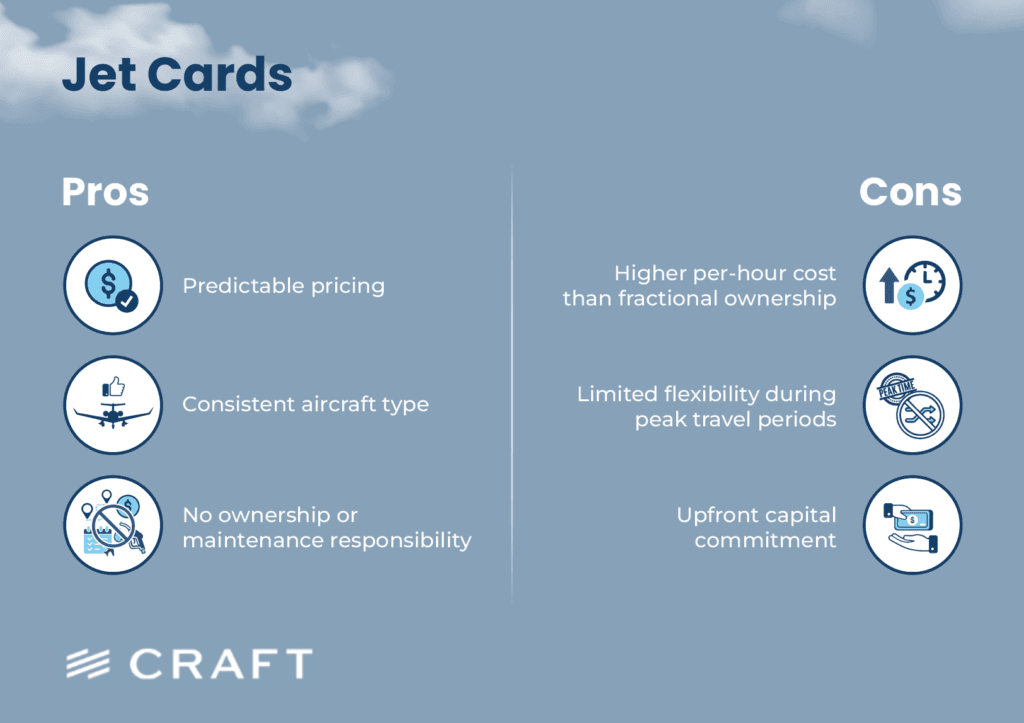
From an objective standpoint, this is effectively chartering with more predictability. You’re typically given the same aircraft type every time, and some services even allow you to request a specific pilot or crew.
Jet cards are ideal for travelers who fly between 20 and 50 hours per year. Fly less than that and chartering may make more sense. Fly more, and fractional or whole plane ownership becomes more attractive.
Well-known jet card providers include Flexjet, NetJets, and Wheels Up.
Pros
- Predictable pricing
- Consistent aircraft type
- No ownership or maintenance responsibility
Cons
- Higher per-hour cost than fractional ownership
- Limited flexibility during peak travel periods
- Upfront capital commitment
How to Select a Jet Card Service
If you’ve decided jet cards are the right fit, the next step is choosing the right provider. Services vary significantly in fleet size, responsiveness, and geographic coverage.
Key considerations include:
- Fleet size
- Cabin class options
- Lead times
- Proximity to your primary residence
Larger fleets generally mean shorter lead times and better access during peak periods. NetJets, for example, operates over 800 aircraft worldwide and is known for its ability to accommodate short-notice travel. It’s also the most established provider in the market and is owned by Berkshire Hathaway.
As you evaluate options, pay close attention to how providers define peak travel periods. These often include major holidays, large events like the Super Bowl or Kentucky Derby, and sometimes specific summer weeks that require additional fees.
On-Demand Chartering
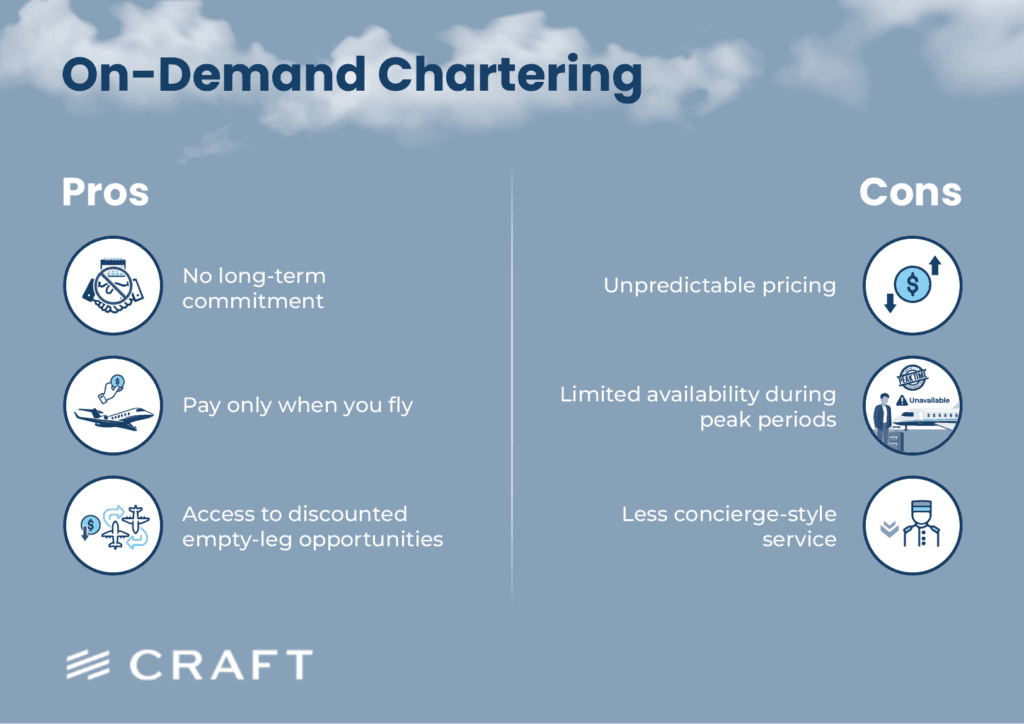
On-demand chartering is best suited for more occasional travelers. Flights are booked on a per-trip basis, with no long-term commitment or prepaid hours.
As with jet cards, you don’t own the aircraft or worry about upkeep. The key difference is pricing volatility. Charter costs fluctuate based on availability, demand, fuel prices, and other variables that are difficult to predict.
One way to reduce costs is through empty-leg flights. These are repositioning flights offered at a discount when an aircraft needs to return to another location. While the price can be attractive, flexibility is limited.
Chartering typically makes sense for travelers flying fewer than 20 hours per year. Beyond that, jet cards or fractional ownership tend to be more efficient.
Pros
- No long-term commitment
- Pay only when you fly
- Access to discounted empty-leg opportunities
Cons
- Unpredictable pricing
- Limited availability during peak periods
- Less concierge-style service
Selecting a Chartering Service
Because chartering does not involve a long-term agreement, the selection process is more straightforward. Price differences matter, but responsiveness and service quality often matter more.
You should also consider catering options, cabin class availability, and lead times. Some providers operate more like brokers, while others offer a more hands-on, concierge-style experience.
Fractional Ownership
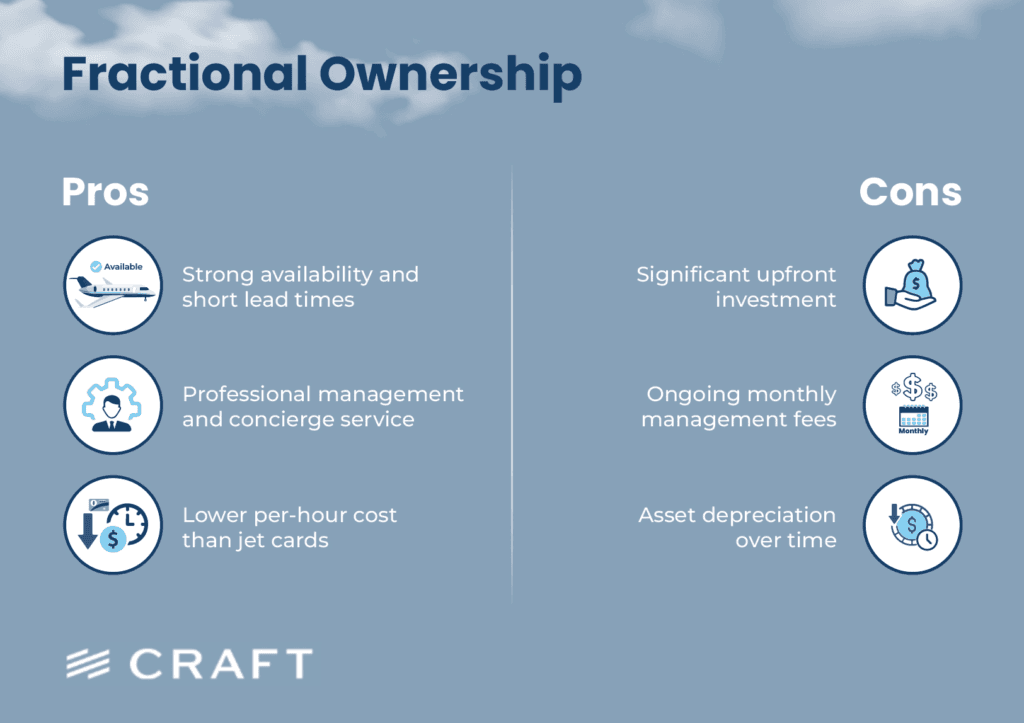
Fractional ownership involves purchasing a share of an aircraft. Shares typically start at 1/16, which provides approximately 50 occupied flight hours per year.
This option is ideal for moderate to frequent travelers who need reliable access with minimal notice. Fifty hours per year generally covers seven to ten domestic flights or several international trips.
Fractional ownership offers consistency, flexibility, and professional management, making it a popular option for business travelers.
Key Things to Know
- Although you buy into a specific aircraft, you’ll usually fly on different planes based on proximity
- Some services allow you to request preferred pilots or crews
- Catering options are often highly customizable
- Owners are financially responsible for maintenance and upkeep
Pros
- Strong availability and short lead times
- Professional management and concierge service
- Lower per-hour cost than jet cards
Cons
- Significant upfront investment
- Ongoing monthly management fees
- Asset depreciation over time
A 1/16 share can require a deposit ranging from several hundred thousand dollars to several million, depending on the aircraft. Monthly management fees typically range from $5,000 to $10,000, plus an occupied hourly rate that can exceed $10,000 per hour.
Most agreements require a five-year commitment. At the end of the term, owners may renew or sell their share, which has typically depreciated by around 30%.
How to Choose a Fractional Ownership Program
Many jet card providers also offer fractional ownership programs. NetJets is a prime example, but it’s not the only option worth considering.
Fleet size is one of the most important factors. Larger fleets generally provide greater flexibility and shorter lead times. Some services also allow you to pay more for higher-priority access.
Other considerations include cabin class options, catering, pilot continuity, and overall cost structure. While fee categories are similar across providers, pricing can vary significantly.
Whole Plane Ownership
Whole plane ownership is the most expensive way to fly privately, but it also offers the highest level of flexibility. Owners typically have access to 400 or more occupied hours per year and can arrange flights with only hours of notice.
With this level of access comes significant responsibility. While management companies can handle daily operations, the ultimate responsibility for maintenance, storage, staffing, and logistics rests with the owner.
Whole plane ownership typically starts at several million dollars and increases substantially based on aircraft size and capabilities.
Pros
- Maximum flexibility and availability
- Full customization and control
- Ideal for frequent, time-sensitive travel
Cons
- Extremely high upfront and ongoing costs
- Full operational responsibility
- Complex long-term financial commitment
This option is best suited for individuals or executives who travel constantly across multiple locations and require immediate access with minimal notice.
How to Choose a Private Plane
Choosing a private plane is both simpler and more complex than other options. On one hand, price sensitivity is no longer the primary concern. The focus shifts entirely to access, range, comfort, and customization.
On the other hand, the long-term costs of ownership extend far beyond the sticker price. Storage, repositioning, fuel, maintenance, catering, and staffing can ultimately exceed initial expectations.
Because of the financial stakes involved, thorough research is critical to ensure the aircraft aligns with both your travel needs and your long-term budget.
How Craft Does Things Differently
Craft takes the best features of the options described above and delivers them through a more efficient financial mechanism. Our model most closely resembles fractional ownership, but instead of purchasing a share of a specific aircraft, your investment goes into a pod that includes aircraft ownership.
This distinction matters. It helps insulate your capital from depreciation and introduces potential upside based on market performance, rather than tying your money to a single depreciating asset.
If you’re interested in learning more, reach out to speak with a Craft representative. We’re happy to explain the investment structure, fleet access, lead times, catering options, and everything else you need to know.
What are the key costs associated with fractional ownership programs?
Fractional ownership requires an initial purchase price, a monthly management fee, and an occupied hourly rate for flight hours. Additional administrative costs may include hangar space, pilot training, and ferry fees. Despite these costs, fractional jet ownership can be more cost effective than full ownership for business aviation or frequent flyers.
How do I choose the right private jet or fractional ownership program?
Consider factors such as aircraft types, cabin classes, fleet size, access to major airports, and guaranteed short notice availability. Look for transparent pricing and programs that offer personalized service and exceptional access across the world’s largest networks of private jets. Comparing jet card programs, fractional ownership programs, and whole aircraft ownership helps identify the most cost effective option for your travel plans.
How does Craft’s approach differ from traditional private aviation options?
Craft offers a fractional jet ownership model where your investment goes into a pod that includes aircraft ownership, rather than a specific aircraft. This structure reduces exposure to depreciation while maintaining guaranteed access, premium aircraft, and personalized service. It combines the benefits of fractional private jet ownership with added financial flexibility and potential upside.
Frequently asked questions
What is fractional jet ownership, and how does it differ from whole aircraft ownership?
Fractional jet ownership lets you purchase a share of a private jet rather than an entire aircraft, giving you guaranteed access to flight hours without full ownership responsibilities. Whole aircraft ownership provides maximum flexibility and access but comes with full operational, maintenance, and staffing costs. Fractional ownership programs are ideal for frequent flyers who want private jet travel with professional management and personalized service.
How do jet card programs compare to private charter flights?
Jet card programs offer fixed hourly rates, consistent aircraft types, and guaranteed access, making them a predictable option for private travel. Private charter flights are booked per trip, with pricing that fluctuates based on demand, fuel, and availability. While chartering can be cost effective for short trips or occasional flyers, jet cards provide more reliable flight options and exceptional service.
Who benefits most from fractional private jet ownership?
Frequent flyers who need more hours than a typical jet card allows but want to avoid the administrative costs of full ownership benefit most. Fractional jet programs provide guaranteed access, a diverse fleet, and options to customize cabin classes and catering. This makes them ideal for business aviation or individuals with complex travel plans.
What are empty leg flights, and how can they reduce costs?
Empty leg flights are repositioning flights offered at a discount when a private jet must return to another location. These flights provide a cost effective option for flexible travelers but require short notice and limited availability. They are commonly used in private jet charter and jet card programs to provide more flight options.
Related
Related guides
- Fractional Ownership vs. Long-Term Leasing: Comparing Commitment and Financial Risk
- The Investment Value of Fractional Jet Ownership
- A Guide to Private Jet Fractional Ownership Costs
- Fractional Shares Explained: Choosing the Right Shares for Your Annual Flight Hours
- Fractional Jet Ownership Comprehensive Overview
Read next
Statistics
Fractional Jet Ownership vs. Charter: Cost Comparison Statistics
Fractional jet ownership and chartering are two of the most popular options for private travelers who don’t want the cost or logistical overhead of full plane…
October 5, 2026 · 5 min read
Fractional Ownership vs. Whole Plane Ownership: Which Offers the Most Control?
When it comes to private aviation, there are several options: jet cards, chartering opportunities, fractional ownership, and complete jet ownership.
February 18, 2026 · 6 min read
Jet Cards
Jet Card vs. Charter: Which Private Aviation Model Is Right for You?
Jet cards and on-demand charter are the two most accessible entry points to private aviation. But accessible doesn’t mean equivalent.
April 15, 2026 · 5 min read


Charter Sales
Tell us the trip. We'll tell you the number.
Route, dates, rough timing, how many people. That is enough to start, and you get a firm price for that specific trip rather than a range.
Text us and you'll get a reply within 60 seconds, any hour.