
Ownership
What is a Private Jet Card? Your Ultimate Guide to Fixed-Rate Flying
Jet cards cater to a very particular kind of customer: private travelers who fly too often to fully benefit from chartering their planes, but who also don’t…
 Israel SlodowitzFounder & CEOUpdated December 26, 2025 · Published December 26, 2025 · 6 min read
Jet cards cater to a very particular kind of customer: private travelers who fly too often to fully benefit from chartering their planes, but who also don’t want the high cost, the complications, or the overhead associated with owning their own jet.
Private jet card programs offer a suitable alternative, giving you all the access you could want in a format that prioritizes freedom and flexibility.
Like any major purchase, there are many considerations that need to be taken into account. Everything from the type of aircraft a service is able to provide to the way they handle catering and staffing.
This guide is designed to explain everything you need to know, from how much access you are given to what kind of costs you should expect.
Read on to learn everything you need to know about private jet cards and private jet memberships.
What Jet Cards Are
Jet cards are, at the end of the day, a little like a gift card. They provide you with prepaid access to a service. You can purchase blocks of time for which you’ll be able to use the jet of your choice.
While services will structure this a little differently, the core component is generally time-based.
You’re paying for flight hours in the plane. While the extent of your access will vary by package size and by the options provided by the service, a general range is between 25 to 100 occupied hours per year.
Why Jet Cards Are Better Than Chartering
There are a few reasons that some people prefer jet cards to chartering planes. For one thing, some pricing models allow you to have equity in the jet.
We’ll discuss that more in a later heading. In that way, some jet card users are able to, if not profit from the arrangement, at least make it so that their utilization retains a certain level of value.
In terms of jet cards versus chartering, the benefits are based primarily around access and convenience.
Many jet card programs can have a jet ready within hours, requiring nothing more from you than a phone call to set things up. This immediate access and personalized service make private jet travel far more convenient than traditional chartering.
Cost Breakdown
While the cost structure will be a little different from service to service, it looks something like this.
- You make an initial deposit. The initial deposit will range in price, but generally can cost anywhere from $50,000 to several hundred thousand. That figure will be more substantial in situations where you are buying equity in a jet. In that case, when you deposit funds, the amount will be proportionate to a fraction of the jet’s overall value.
- You pay a monthly fee. The monthly fee includes covering the overhead of the aircraft. This includes maintenance, storage, staffing, staff training, and more.
- You pay an occupied hourly rate. The hourly rate for the jet will include the fuel costs, the staffing, and any catering services that you require during your flight time.
In traditional fractional ownership programs, such as the NetJets model, the deposit does translate into equity. This means that after a long term commitment, generally five years, you can sell your share and see a return on your investment.
Craft operates a little bit differently. With this service, you buy into an investment pod that diversifies your investment.
The pod owns a series of assets, including aircraft. Craft is one of the few jet card programs through which it is possible to see your investment retain or even increase its value, potentially making money over time.
Limitations
There are a few things to keep in mind when considering the limitations of a jet card. These include:
- Consistency. While some jet card programs allow you to buy equity in a specific aircraft, you will generally use a fleet of vehicles consistent with the model you paid for. You also may have a different pilot and crew every time you use the jet, though some services strive for continuity as much as possible. While the actual inconvenience of these considerations is minimal, the experience nevertheless differs slightly from the stability you would have if you owned the aircraft outright.
- Access. Your actual level of access will vary based on the program itself as well as where you are located. NetJets is particularly known for providing the highest level of immediate access because they operate a large fleet of more than 800 aircraft. This makes it easy to get jets out quickly to many airports, even with as little as a few hours’ notice. NetJets has this advantage; smaller providers, or services being asked to provide vehicles in remote areas, may struggle to provide that level of immediacy.
In high-demand periods, some private jet operators attach a surge charge for peak travel seasons. This can include Christmas, Thanksgiving, and the days surrounding major events like the Kentucky Derby or the Super Bowl. These additional fees, while most people do not find these concerns too limiting, are worth keeping in mind.
Three Basic Jet Card Models
There are three basic private jet card models, each with their own strengths and disadvantages. They include:
The Fractional Ownership Model
The fractional ownership model allows you to purchase a literal fraction of an aircraft, starting at 1/16th and going up from there, which typically translates into approximately 50 occupied flight hours in the air.
The fractional approach is the most expensive option, but it also tends to offer the most value, as you leave with an asset that you can sell at the end of your five-year ownership period.
Membership-Based Jet Card Programs
Membership-based jet card programs are essentially prepaid charter groups. This model is similar to renting a private jet, but with the advantage of more consistent, user-friendly access, sometimes at a slightly discounted rate. Some programs even offer round trip discounts.
A well-known example of this type of program is Wheels Up, though many other jet card memberships exist in the market.
The Craft Model
The Craft model is unique in that it allows investors to buy into a diversified set of assets that includes, but is not limited to, aircraft.
This diversification helps insulate your investment from the risk of depreciation, allowing you to buy into access to a jet while also maintaining the potential to make money.
In all cases, your first year will typically be the most expensive due to the required initial deposit.
Considerations To Keep in Mind
Aside from the cost and relative value propositions of each option include the various factors that influence your overall experience with a service. These include:
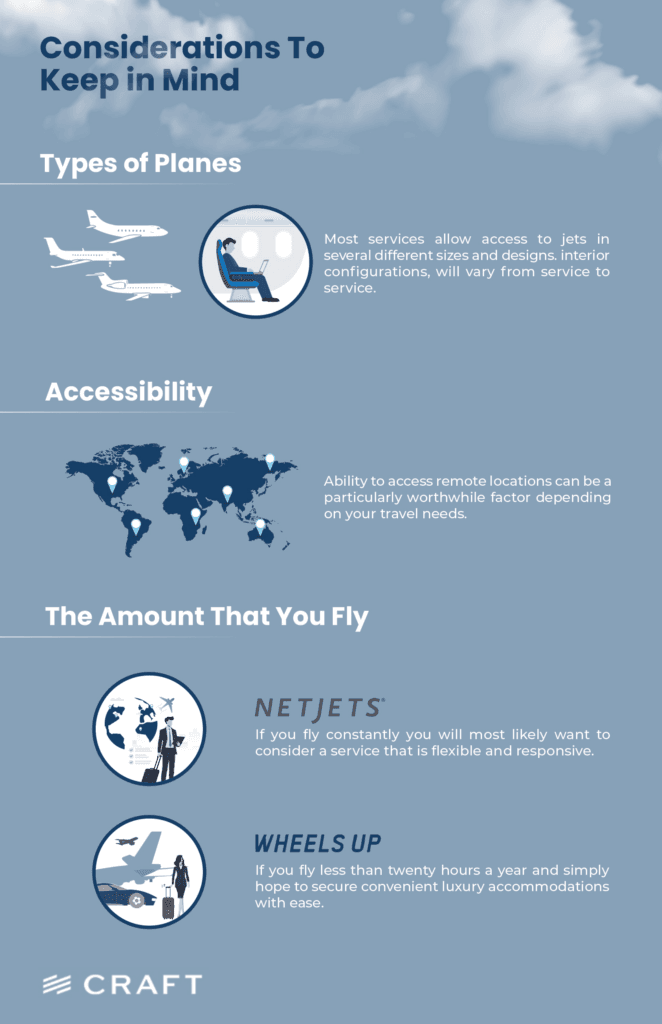
- Types of Planes: While most services allow access to jets in several different aircraft sizes and designs—from light jets to heavy jets—the specific offerings, as well as their interior configurations, will vary from service to service.
- Accessibility: Another consideration is the ability to access remote locations. Several jet card providers specifically brand themselves around their ability to get anywhere quickly. This can be a particularly worthwhile factor depending on your travel needs.
- The Amount That You Fly: If you fly constantly you will most likely want to consider a service that is flexible and responsive. While jet card providers fitting this category (think NetJets) will be more expensive, they will make up for this with convenience. On the other hand, if you fly less than twenty hours a year and simply hope to secure convenient luxury accommodations with ease, a more casual subscription based system like Wheels Up may be better. How many hours you fly annually is one of the most important factors in choosing the right program.
Ultimately, the right jet card program depends on your specific travel patterns, budget, and priorities. The most expensive option isn’t always the best fit, and the most convenient provider may not offer the best value.
Take time to evaluate what matters most to you—whether that’s guaranteed availability, transparent pricing, aircraft variety, or the ability to retain value in your investment—and choose accordingly.
The Bottom Line
Traditional jet cards and fractional ownership treat private aviation as a consumable expense or a depreciating asset. Craft treats it as what it should be for high-net-worth investors: one component of a diversified, tax-efficient wealth management strategy.
If you’re going to spend six or seven figures on private aviation access anyway, doesn’t it make sense to do it in a way that preserves and potentially grows your capital? No hidden costs, no wasted fees—just smart investing that lets you save time in the air.
Discover how Craft’s value proposition works in practice—smarter flying through smarter investing. Contact a private aviation advisorto learn more about how this innovative model could work for your portfolio and how to join a program where your financial goals remain the priority.
Related
Related guides
Read next
Jet Cards
Flexjet vs Craft: Fractional Shares vs a Fixed-Rate Card
Between FlexJet and Craft, both private aviation services, there are actually three distinct models of transportation.
February 3, 2026 · 5 min read
Jet Cards
Fixed Rate Versus Dynamic Pricing Jet Cards: Which Model Saves You More Money?
Jet cards provide high levels of access and convenience for private aviation.
January 16, 2026 · 5 min read
Private Jet Fixed Costs Explained
Discover what private jet fixed costs entail, from crew salaries and insurance to hangar fees and maintenance.
December 12, 2024 · 9 min read


Charter Sales
Tell us the trip. We'll tell you the number.
Route, dates, rough timing, how many people. That is enough to start, and you get a firm price for that specific trip rather than a range.
Text us and you'll get a reply within 60 seconds, any hour.