
Ownership
How Does Fractional Ownership Work for Private Jets
Discover how does fractional ownership work for private jets. Our guide breaks down the costs, benefits, and smart investment strategies for aviation access.
 BenedictPrivate Aviation ConsultantUpdated January 28, 2026 · Published January 12, 2026 · 19 min read
So, how does fractional jet ownership actually work? At its core, it's a way for several people to share the cost and benefits of owning a private aircraft. You're not just renting time; you're buying a genuine, deeded share of the plane itself.
Think of it less like a timeshare and more like a high-end real estate syndication. You purchase a specific fraction—say, a 1/16th share—which directly translates into a set number of flight hours you can use each year. This structure gives you the prestige and convenience of private flight without the staggering financial and operational weight of owning a jet outright.
A Smarter Way to Own a Slice of the Sky

Imagine wanting a high-performance supercar but knowing you'd only drive it a few weeks out of the year. It wouldn't make sense to buy it outright and pay for insurance, storage, and maintenance while it just sits in a garage. A much savvier move would be to pool your resources with a few like-minded enthusiasts to share the costs.
Fractional jet ownership applies this exact logic to private aviation. It brilliantly transforms what was once an almost unattainable luxury into a practical, accessible asset for savvy investors and business leaders. Instead of shouldering the entire multi-million-dollar burden yourself, you simply acquire a piece of it.
This is a critical distinction from on-demand charters or jet cards. With those, you're just a customer buying a service. Here, you hold equity in a tangible asset.
Fractional ownership provides deeded ownership, meaning your investment has the potential to appreciate with the market value of the aircraft, unlike a timeshare where you only purchase time.
The Nuts and Bolts of a Fractional Program
For anyone from entrepreneurs to family offices, getting a grip on how fractional ownership works means understanding its three main pillars. This model breaks down the traditional barriers to entry by spreading the financial and logistical responsibilities across a group of owners.
To help clarify, this table breaks down the fundamental components of a typical fractional jet program.
Fractional Ownership At a Glance
| Concept | Description | Typical Example |
|---|---|---|
| Share Size | The percentage of the aircraft you own. Common sizes are 1/16, 1/8, and 1/4. | A 1/16th share is a very common entry point. |
| Annual Flight Hours | The number of hours you're entitled to fly per year, directly tied to your share size. | A 1/16th share typically grants 50 occupied flight hours. |
| Acquisition Cost | The one-time, upfront capital investment to purchase your share of the aircraft. | A $500,000 capital outlay for a share in an $8 million light jet. |
| Monthly Management Fee | A fixed recurring fee covering indirect operating costs. | $5,000 – $15,000 per month to cover pilots, insurance, and hangarage. |
| Hourly Operating Rate | A variable cost charged only when you fly, covering direct trip expenses. | $3,000 – $6,000 per hour for fuel, maintenance reserves, and catering. |
This structure makes the economics of private aviation far more manageable. Whole ownership can easily demand a $10-20 million investment plus $2-3 million in annual operating costs. Fractional ownership dramatically lowers that barrier.
It’s no wonder the model has proven so successful. Industry pioneers like NetJets have flown over 5 million hours since 1986 and were serving more than 10,000 owners by 2023. You can explore a modern perspective on how fractional jet ownership solutions work to maximize value in today's market.
Ultimately, this approach strikes a perfect balance. It delivers the consistency, guaranteed availability, and premium experience of full ownership without the immense capital commitment and day-to-day operational headaches, making it a powerful tool for anyone who values their time.
How Fractional Jet Programs Actually Operate

The theory behind fractional ownership is one thing, but how it works day-to-day is where its real value shines through. The whole model is engineered to give you the experience of owning your own plane, but without the colossal logistical headaches that come with it. It all starts with the size of your share.
Your ownership stake—whether it's a 1/16th, 1/8th, or something larger—is tied directly to how many hours you can fly each year. Think of it like a time-share for the sky. A 1/16th share, for example, typically gives you 50 occupied flight hours annually, while a 1/8th share doubles that to 100 hours. It’s a straightforward formula that lets you match your investment to your actual travel patterns.
This system takes all the guesswork and operational drag out of private aviation. The program operator handles everything in the background—crew, flight planning, maintenance—delivering a service that's truly turnkey.
The Seamless Scheduling Experience
One of the most impressive parts of the operation is just how simple scheduling a flight becomes. Forget about coordinating pilots, filing flight plans, or arranging for ground services. As a fractional owner, you just make a call or send a message to a dedicated owner services team.
This team essentially acts as your personal flight department, on call 24/7/365. Most of the top programs guarantee they'll have a jet ready for you with as little as 4 to 24 hours' notice. That's a level of responsiveness that on-demand charter services often struggle to deliver, especially during holidays or major events.
The core promise of a fractional program is guaranteed access. When you need a jet, one is made available from the fleet, ensuring you can fly on your schedule, not the aircraft's.
This is a crucial distinction. You aren't just limited to the specific tail number you technically co-own. You have access to the entire fleet of identical or comparable aircraft. So, if "your" plane is being used by another owner or is down for maintenance, it doesn't matter. Another one is seamlessly swapped in.
Behind the Scenes Logistics and Safety
While you’re enjoying the effortless travel, the fractional operator is managing an incredibly complex logistical machine. This covers all maintenance, crew hiring and training, insurance, and FAA compliance—all the jobs that would normally require a full-time, in-house flight department.
When you dig into how these programs are structured, it’s helpful to understand the different legal structures for asset ownership, such as family trusts vs companies, as these frameworks can define how the operation is governed. But ultimately, the operator shoulders the immense responsibility of keeping the entire fleet in pristine, airworthy condition.
That commitment to excellence is most evident when it comes to safety. Reputable fractional programs operate under the most stringent safety protocols in the industry, often earning certifications that go well beyond standard FAA requirements.
- ARGUS Platinum Rating: This is one of the highest and most respected third-party safety audits in business aviation, signaling a deep, verifiable commitment to best practices.
- IS-BAO Stage 3 Registration: This international standard indicates a fully mature and integrated Safety Management System (SMS) is in place.
- Extensive Pilot Training: Pilots in these programs typically undergo rigorous, simulator-based training every six months, which is double the FAA's requirement for commercial pilots.
The model works because your diversified stake delivers usage rights without saddling you with direct operational liability. You get the benefits without the burden. Top-tier programs also offer fixed hourly rates, giving you cost certainty that the volatile charter market can't match. For many entrepreneurs and investors, this is a far more tax-efficient way to fly than liquidating stock to pay for travel. And with the best operators boasting dispatch reliability rates of 99.9%, you know safety is never compromised.
This comprehensive, behind-the-scenes management is precisely what you’re paying for. It turns a complex asset that requires constant oversight into a simple, on-demand travel solution.
What Does Fractional Jet Ownership Actually Cost?
To figure out if fractional ownership is the right move, you have to look past the initial price tag. The whole financial model is built around predictability, breaking the total cost down into three clear, manageable pieces. Getting a handle on how these three parts fit together is the secret to understanding the real-world economics of flying this way.
Each cost bucket covers something specific, from your capital stake in the plane itself to the direct expenses of a single trip. This separation takes the mystery out of the numbers and makes budgeting straightforward—a huge leg up over the wild price swings you often see with on-demand charters.
1. The One-Time Acquisition Cost
This is your upfront buy-in. Think of it as the down payment on your slice of the aircraft. This one-time payment buys you an actual deeded share of the jet, and the amount is tied directly to the size of your share and the plane's market value.
Let's say a super-midsize jet is valued at $16 million. A 1/16th share (which typically gets you 50 hours of flight time a year) would mean a $1 million acquisition cost. It's a serious investment, no doubt, but it's a world away from buying the whole aircraft outright. This way, you can get the benefits of ownership without having an enormous amount of capital tied up in a single asset. That payment officially makes you a co-owner.
2. The Fixed Monthly Management Fee
Once you own your share, you start paying a fixed monthly management fee. This is a predictable, recurring cost that covers all the background expenses of keeping a multi-million dollar jet and its crew ready to go at a moment's notice. It’s the same amount every month, whether you fly all your hours or none at all.
This fee is what makes the whole "turnkey" service possible. It pools the funds from all the owners to cover the essential, shared costs that aren't linked to any specific flight.
- Pilot and Crew Salaries: This ensures top-tier, experienced pilots are always on standby.
- Hangarage: The cost to keep the aircraft safe and sound in a secure, climate-controlled facility.
- Comprehensive Insurance: Covering a high-value asset and all associated liability.
- Admin and Scheduling Support: The people who make it all happen—the owner services team that coordinates every detail of your trip.
For that same 1/16th share in our super-midsize jet, you can expect this fee to land somewhere between $12,000 and $20,000 per month. It's the price of peace of mind, knowing that a professional flight department is handling all the complex logistics for you.
3. The Occupied Hourly Fee
The final piece of the puzzle is the occupied hourly fee. This is a variable cost you only pay when you're actually on the plane—from takeoff to landing. It's designed to cover all the direct, per-flight expenses tied to your specific trip.
This "pay-as-you-fly" structure means you’re only billed for what you actually use. It typically rolls up costs like:
- Fuel: By far the biggest variable expense on any flight.
- Maintenance Reserves: Funds set aside for routine inspections and major engine overhauls down the line.
- In-flight Catering: Standard catering and drinks for you and your guests.
- Landing and Airport Fees: The charges from the airports you use.
The occupied hourly fee isolates trip-specific costs, making it fair for everyone involved. You pay for your own travel, not for the flights other owners are taking.
Back to our example, the occupied hourly rate for that super-midsize jet might be around $6,500. So, for a three-hour flight, your direct cost for that trip would be $19,500 on top of your monthly management fee.
This model gives you a crystal-clear way to budget for your travel. For a deeper dive into how these costs stack up against other options, check out our complete guide to the cost of a private jet. By putting these three elements together—acquisition, management, and hourly—you get the full financial picture, giving you the clarity needed to make a smart decision.
A Head-to-Head Comparison of Private Aviation Models
To really grasp where fractional ownership fits, you have to look at the whole picture. It’s one of four main ways to fly privately, and each one strikes a different balance between cost, control, and convenience. Think of it as a spectrum: on one end, you have total control with maximum financial commitment, and on the other, you have complete flexibility with no long-term ties.
Choosing the right path isn’t about which one is "best"—it's about which one aligns with your travel patterns, financial goals, and tolerance for operational headaches. Let’s break down how fractional stacks up against the other big players in the market.
This chart lays out the two fundamental cost pillars of fractional ownership: the upfront capital to buy your share and the recurring fees that keep you flying.
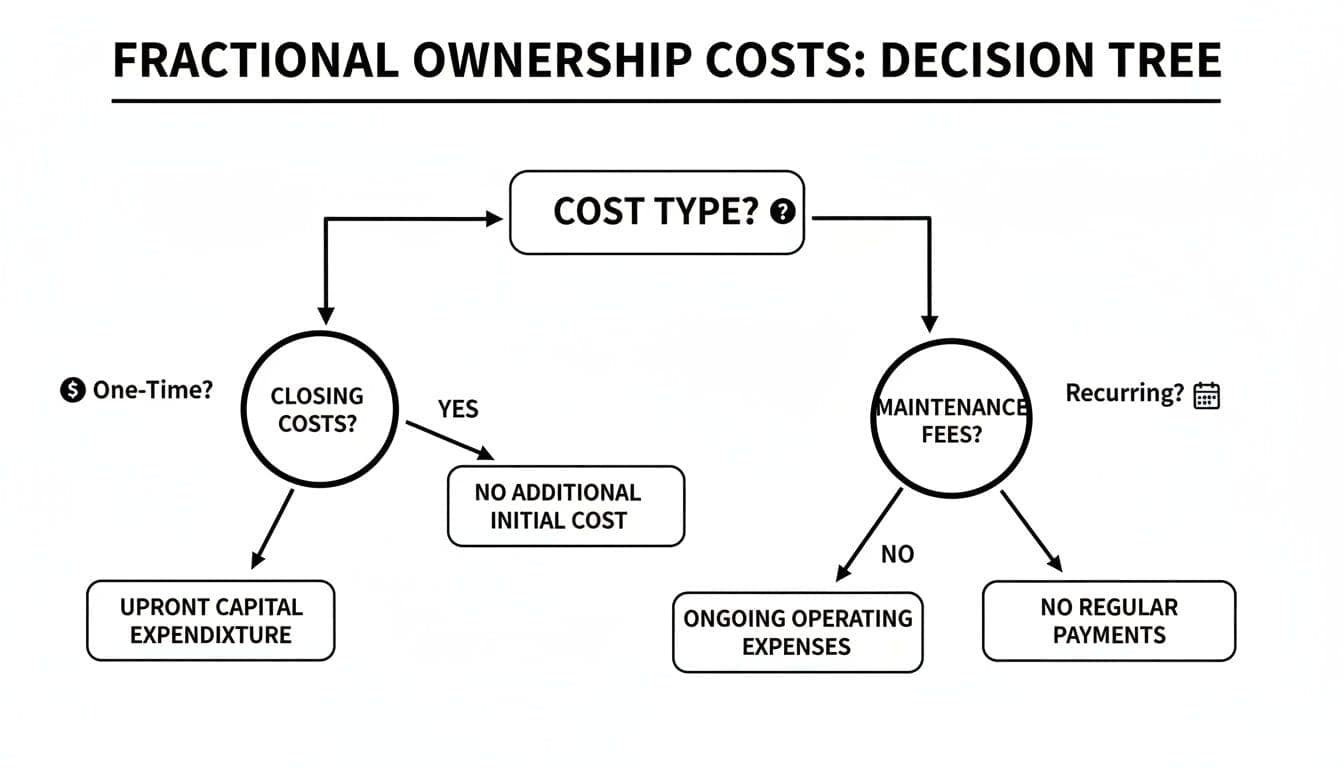
As you can see, the financial model is split. There's the initial investment to acquire the asset, followed by predictable monthly and hourly charges that cover all the operational details.
To help you see the bigger picture, here’s a direct comparison of the four primary ways to access a private jet.
Private Jet Access A Head-to-Head Comparison
| Criteria | Fractional Ownership | Full Ownership | Jet Card | On-Demand Charter |
|---|---|---|---|---|
| Upfront Cost | High (share purchase) | Highest (full aircraft) | Medium (deposit) | None |
| Ongoing Costs | Monthly management + hourly fees | All ops, crew, maintenance | Pay-as-you-go from deposit | Trip-by-trip basis |
| Cost Predictability | High (fixed rates) | Low (unplanned events) | High (fixed hourly rates) | Very Low (market driven) |
| Asset Ownership | Yes (Deeded Share) | Yes (Full Title) | No | No |
| Operational Burden | None (managed by provider) | Full Responsibility | None | None |
| Consistency | High (dedicated fleet) | Absolute (your plane) | High (guaranteed class) | Low (varies by operator) |
| Availability | Guaranteed (with notice) | Guaranteed (your plane) | Guaranteed (with notice) | Not Guaranteed |
This table highlights the fundamental trade-offs. Now, let’s dig into what these differences mean in practice.
Full Ownership The Peak of Control and Cost
Owning your own aircraft is the pinnacle of private aviation. It's like owning your home outright—you have absolute control. You decide the paint scheme, the cabin layout, the crew, and the schedule, with no compromises.
But that freedom comes at a steep price. Beyond the multi-million dollar acquisition, you’re on the hook for every single operational cost. Crew salaries, hangar fees, insurance, and maintenance can easily run over $1 million a year. It's not just an asset; it's a full-fledged business that requires constant management.
On-Demand Charter Ultimate Flexibility
Chartering is the most straightforward way to fly private. You simply book a jet for a specific trip, pay for it, and you're done. No long-term commitments, no upfront capital. It’s the perfect solution for infrequent travelers or those whose plans are always in flux.
The trade-off? Consistency and cost. Prices can swing wildly based on demand, aircraft availability, and even the time of year. You also have no say in the specific aircraft or crew you get, which means the experience can vary significantly from one flight to the next.
Jet Cards A Step Toward Predictability
Jet cards were created to solve the unpredictability of charter. You prepay for a block of hours—usually 25 or 50—on a certain category of jet at a locked-in hourly rate. This brings a welcome dose of budget certainty and a more consistent service standard than ad-hoc chartering.
The catch is that you're still just a customer, not an owner. Your access often comes with strings attached, like peak-day surcharges, blackout dates, or strict limits on your service area. It’s a great product, but it doesn't give you an actual equity stake in a tangible asset.
Fractional ownership is unique in that it provides the consistency and high service levels of full ownership while spreading the financial and operational load across multiple owners, a structure charter and jet cards cannot offer.
Each of these models serves a distinct purpose. To really get into the weeds, you'll want to explore a more detailed breakdown. You can learn more about these private aviation models and how they compare in our complete guide. The key is to honestly assess your own needs against the trade-offs of capital, operating costs, and control to find the solution that truly fits.
The Modern Evolution of Fractional Ownership
While the classic fractional model was a big step forward, it never quite solved a fundamental problem: the aircraft itself is a rapidly depreciating asset. Owners would buy a share, pay hefty monthly fees, and then, years later, sell that same share for a massive loss.
But what if you could separate the luxury of having a jet on call from the financial liability of actually owning it?
This is exactly where the modern evolution of fractional ownership is heading. New structures are popping up that treat private aviation less like a sunk cost and more like a strategic piece of a larger investment portfolio. By shifting the focus from owning a sliver of a plane to holding a stake in a managed fund, these models are completely rewriting the financial rules for smart investors.
The whole idea is to transform private flight from a high-cost luxury into a tax-efficient, wealth-building tool. This approach zeroes in on the biggest pain points of the old model—depreciation, endless management fees, and inefficiently parked capital—by weaving private travel into sophisticated financial planning.
From Depreciating Asset to Strategic Investment
The real game-changer is the move away from direct ownership of a specific airplane. Instead of buying a 1/8th share of, say, a Challenger 350, you contribute capital to a managed investment fund. That fund, in turn, provides you with access to a fleet of Challenger 350s.
It’s a subtle but critical distinction. Your capital isn't locked up in a single piece of machinery that’s losing value every year—a loss that can easily be 4-6% annually. Instead, your money is part of a diversified portfolio, professionally managed to preserve your principal and hopefully generate returns. You get all the perks of on-demand private jet access without taking the direct financial hit from depreciation.
The goal here is simple: uncouple the convenience of private flight from the economic drag of owning the aircraft. Your investment works for you in the market, while a professionally managed service delivers the flight experience you need.
This model is especially powerful if you’re sitting on significant holdings of appreciated stock. Rather than selling those securities and triggering a painful capital gains tax bill, you can contribute the stock directly to the fund. This lets your entire principal keep compounding, tax-deferred, while simultaneously unlocking the door to private aviation.
Key Financial Differentiators
This fee-less, fund-based structure brings some serious financial advantages to the table that are simply impossible in traditional fractional programs. It’s really designed for high-net-worth individuals, family offices, and entrepreneurs who are always thinking about tax efficiency and capital preservation.
Here’s what really sets this model apart:
- You Sidestep Aircraft Depreciation: Your investment is in a fund, not the plane. When it's time to exit, you get your fund stake back, completely insulated from the 20-30% drop in value a typical fractional share might suffer over five years.
- Tax Deferral on Appreciated Assets: Contributing appreciated stock lets you put off paying capital gains taxes. For an investor with $50 million in stock, this could easily be a multi-million dollar tax advantage, keeping that capital invested and growing instead of going to the IRS.
- Bonus Depreciation Benefits: Some structures allow you to take advantage of bonus depreciation, which creates a significant tax deduction you can use to offset income from other sources. This is hugely valuable for anyone in the top 37% tax brackets.
- No Monthly Management Fees: Because the whole thing is structured as an investment fund, those burdensome monthly management fees that define the old model are gone. Your contribution covers your access, period.
This kind of structure thrives on global scale and modern technology. While traditional fractional fleets were already serving 4 million passengers a year by 2023, this evolved model offers a distinct financial edge that's hard to ignore.
For a corporate executive, contributing $3 million for 200 hours of flight time on premium Challenger 350s suddenly becomes far more efficient than shelling out $1.2 million a year on charters. And with rigorous FAA/GAAP audits ensuring everything is above board, it’s a financially sound way to approach private travel. You can find more insights into how modern ownership structures create value on raveum.com.
Ultimately, this evolution completely reframes the question of "how does fractional ownership work?" It stops being about just acquiring an asset and starts being about smart capital allocation. It gives investors a clear path to enjoy premier mobility while making sure their capital remains a productive part of their long-term financial strategy.
Answering Your Key Questions
Even after you've got your head around the mechanics and the costs, some practical questions always pop up. It's one thing to understand the model in theory, but it’s another to know how it works in the real world. Let’s tackle some of the most common questions I hear from potential owners to build a complete picture of what this journey really looks like.
What Happens If I Need to Sell My Fractional Share?
This is usually the first question people ask, and for good reason—liquidity is everything. When you decide to exit a traditional fractional program, you can't just walk away. You have to sell your deeded share. The program operator will help you, of course, by listing your share for sale to new buyers.
But you're at the mercy of the market. The resale value is tied directly to the current market price of that specific aircraft model, and planes, like cars, almost always depreciate. It’s not at all unusual for a share you bought for $1 million to be worth 20-30% less after a five-year term. The sale can also drag on for a while, depending on the demand for that particular jet.
This is where you see a huge difference with modern fund-based models. In those structures, you’re not selling a piece of a physical airplane. Instead, you're just redeeming your stake in an investment fund. This completely sidesteps the headache of the aircraft resale market because your exit is a straightforward financial transaction with the fund itself, designed to return your principal without being hit by aircraft depreciation.
Are There Tax Benefits to Fractional Jet Ownership?
Yes, absolutely. Fractional ownership can come with significant tax advantages, but it all hinges on how you use the aircraft. If it's for legitimate business purposes, you can typically deduct a portion of your ownership costs, like the monthly management fees and the hourly rates you pay to fly.
The real powerhouse, historically, has been bonus depreciation. This tax rule allows a business to immediately write off a huge percentage of the asset's cost in the first year. The catch? The aircraft has to be used more than 50% for qualified business travel, and that means keeping meticulous, flight-by-flight records to prove it to the IRS.
Newer, innovative structures, however, offer far more direct and powerful tax angles. For instance, contributing highly appreciated stock into an exchange fund to get your jet access lets you defer the capital gains tax you would have paid by selling those securities. This is a massive win for savvy investors because it keeps your entire principal invested and compounding. Certain modern structures can also leverage bonus depreciation to create deductions that offset other income streams, delivering a much more direct financial benefit than just a travel write-off.
How Is Safety Guaranteed in a Fractional Program?
For any reputable fractional provider, safety is the absolute, non-negotiable top priority. Their entire operational model is built on safety protocols that often go well beyond the strict requirements of the Federal Aviation Administration (FAA). This commitment is a core part of what you're paying for.
The best operators all run a robust internal Safety Management System (SMS), which is a formal, top-down program for proactively sniffing out and mitigating risks across every part of the operation. Their pilot hiring standards are also incredibly high, demanding thousands of flight hours and specific type ratings for the aircraft they fly.
To prove they're walking the walk, fractional providers regularly undergo tough third-party audits. When you're vetting a provider, look for these credentials:
- ARGUS Platinum: This is the highest safety rating in private aviation. It's a clear sign of a deep, proven commitment to the industry's best safety practices.
- IS-BAO Stage 3: This international standard confirms that a mature, fully integrated safety system is not only in place but is actively driving continuous improvements.
These ratings are your external validation that the operator's safety standards meet or even exceed those of major global airlines. It’s what gives you complete peace of mind every time you step on board.
Can I Use a Different Aircraft for a Specific Trip?
Definitely. This flexibility is one of the biggest perks of fractional ownership. Even though you own a share in a specific type of jet, you aren't stuck flying only on that model. Good programs maintain a diverse fleet, and owners can easily exchange their hours to access a different jet that's a better fit for a particular mission.
For example, maybe you own a share in a super-midsize jet that’s perfect for domestic trips, but you need a larger, long-range aircraft for a flight to Europe. Or maybe you need a smaller light jet to get into an airport with a short runway. The program handles this through what's called an "interchange ratio."
This ratio simply determines how your hours translate from one aircraft to another. Upgrading to a bigger, more expensive jet will burn your hours at a faster rate (say, 1.5 hours from your account for every 1 hour you fly), while downgrading to a smaller jet uses them more slowly. This system gives you incredible adaptability, ensuring you always have the right tool for the job without having to own multiple planes.
Ready to transform private aviation from a depreciating expense into a strategic investment? Craft offers a smarter path forward. Our fee-less, exchange-fund model allows you to defer capital gains, avoid aircraft depreciation, and retain a diversified fund stake—all while enjoying on-demand access to a premier fleet. Discover a more efficient way to fly and invest at https://Craft.com.
Related
Related guides
Read next
Ownership Cost
NetJets Fractional Ownership: Costs, Fleet, Pros & Cons (2026 Guide)
Complete guide to NetJets fractional ownership — pricing from 1/16 shares to jet cards, fleet details, management fees, hourly rates, and how it compares to…
April 10, 2026 · 5 min read
Ownership Cost
Fractional Jet Ownership Companies Compared
The main fractional jet ownership companies, how their shares, monthly fees and hourly rates work, what each one publishes about its jet cards, and how to compare them.
October 4, 2026 · 9 min read
Ownership Cost
The Ultimate Private Aviation Comparison: Fractional, Charter, Jet Card, and Whole Ownership
There are lots of ways to fly privately. All of them come at different price points while also providing different levels of access, convenience, and required…
February 3, 2026 · 6 min read


Charter Sales
Tell us the trip. We'll tell you the number.
Route, dates, rough timing, how many people. That is enough to start, and you get a firm price for that specific trip rather than a range.
Text us and you'll get a reply within 60 seconds, any hour.