Ownership Cost
Fractional Ownership vs. Whole Plane Ownership: Which Offers the Most Control?
When it comes to private aviation, there are several options: jet cards, chartering opportunities, fractional ownership, and complete jet ownership.
 Israel SlodowitzFounder & CEOUpdated February 18, 2026 · Published January 21, 2026 · 6 min read
When it comes to private aviation, there are several options: jet cards, chartering opportunities, fractional ownership, and complete jet ownership.
Each tier provides different levels of access, as well as a unique fee and administrative load.
In this article, we take a look at which option provides the most control and how you can decide between fractional and complete plane ownership. Read on for more.
Which Option Provides the Most Control?
Short answer: owning your own jet will always provide a higher level of access than fractional ownership. It’s the difference between a timeshare and a second home.
Fractional ownership provides high levels of convenience and access, but you’re ultimately relying on a service. There are limits to how much time you can spend in the air, as well as limits on the amount of control you have over the crew, the catering, and other details.
You are also limited in terms of lead time. Private plane ownership can provide access to your jet within just a few hours, whereas fractional ownership typically requires notice of 24 to 72 hours.
With fractional ownership, you won’t even access the same plane every time you fly. You’ll have continuous access to a predetermined cabin class, but that isn’t the same thing as having the exact same vehicle.
If you’re looking to maximize control, optimize convenience, and have a private jet experience without compromise, owning your own plane is, without question, the best way to do it.
Who Is Private Plane Ownership For?
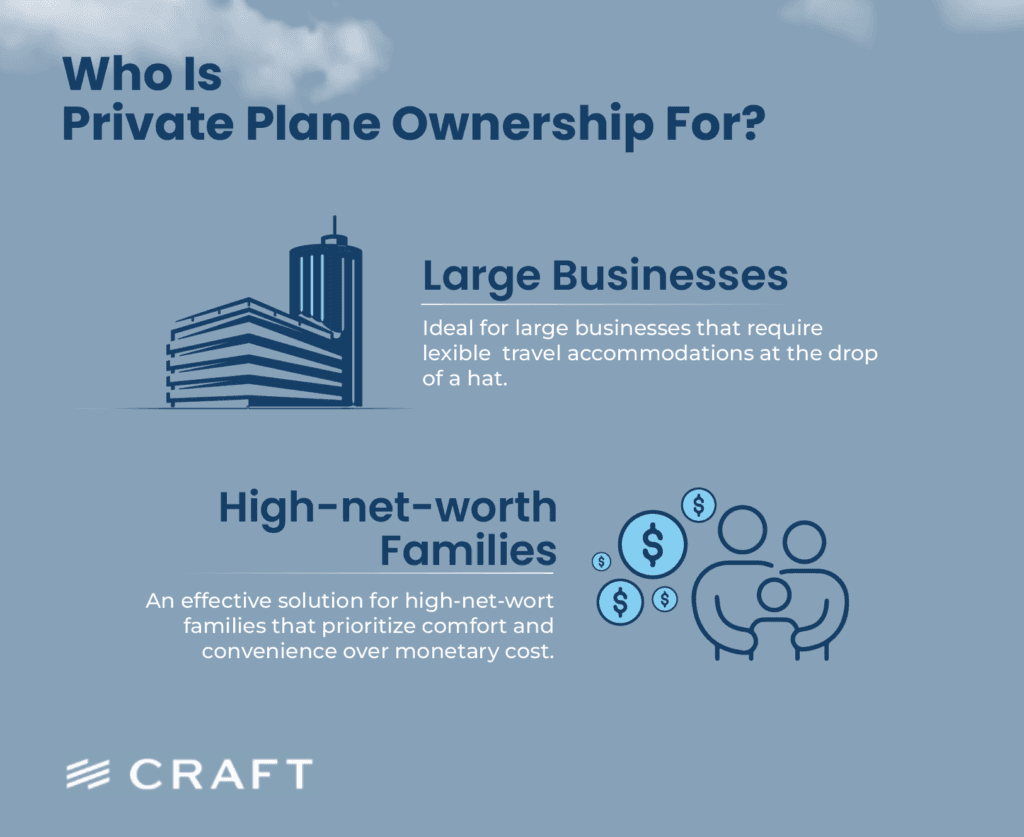
Private plane ownership is ideal for large businesses that require flexible travel accommodations at the drop of a hat. It can also be an effective solution for high-net-worth families that prioritize comfort and convenience over monetary cost.
While it is considerably more expensive than fractional ownership—about 16 times more expensive, to be precise—the level of access it provides can be financially advantageous for businesses that rely on adaptive transportation for high-value meetings. There is also some tax insulation, particularly in the form of reduced capital gains exposure, due to depreciation.
That said, from a financial sensibility standpoint, it is not the most cost-effective way to travel. It exceeds the price of a business-class airline ticket by thousands of percent, but for those who require uncompromising flexibility and control, it is the ideal choice.
How Much Does Whole Plane Ownership Cost?
The cost of whole plane ownership can vary dramatically, ranging from the upper seven figures on the low end to nine figures on the high end. Jets equipped to carry six to eight passengers on domestic flights typically fall into the higher seven-figure range.
Deluxe cabin class aircraft capable of uninterrupted 17-hour international flights, however, can command prices well into the nine-figure range.
Downsides to Exclusive Plane Ownership
The primary barrier to private plane ownership is, of course, the price. Even most high-income individuals would struggle to afford both the sticker price of a private plane and the exorbitant maintenance, fueling, staffing, and storage requirements that come with it.
Even assuming complete plane ownership is within your means, it’s often more service than most people actually require. Fractional ownership or jet cards are a sensible solution for people who fly between 10 to 50 hours per year, which, for context, can cover several international trips or roughly 7 to 10 round-trip domestic flights.
It’s only when you begin logging several hundred hours in the air per year that the benefits of private plane ownership fully manifest.
The other major disadvantage is administrative and managerial. When you own a plane outright, you either need to coordinate upkeep yourself or hire someone to manage it. In either case, it’s far less turnkey than the concierge-level support provided by services like NetJets, Flexjet, or Craft.
Fractional Ownership Overview
So how do fractional ownership programs function? In many ways, they’re actually similar to the experience you get with exclusive ownership. The process goes something like this.
The process:
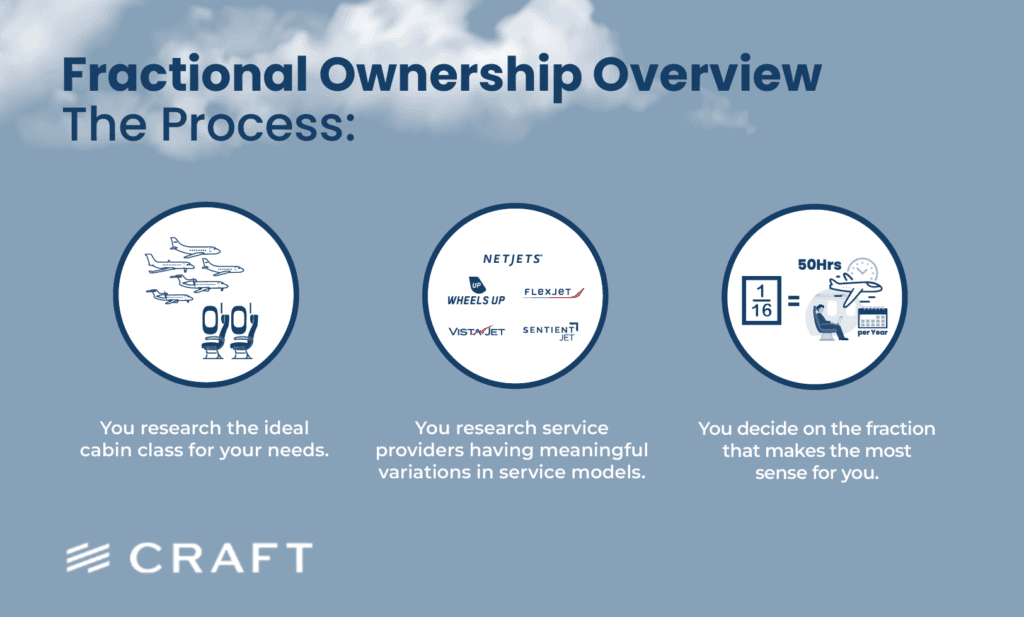
- You research the ideal cabin class for your needs. Some jets are designed primarily for relatively short domestic flights, while larger aircraft are capable of uninterrupted international travel.
- You research service providers. While many fractional or jet card programs may feature ostensibly the same aircraft, there are meaningful variations in service models that warrant consideration. What are the lead times? What is the fee structure? Are aircraft easily available in your area? These factors will ultimately have a significant influence on your experience.
- You decide on the fraction that makes the most sense for you. The most commonly chosen investment tier is a one-sixteenth share, which buys you 50 occupied hours per year. You can buy into more. For example, a one-eighth share will get you 100 hours, a one-fourth share will get you 200 hours, and so on. Typically, the price of the aircraft, along with the associated management fees, increases proportionally with each larger share tier.
Much of the work is done on the front end, as you weigh your options and determine which aircraft and service provider are right for you.
Fractional Ownership Fee Structure
The first year of fractional ownership is typically the most expensive, as you are required to pay an upfront deposit that is proportionate to your fraction of the aircraft’s value. Depending on the cabin class you select, this deposit can range anywhere from $500,000 to several million dollars.
The deposit is at least partially retrievable. At the time of making your deposit, you will sign a five-year agreement. At the end of that five-year term, you are able to sell your share, minus the cost of depreciation.
In addition, you’ll pay monthly management fees. These cover pilot training, storage, fuel programs, maintenance, hangar and runway fees, and other operational costs. Monthly management fees are proportionate to your share of the aircraft. For example, a one-sixteenth share might carry approximately $10,000 in monthly management fees, while a one-eighth share could be closer to $20,000 per month.
You’ll also pay an occupied hourly rate, which generally covers fuel, crew staffing, and catering. This rate can range from several thousand to several tens of thousands of dollars per hour, depending on the aircraft.
Additionally, all private aviation is subject to the federal excise tax, which increases the total cost of the flight experience.
Are There Downsides or Limitations of Fractional Jet Ownership?
There are a few limitations worth noting. Relative to complete private ownership, the biggest downside is slightly delayed access and control.
With fractional ownership, you may have to wait up to three days for your flight, even during normal periods, and quite possibly longer during peak travel times like Thanksgiving, Christmas, the Super Bowl, Coachella, and so on.
The other issue is that the amount of access you’re given to the plane might not be ideal for everyone. Fractional ownership tends to be optimal for people who fly between 50 to 100 hours per year.
Once you move beyond that level, the costs are comparable to those of exclusive ownership. Given the diminished access relative to that experience, it may make more sense to consider buying your own plane, assuming you have the means.
There is another issue with fractional ownership, though not one you’re spared with total plane ownership. That’s the risk of depreciation.
You’re putting your money into an actual plane, and even though you might not fly in the specific aircraft you bought into very often, you’re still financially responsible for its deterioration. After five years, your initial investment will have likely declined in value by about 30%, sometimes more.
Of course, this is also a risk with private plane ownership. At Craft, we utilize a unique investment structure that insulates you from the threat of depreciation.
Craft’s Unique Financial Structure
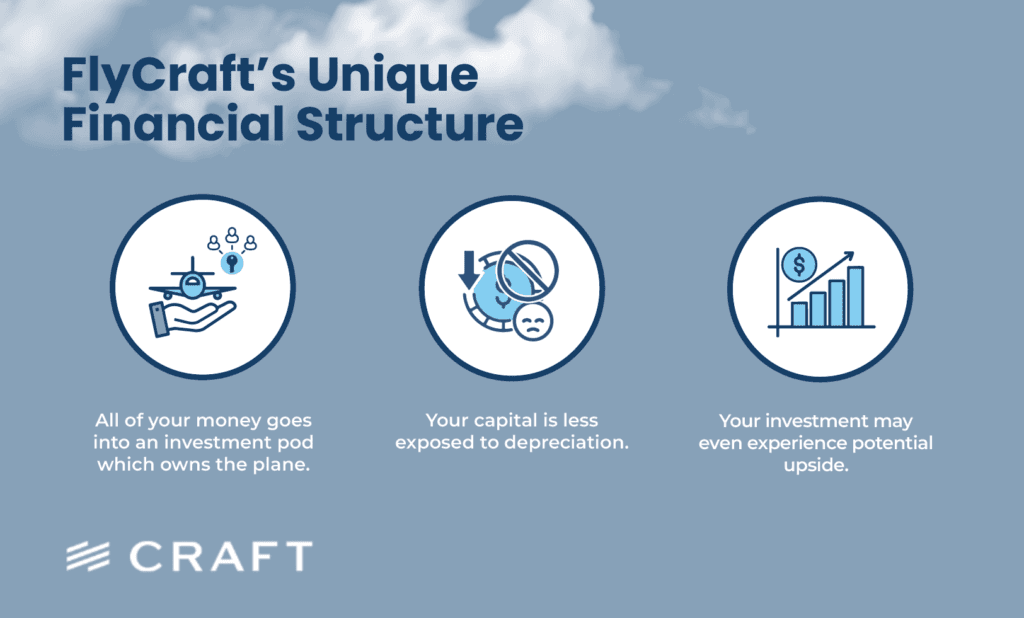
At Craft, all of your money goes into an investment pod. The pod itself owns the plane, and you’re given access to it proportionate to your investment. While investment tiers can vary considerably, most begin in the six-figure range and scale from there.
Because the Craft owns other assets in addition to the aircraft, your capital is less exposed to depreciation. In certain contexts, your investment may even experience potential upside.
If you’re interested in learning more about the unique model behind Craft, or if you’d simply like to hear more about our aircraft, lead times, and fee structures, book a meeting today. We’ll walk you through everything you need to know.
Frequently asked questions
What is fractional jet ownership?
Fractional jet ownership allows multiple owners to purchase a share of an aircraft rather than a whole plane. Fractional owners gain access to a private jet or fleet of aircraft based on their share, typically with guaranteed access and proportional monthly management fees.
How does whole aircraft ownership differ from fractional ownership?
Whole aircraft ownership gives you full control over a specific plane, including the crew, maintenance, and scheduling. Unlike fractional private jet ownership, full ownership involves higher acquisition costs, operational costs, and administrative responsibilities.
What does fractional ownership cost?
Fractional jet ownership cost varies based on aircraft type, cabin class, and share size. Owners pay an initial investment, monthly management fees covering fuel, hangar space, maintenance, and pilot training, plus an occupied hourly rate for each flight hour.
Who benefits most from fractional or whole aircraft ownership?
Frequent flyers, business executives, and high-net-worth individuals benefit from fractional or whole aircraft ownership. Fractional programs are ideal for those flying 50–100 hours per year, while full plane ownership is better for those needing flexible, short-notice access to private aviation.
Are there risks or downsides to fractional aircraft ownership?
Fractional owners face limits on access and control, potential dynamic pricing for high-demand flights, and exposure to aircraft depreciation. While monthly management fees cover maintenance and service, unused hours cannot always be fully recouped.
What is included in fractional ownership fees?
The monthly management fee covers fuel, crew staffing, hangar space, maintenance, insurance, and other operating costs. Additional fees include the occupied hourly rate and federal excise tax, which contribute to total private jet travel costs.
Can fractional owners fly specific aircraft or cabin classes?
Fractional programs allow owners to select preferred aircraft type or cabin classes, though access may rotate among a diverse fleet. Owners can request the right aircraft for their travel needs, but exact assignments depend on fleet availability and short-notice demand.
Related
Related guides
Read next
The Ultimate Private Aviation Comparison: Fractional, Charter, Jet Card, and Whole Ownership
There are lots of ways to fly privately. All of them come at different price points while also providing different levels of access, convenience, and required…
February 3, 2026 · 6 min read
NetJets Fractional Ownership: Costs, Fleet, Pros & Cons (2026 Guide)
Complete guide to NetJets fractional ownership — pricing from 1/16 shares to jet cards, fleet details, management fees, hourly rates, and how it compares to…
April 10, 2026 · 5 min read
Fractional Jet Ownership Companies Compared
The main fractional jet ownership companies, how their shares, monthly fees and hourly rates work, what each one publishes about its jet cards, and how to compare them.
October 4, 2026 · 9 min read


Charter Sales
Tell us the trip. We'll tell you the number.
Route, dates, rough timing, how many people. That is enough to start, and you get a firm price for that specific trip rather than a range.
Text us and you'll get a reply within 60 seconds, any hour.