
Ownership Cost
A Guide to Private Jet Fractional Ownership Costs
Discover the true private jet fractional ownership costs. Our guide breaks down fees and compares ownership, charter, and modern investment-based models.
 BenedictPrivate Aviation ConsultantUpdated February 1, 2026 · Published January 8, 2026 · 16 min read
When people start looking into fractional jet ownership, the costs can be a bit of a shock. It's not just one price tag; it's a mix of a major upfront investment, fixed monthly bills, and what you pay each time you fly. For even a basic share in a super-midsize jet, you're easily looking at a seven-figure commitment once you add everything up for the year. This isn't just a step up from chartering a plane—it's a completely different financial league.
The Real Cost of Flying Private: An Executive Overview
To get a real handle on fractional ownership costs, you have to look beyond the glamour of the jet and see the full financial model. The initial price for your share is just the ticket to get in the door. It's less like buying a car and more like joining an exclusive golf club that also happens to run a fleet of aircraft. You pay a hefty, non-refundable fee to join, then you have monthly dues to keep the place running, and on top of that, you pay every time you play a round.
This whole setup is built to give you guaranteed access and a consistent, high-quality experience, but that guarantee comes at a steep price. The total cost is a puzzle made of different fees that all fit together, and you need to understand each piece.
The Three Pillars of Fractional Costs
If you're seriously considering this, you need to break down the investment into three main buckets:
- Acquisition Cost: This is the big check you write upfront to buy your share of the aircraft, whether it's a 1/16th or a 1/8th slice. That capital is tied up for the life of your contract, which is usually about five years.
- Fixed Monthly Management Fees: Think of these as your non-negotiable monthly dues. They cover all the fixed costs of keeping the fleet ready to go—things like pilot salaries, hangar space, insurance, and scheduled maintenance. You pay this every month, whether you fly 10 hours or zero.
- Variable Occupied Hourly Fees: This is what you pay only when you're actually in the air, wheels up to wheels down. It covers the direct costs of your flight, like fuel, catering, and putting money aside for future engine overhauls.
The numbers here can really add up. A 1/16 share (which gives you 50 hours of flight time) in a popular super-midsize jet often requires a $600,000–$900,000 upfront investment. On top of that, you'll see monthly management fees in the $10,000–$15,000 range. Then, when you fly, your occupied hourly rate can easily be $5,000–$7,000. Do the math, and the all-in cost for a 50-hour user often tops $400,000 a year. You can find more detailed industry statistics and trends at element-aviation.com.
To give you a clearer picture, here’s a breakdown of what a typical first-year and ongoing annual budget might look like for a standard 50-hour share.
Estimated Annual Cost for a 1/16 Super-Midsize Jet Share
| Cost Component | Typical Low-End Estimate | Typical High-End Estimate |
|---|---|---|
| Acquisition Cost (First Year) | $600,000 | $900,000 |
| Annual Management Fees | $120,000 | $180,000 |
| Occupied Hourly Fees (50 hrs) | $250,000 | $350,000 |
| Federal Excise Tax (7.5%) | $18,750 | $26,250 |
| First-Year All-In Total | $988,750 | $1,456,250 |
| Ongoing Annual Total (Yrs 2-5) | $388,750 | $556,250 |
This table shows how the hefty acquisition cost dominates the first year, but the ongoing annual costs remain substantial, often landing somewhere between chartering on-demand and owning a whole aircraft.
A smart evaluation goes way beyond the quote from the sales rep. You have to factor in how much the asset will depreciate, the opportunity cost of having that much capital locked up, and whether the ownership structure is tax-efficient. The true price isn't just what you pay—it's what that money could have been doing for you somewhere else.
Deconstructing Fractional Jet Ownership Fees
Buying a slice of a private jet isn’t like picking a product off a shelf. It’s more like signing on as a key partner in a complex aviation operation where every fee has its purpose.
When you dive into fractional ownership, you’re not looking at a single sticker price. Instead, your expenses break down into three interlocking pieces that together define your real cost of travel.
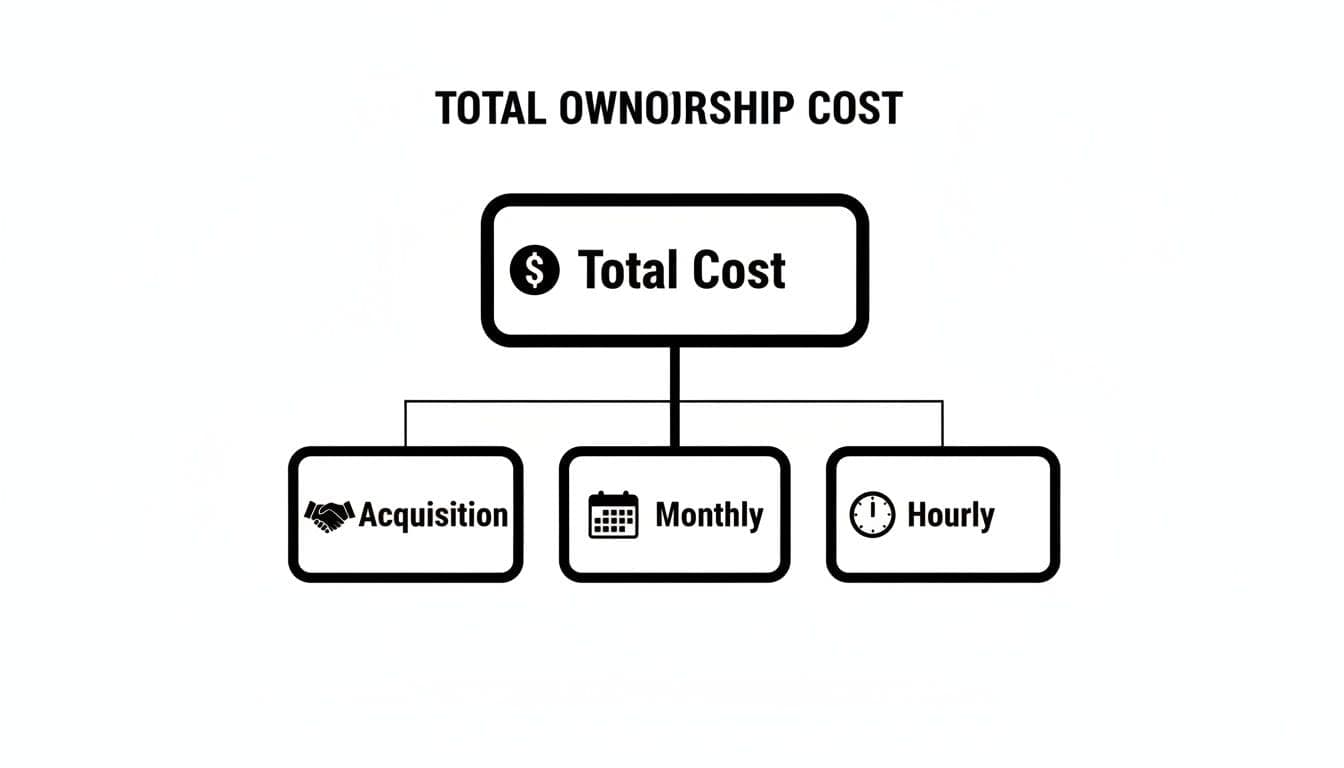
As the diagram shows, acquisition, fixed monthly fees, and variable hourly rates aren’t separate buckets—they form one financial ecosystem powering your jet access.
The Initial Capital Outlay
Your journey starts with the acquisition cost—the hefty upfront payment securing your share of an aircraft. For a 1/16th share on a super-midsize jet, you’re typically looking at $500,000 to well over $1 million. That cash doesn’t buy a standalone plane; it buys you a seat at the table and guaranteed flight access for the next five years.
Think of it as buying into a well-funded service network rather than owning a tangible asset. Your funds merge with other owners’ contributions to keep the fleet ready whenever you need it.
Non-Negotiable Monthly Management Fees
Once your initial capital is in place, you’ll face the monthly management fees—your subscription to a dedicated aviation team on call.
Imagine paying a retainer that covers pilots’ salaries, hangar space, routine maintenance, insurance, and scheduling staff. That’s exactly what this fee does: it keeps the engine running—literally.
Typical costs for a 1/16th share range from $10,000 to $15,000 per month, which adds up to $120,000 to $180,000 annually. In return, you get:
- Pilots & Crew Compensation: Top-tier professionals ready for every departure.
- Hangar & Storage: Secure bases at airports around the globe.
- Insurance Coverage: Full hull and liability protection.
- Scheduled Maintenance: Regular checks mandated by aviation authorities.
- Administrative Support: Flight planning, dispatch, and regulatory compliance.
Variable Occupied Hourly Rates
On top of your subscription, you pay only when you fly. The occupied hourly fee covers direct, flight-specific costs—from takeoff to touchdown.
Key components include:
- Fuel Consumption: The single largest variable cost, sometimes with an extra surcharge.
- Maintenance Reserves: Funds set aside for engine overhauls and major service events.
- In-Flight Services: Standard catering, crew travel expenses, and airport landing fees.
Expect rates between $5,000 and $7,000 per hour for a super-midsize jet. When you calculate total annual usage, these numbers quickly add up.
Uncovering Ancillary And Exit Costs
Even after you understand the three main charges, small add-ons can catch you off guard. Common ancillary fees include de-icing in winter, special catering requests, international overflight charges, and repositioning fees if you launch from outside the core service area.
Finally, remember the contract endgame. At the close of your five-year term, the provider buys back your share at fair market value. Since jets depreciate, you’ll often see a 30% to 50% drop in share value—which translates into a significant exit cost.
Exploring a modern fractional ownership solution can introduce structures—like contribution or exchange funds—that soften depreciation and streamline your financial footprint.
Comparing Private Aviation Financial Models
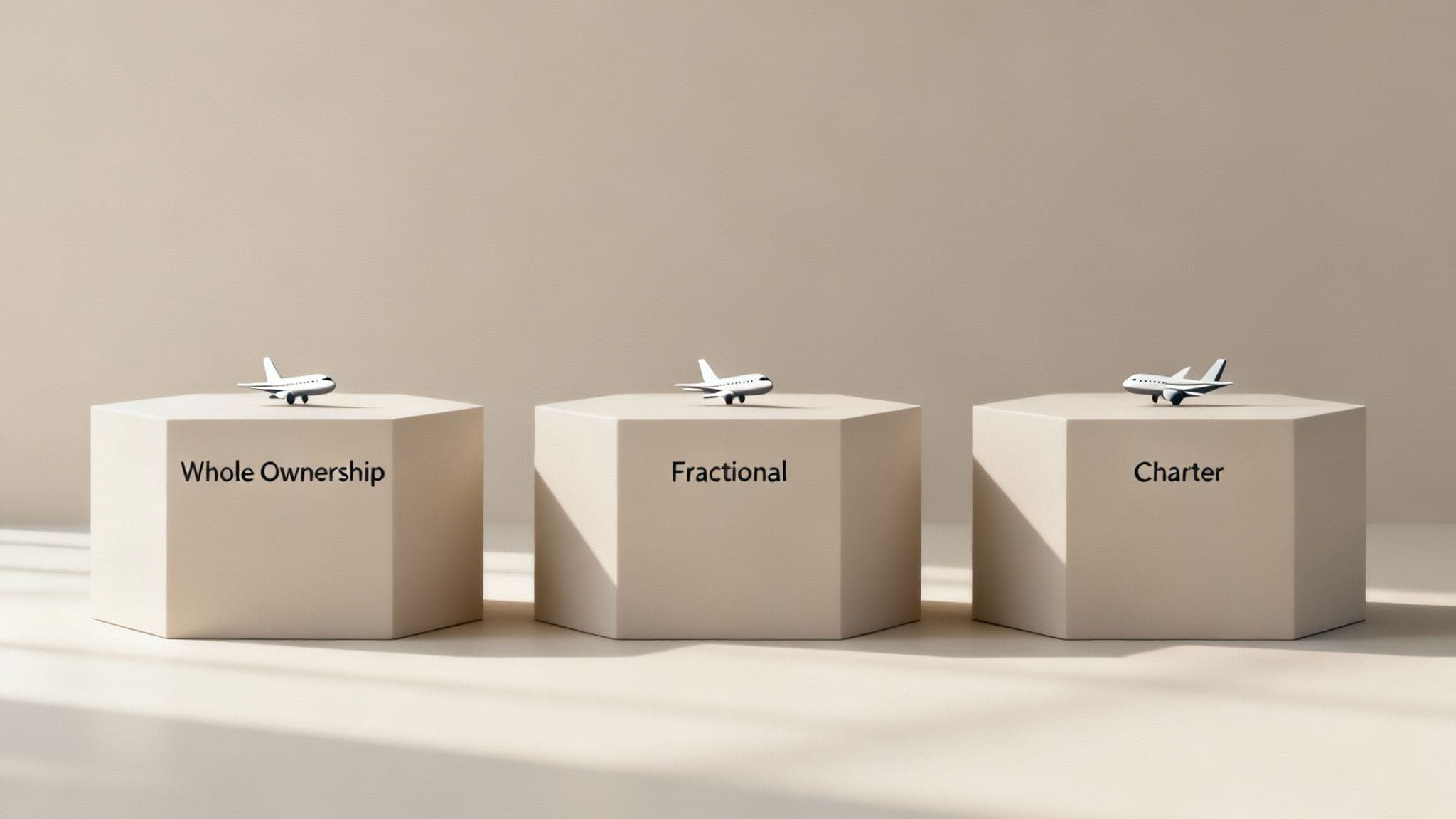
Trying to get your head around the true cost of fractional jet ownership means you first have to understand the alternatives. Private aviation really boils down to three main paths: buying the whole plane, chartering on-demand, or fractional ownership.
Each one represents a different trade-off between how much you spend, how much control you have, and how easy it is to just get up and go. The right answer for you comes down to your real-world travel habits, your financial big picture, and how much you want to deal with the nitty-gritty of managing an aircraft.
Making a smart call here is about more than just comparing hourly rates. It's about making sure your capital is working for you, not against you. Let's pit these three models against each other to see how they really stack up.
Whole Aircraft Ownership: The Peak of Control and Cost
Owning a jet outright gives you the ultimate freedom. The plane is yours, ready whenever you are, and set up exactly how you like it. But that absolute control comes with the heaviest financial and operational load you can imagine. The sticker price—often tens of millions of dollars—is just the entry fee.
You’re on the hook for everything. That means paying for the hangar, the insurance, the pilots' salaries, and every surprise maintenance bill that comes your way. It’s a massive undertaking, often requiring you to build out a full flight department or hire an expensive management company just to handle the logistics.
For a deeper dive into all the line items, our complete guide on the full https://Craft.com/private-jet-ownership-cost/ lays out every single expense.
On-Demand Charter: Maximum Flexibility, Zero Commitment
On the complete other end of the spectrum, you have on-demand charter. Think of it as the Uber of private jets—you pay as you go, with absolutely no upfront capital required. You book a plane for a specific trip, pay the price you're quoted, and you're done. No strings attached.
This makes it a great fit for people who fly infrequently or need different types of jets for different missions. The catch? The flexibility costs you. Per-hour rates are the highest in the business, and the quality of service can be a roll of the dice depending on the operator. When demand is high, just finding a plane at a decent price can be a real headache, and you have zero guarantee of availability.
Fractional Ownership: The Traditional Middle Ground
This is where traditional fractional ownership comes in, designed to be the happy medium between the other two extremes. You get guaranteed access to a jet and consistent service without having to shoulder the entire financial burden of whole ownership. By buying a share, you lock in a specific number of flight hours each year on a certain type of aircraft from a managed fleet.
Fractional ownership neatly solves the "will I get a plane?" problem of charter while spreading out the massive capital risk of buying a whole jet. The downside is its own web of costs. You’re still looking at a hefty upfront investment, steep monthly management fees, and the inescapable financial drag of a depreciating asset. For many, it's a workable balance, but it’s still a capital-heavy, expense-based way to fly.
Choosing the right model requires a clear-eyed assessment of your finances and flight needs. While fractional ownership offers a structured solution, it's crucial to analyze the provider's financial stability and the transparency of their fee structure. For a deeper dive into evaluating providers, learning how to read company financial statements can be an invaluable skill.
To really see how these models differ at a glance, the table below breaks down the key financial and operational trade-offs side-by-side.
Private Aviation Models: A Financial and Operational Comparison
This comparison lays out the core differences you'll encounter when deciding between buying, sharing, or chartering. Each attribute directly impacts both your wallet and your travel experience.
| Attribute | Whole Ownership | Fractional Ownership | On-Demand Charter |
|---|---|---|---|
| Upfront Capital | Highest ($10M – $75M+) | Significant ($500k – $5M+) | None |
| Asset Depreciation | Borne entirely by owner | Borne by owner (pro-rata) | None |
| Monthly Fixed Costs | Very High (all costs) | High (management fee) | None |
| Per-Hour Cost | Lowest (direct operating) | Moderate (occupied rate) | Highest |
| Guaranteed Access | Absolute (your own jet) | High (contractually guaranteed) | Low (market-dependent) |
| Operational Burden | Full Responsibility | None (handled by provider) | None |
| Consistency | Total (your crew/jet) | High (standardized fleet) | Variable (different operators) |
| Flexibility | Limited to one aircraft | High (fleet access) | Highest (market access) |
As you can see, there’s no single "best" option—only the one that best aligns with your specific needs for capital allocation, access, and convenience.
Understanding the Market Forces Driving Jet Costs
The fees in fractional ownership don't just appear out of nowhere. They're a direct reflection of some powerful market forces that set the price for every private flight. Getting a handle on these dynamics is key to understanding why fractional ownership is structured the way it is—and why the costs keep creeping up.
Think of it like this: the fractional market is a highly exclusive, on-demand subscription service. The core promise is guaranteed access to a luxury jet whenever you need it. To make good on that promise, operators have to build and maintain a massive, incredibly complex, and eye-wateringly expensive infrastructure of jets, pilots, hangars, and maintenance crews, all humming along in a state of constant readiness.
That operational readiness is the real product they're selling. Your monthly management fees are basically the subscription cost to keep that entire system on standby just for you, whether you fly five hours one month or fifty the next.
Supply and Demand in the Skies
In the last few years, demand for private aviation has absolutely skyrocketed. This isn't just a blip; it's a fundamental change in how people and companies think about travel. With this boom, the entire supply chain is feeling the squeeze, which directly inflates the costs that get passed on to you, the fractional owner.
This upward pressure shows up in a few key areas:
- Aircraft Acquisition: With more people wanting in, the prices for both new and pre-owned jets have jumped. Operators simply have to pay more to grow and update their fleets.
- Pilot Salaries: We're in the middle of a global pilot shortage, which has pushed pilot pay to record highs. Finding and keeping the best flight crews is now one of the biggest line items for any operator.
- Maintenance Expenses: When fleets are flying more hours than ever, the need for parts, labor, and skilled technicians goes through the roof. This strains the entire maintenance, repair, and overhaul (MRO) network, driving up prices for everyone.
The bottom line is that guaranteeing a jet will be ready for you is an expense-driven business. The operator's main job is to manage these constantly rising background costs, which they then pass on to owners through all those fixed and variable fees.
The Fractional Market's Explosive Growth
On a global scale, shared ownership is now a major engine for business aviation's growth, and that's reshaping the entire cost landscape. Recent analyses valued the private aviation market at around $26.6 billion, with projections showing it could nearly double to $50.8 billion by 2034. A huge part of that growth is coming from shared models like fractional ownership. You can read more about the private aviation growth trends at flyapg.com.
This rapid expansion creates a kind of feedback loop. As more owners sign up for fractional programs, operators have to buy more planes and hire more pilots. This, in turn, puts even more pressure on the industry's supply-and-demand issues. Understanding this context helps you see that the high costs aren't arbitrary—they're a direct result of how the market is built. It also shines a light on why new financial models, which treat aviation access more like an investment than a pure expense, are becoming so important.
A Smarter Model: Turning an Expense Into an Asset
Traditional fractional ownership programs get one thing right: guaranteed access. But in solving that problem, they create a massive financial one. They require you to take a productive asset—like cash or stocks—and sink it into an illiquid, depreciating share of a jet.
It’s a flawed model from the start. Your capital gets locked up, its value slowly draining away, all while you're still on the hook for hefty monthly and hourly fees just to fly. The entire structure is built around spending, not smart investing.
But what if you could completely flip that script? What if your capital could keep growing while also giving you access to an elite private jet fleet? That’s the core idea behind a modern, investment-first approach. It’s about separating the act of flying from the act of capital allocation.

The Power of a Contribution Structure
Forget about buying a slice of a single, depreciating airplane. Instead, imagine contributing to a diversified investment fund, much like a private equity or high-end real estate fund. Your contribution secures a stake in a professionally managed portfolio, and as a key benefit of your membership, you gain access to a fleet of top-tier aircraft.
This structure fundamentally changes the financial dynamics. Your capital isn't bleeding value in a single piece of machinery. It's working for you in a diversified portfolio designed for growth and capital preservation. You fly on the fleet, but your money stays invested.
This shift transforms private aviation from a pure consumption expense into a strategic capital allocation. You’re not just buying flight hours; you’re making an investment that also happens to unlock elite travel benefits.
This model is a game-changer, especially for investors holding highly appreciated assets, like a concentrated stock position after a business exit or a successful early-stage investment.
Unlocking Unprecedented Tax Efficiency
The real power of this investment-led model is its tax efficiency. Let’s walk through a typical scenario. In a traditional program, if you need $1 million for a share, you have to come up with that cash first. If that money comes from selling appreciated stock, you could easily face a 20-30% capital gains tax bill.
That means you'd have to sell $1.3 million or more of your stock just to net the $1 million needed for the buy-in. That initial tax drag is a permanent loss—capital that’s gone forever and can never compound.
A properly structured contribution fund, however, offers a brilliant alternative. By contributing appreciated securities directly to the fund, you can potentially execute a tax-deferred exchange. This lets you:
- Defer Capital Gains Tax: You sidestep the immediate tax hit from selling your stock. Instead of handing over a huge chunk of your principal to the IRS, the entire amount goes to work for you inside the fund.
- Keep Your Principal Compounding: That $300,000+ you would have paid in taxes remains invested, continuing to grow year after year. This is a massive long-term wealth advantage.
- Leverage Bonus Depreciation: Some of these structures are designed so members can benefit from bonus depreciation on the aircraft. This can generate a significant passive "paper loss," which you can then use to offset other income and potentially lower your overall tax bill.
Realigning Incentives for the Owner
At its heart, this investment-first model completely realigns the incentives. The program's success is tied directly to the performance of the investment portfolio, not just the number of flight hours it sells. This creates a genuine partnership between the member and the manager, with both parties focused on smart capital growth.
Your access to the jets becomes a direct benefit of your investment. Suddenly, what was once the largest of all private jet fractional ownership costs—the acquisition—is transformed into an appreciating asset. It’s a far smarter, more strategic way to fly that keeps your capital working for you long after your plane has landed.
Finding the Right Aviation Solution for You
Choosing how you fly privately isn't just about finding the cheapest hourly rate. It's about matching the financial structure of the solution to your unique travel habits and financial goals.
What works beautifully for a Fortune 500 company's flight department could be a terrible fit for a tech founder sitting on a large stock position. The secret is to really understand your own needs first, before you start shopping for a jet.
Let's walk through a few real-world examples to see how this plays out.
Matching the Model to Your Mission
Take the classic corporate executive who flies 100+ hours a year on predictable, multi-city business trips. For them, reliability and availability are everything. Traditional fractional ownership often hits the mark here. The high fixed costs are justified because guaranteed access to the jet is a non-negotiable tool for doing business.
Now, let's pivot to a tech founder fresh off a major exit. They’re holding a massive, highly appreciated stock position and need flexible travel, but their primary focus is smart wealth management. Dropping millions in cash on a depreciating jet share—and triggering a huge capital gains tax bill in the process—is the last thing they should do. An investment-focused contribution model, which can defer those taxes, makes far more sense for their situation.
Finally, think about a family office managing wealth for multiple generations. Their travel is unpredictable. One month it's a light jet for a quick weekend getaway; the next, it's a large-cabin aircraft for an international family vacation. On-demand charter provides the ultimate flexibility with zero capital tied up, making it the most logical choice.
Why Utilization Drives the Fractional Model
So, why are the costs of traditional fractional programs so high? It all comes down to their core promise: high availability. This is an incredibly infrastructure-heavy business model that depends on keeping its planes in the air constantly.
Consider this: in North America, the world's biggest market, fractional fleets logged a record 578,835 departures in recent years. That’s more than all corporate flight departments combined. Yet, these fractional jets make up only about 6% of the entire business jet fleet in the region.
This single stat shows just how hard each aircraft has to work to meet owner demand. You can discover more insights about fractional jet activity here.
Ultimately, the best aviation solution is the one that treats your capital with the same respect it gives your time. By analyzing your financial position, tax considerations, and typical travel needs, you can move beyond simply comparing private jet fractional ownership costs and instead select a model that actively supports your broader financial strategy.
Frequently asked questions
What Happens If I Fly More Than My Allotted Hours?
It's a common question, and the answer usually involves your wallet. Most fractional programs will sell you extra hours, but they won't be cheap. You can typically expect to pay a premium of 25-50% over your standard hourly rate for any time you fly beyond your share.
Keep in mind, though, that money isn't the only factor. Access to these extra hours hinges entirely on aircraft availability. If you're trying to book a last-minute flight during a major holiday or a peak travel season, you might find that no amount of money can get you a plane.
Are Fuel Surcharges Included in The Hourly Rate?
This is one of the most important details to get straight before you sign anything. The "occupied hourly rate" you see in a brochure is often just the starting point. A variable fuel surcharge is almost always added on top of that base rate.
Because this surcharge is tied to the volatile global energy market, it can make your true flight costs unpredictable. It’s not uncommon for fuel to add 15-30% or more to your hourly bill, so you have to account for that to budget accurately.
> A lot of new fractional owners get blindsided by the variable fuel surcharge. It's often tucked away in the fine print and can turn what you thought was a fixed cost into a major variable each time you fly.
How Does Contributing Appreciated Stock Work?
Instead of the traditional route—selling stock, paying a hefty tax bill, and then using the leftover cash to buy your jet share—some modern programs offer a smarter way. You can contribute appreciated securities directly into a specialized exchange fund structure.
This strategy can allow you to defer the capital gains tax you would have triggered by selling. Your entire principal goes into the fund and stays invested, continuing to work for you. You get your jet access without having to first give a huge chunk of your capital to the IRS.
It’s a fundamental shift in the financial dynamics of ownership. What was once a pure, depreciating expense becomes a productive, tax-efficient investment that also happens to give you access to an elite fleet of private jets.
---
Ready to turn your largest aviation expense into a strategic asset? Learn how Craft uses a smarter, tax-efficient model to provide elite jet access while your capital continues to grow. Explore the solution at https://Craft.com.
Related
Related guides
- Fractional Jet Ownership Comprehensive Overview
- Fractional Ownership vs. Long-Term Leasing: Comparing Commitment and Financial Risk
- Fractional Jet Ownership Cost: A Detailed Breakdown
- The Ultimate Private Aviation Comparison: Fractional, Charter, Jet Card, and Whole Ownership
- The Investment Value of Fractional Jet Ownership
Read next
NetJets Fractional Ownership: Costs, Fleet, Pros & Cons (2026 Guide)
Complete guide to NetJets fractional ownership — pricing from 1/16 shares to jet cards, fleet details, management fees, hourly rates, and how it compares to…
April 10, 2026 · 5 min read
Fractional Jet Ownership Costs
Private jet ownership comes with an eight-figure price tag, but for the comparatively low cost of approximately $400,000 a year (plus buy-in costs), you can…
February 1, 2026 · 7 min read
Understanding the Costs of Fractional Jet Ownership
Discover the true fractional ownership cost in 2024, including maintenance fees, management expenses, and annual charges.
February 1, 2026 · 4 min read


Charter Sales
Tell us the trip. We'll tell you the number.
Route, dates, rough timing, how many people. That is enough to start, and you get a firm price for that specific trip rather than a range.
Text us and you'll get a reply within 60 seconds, any hour.