
Jet Cards
Private Jet Membership Comparison: A Closer Look at Why It Matters
Explore our private jet membership comparison to compare costs, benefits, and flexibility, helping you choose the best program for your travel needs.
 BenedictPrivate Aviation ConsultantUpdated January 23, 2026 · Published January 1, 2026 · 20 min read
Picking the right way to fly private is a major decision, and a proper private jet membership comparison is essential. The differences between chartering a jet on-demand, buying a jet card, or entering into fractional ownership are huge. The best fit really comes down to how much you fly each year, your financial strategy, and how much flexibility you need. Each model strikes a different balance between cost, commitment, and control. This guide will break it all down so you can make a smart choice.
Choosing Your Ideal Private Aviation Model
Getting into private aviation is more than just a lifestyle upgrade; it's a serious financial decision. The market has ballooned, with projections putting the global private jet industry at $35-38 billion by 2025. This isn't just a fluke. The growth reflects a fundamental shift away from the headaches of whole aircraft ownership toward more nimble access models that make sense for today's travel patterns and financial goals.
This guide isn't about glossy brochures. It's a clear framework for high-net-worth individuals and business leaders who need to make the right call. We'll get into the weeds of the five main ways to access private jets and give you the criteria you need to evaluate them properly.
Understanding the Core Access Models
Before we dig into the fine print, let's get a handle on the basic structure of each option. Think of them as different tools for different jobs, each designed for a specific type of traveler—from someone who flies private once a year to an executive who’s constantly in the air.
- On-Demand Charter: This is your pay-as-you-go option. It's perfect if you fly infrequently or just want to test the waters of private aviation without any long-term strings attached.
- Jet Cards: You prepay for a block of flight hours, typically 25 or 50, which gives you predictable pricing and the peace of mind of guaranteed access.
- Fractional Ownership: Here, you're buying a deeded share of a specific aircraft. This makes the most sense for people who are consistently flying 50+ hours a year and want the feel of ownership.
- Traditional Memberships: These are usually deposit-based programs. You put down a chunk of money to get preferred hourly rates and access to a specific fleet.
- Exchange Funds: A newer, smarter model. You make a financial contribution to a fund that owns a fleet, giving you access with some compelling tax and financial advantages.
To give you a quick lay of the land, the table below offers a bird's-eye view of these models.
Private Aviation Access Models At a Glance
This summary table compares the fundamental characteristics of the five main private jet access models, helping you quickly grasp the key differences before our deep dive. Understanding the diverse capabilities of the various aircraft available can further inform your decision.
| Access Model | Best For | Typical Commitment | Primary Cost Structure |
|---|---|---|---|
| On-Demand Charter | Infrequent flyers (under 25 hours/year) | Per-trip basis | Variable hourly rates |
| Jet Card | 25-50 annual hours with cost predictability | 1-2 year card term | Prepaid hourly blocks |
| Fractional Ownership | Frequent flyers (50+ hours/year) | 3-5 years | Acquisition + monthly fees |
| Traditional Membership | Regular regional travel | Annual or deposit-based | Upfront deposit + hourly rates |
| Exchange-Fund | Tax-savvy investors needing flexibility | Fund-specific terms | Capital contribution |
This table is just the starting point. Now, let's really unpack what each of these means for your wallet, your schedule, and your peace of mind.
A Detailed Comparison of Private Jet Access Models
Choosing how to fly privately isn't just about picking a jet; it's about matching a financial and logistical model to your specific life. When you start comparing private jet memberships and access options, you’ll see that each one is built for a different kind of traveler, with its own trade-offs in cost, control, and convenience. To make the right call, you have to look past the marketing and get into the weeds of how they really work across seven key areas, from what you pay upfront to how you get out.
This breakdown offers a real, side-by-side look at the five main ways to access private aviation. By digging into the subtle but crucial differences in their financial structures, who’s on the hook for operational issues, and how much flexibility you truly have, you can find the perfect fit for your goals—whether that’s maximizing tax efficiency, guaranteeing a jet is always ready, or keeping your capital liquid.
To get a quick sense of where you might land, this decision tree helps visualize how factors like your annual flight hours and recent financial events—like selling a business—point you toward the best model.
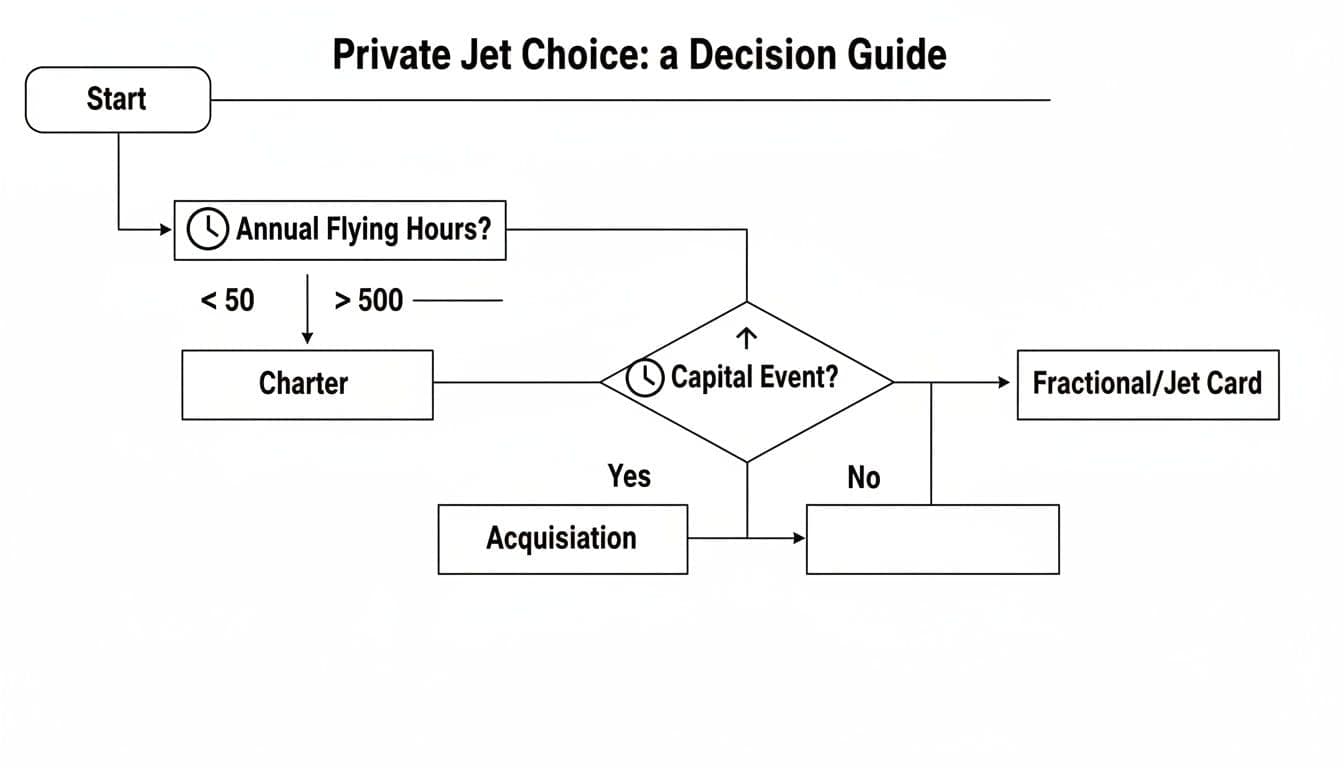
As you can see, there's a clear split. If you fly less often, transactional models like on-demand charter make the most sense. But if you're in the air a lot and have specific financial needs, a more structured solution is probably a better fit.
Cost and Fee Structure Breakdown
The first and most obvious difference is the financial commitment. On-demand charter seems like the simplest route with its pay-as-you-go model, but that simplicity can be deceiving. Prices swing wildly with market demand, and you can get hit with hefty repositioning fees if the plane you need isn't already at your departure airport.
Jet cards bring a bit more predictability. You prepay for a block of 25 to 50 hours at a fixed hourly rate. The catch? You still have to watch out for fuel surcharges, peak-day premiums, and daily minimum flight time charges, all of which can make short trips surprisingly expensive.
Then there’s fractional ownership, which requires the biggest checkbook. You’re looking at a multi-million-dollar buy-in for your share, plus ongoing monthly management fees—$15,000 to $25,000 is typical—and an occupied hourly rate on top of that every time you fly.
Navigating Tax Implications
For any significant financial decision, tax efficiency is a big deal, and private aviation is no different. Fractional ownership has long been popular for its bonus depreciation benefits, which let owners write off a big chunk of the acquisition cost against their income. The downside, of course, is that you're tied to a depreciating asset.
On-demand charter and jet cards are much simpler from a tax perspective—they're straightforward business expenses. You can deduct the cost, but there are no real opportunities for sophisticated tax planning. They are transactional, not strategic.
This is where an exchange-fund model offers a powerful alternative. By contributing appreciated securities (like company stock) instead of cash, members can defer capital gains taxes. This keeps the full, pre-tax value of your assets working for you to fund your flights, all without triggering a major taxable event first. For investors holding concentrated stock positions, this is a game-changer.
Access, Guarantees, and Flexibility
Getting a plane when and where you want it is the whole point. On-demand charter gives you the widest theoretical choice of aircraft, but it comes with zero guarantees. During busy holidays or in popular spots, finding the right jet at a fair price can be a real headache.
Jet cards and fractional ownership solve this with guaranteed availability, usually with just 8 to 24 hours' notice. That reliability is a huge selling point. However, that guarantee often comes with blackout dates on peak travel days and might restrict you to a specific category of aircraft.
The exchange-fund approach also provides on-demand access to a dedicated fleet. Because the model serves a community of fellow investors rather than one-off customers, it can often deliver more consistent availability without the frustrating peak-day limitations you see in many card programs.
Operational and Financial Liability
It's crucial to understand what risks you're taking on. With on-demand charter, the liability for everything from maintenance to crew salaries rests entirely with the Part 135 charter operator. You're just a customer for a single flight.
Fractional ownership puts you squarely in the ownership chain. As a part-owner, you share the financial burden of unexpected major repairs, special assessments, and the inevitable depreciation of the aircraft's market value. You own a piece of a very complex, and very expensive, depreciating machine.
Ensuring Safety and Credentials
Safety should never be a question. All reputable private flight providers operate under strict FAA Part 135 regulations. The best programs, however, go a step further and earn third-party safety ratings like ARGUS Platinum and Wyvern Wingman.
When you book an on-demand charter, it's on you or your broker to vet the safety rating of the specific operator for every single trip. That can lead to inconsistencies.
Jet card and fractional programs maintain one high standard across their entire fleet, which is a major plus. You can be confident that every flight meets the company's strict safety protocol. An exchange-fund model works the same way, partnering exclusively with top-tier, ARGUS Platinum-rated operators to ensure the highest level of safety and crew experience on every flight.
Liquidity and Your Exit Strategy
How easily can you get your capital back? This is a question people often forget to ask until it’s too late. With on-demand charter and jet cards, the exit is easy: you simply stop booking flights or use up your hours.
Fractional ownership makes exiting much more complicated. To sell your share, you have to find a buyer in a fluctuating market. It can take months, and you’ll likely sell at a significant loss because of aircraft depreciation. For many, this lack of liquidity is a major drawback.
The exchange-fund model was built with liquidity in mind. When you decide to exit, your initial capital contribution is returned to you, subject to the fund's terms. This treats your contribution as an investment with a clear exit path, preserving your capital in a way that owning a share of a depreciating jet simply can't. The difference is fundamental: one is a purchase, the other is a redeemable investment.
The Ideal User Profile
At the end of the day, each model is built for a different person. The key to being happy with your choice is to honestly match your profile to the right solution.
- On-Demand Charter: Perfect for the occasional flyer (under 25 hours a year) who values flexibility above all and doesn't need guaranteed access.
- Jet Card: A great fit for those flying 25-50 hours annually. You get predictable costs and a guaranteed jet without the headaches of ownership.
- Fractional Ownership: Built for the heavy flyer (50-150+ hours per year) with predictable travel needs. You want the feel of ownership and can make use of the tax depreciation benefits.
- Exchange-Fund: Designed for the tax-savvy investor flying 50+ hours a year. You get all the perks of fractional (guaranteed access, consistent service) but without the financial liabilities and poor liquidity. It’s an ideal solution for anyone with appreciated assets.
Analyzing the True Costs and Tax Advantages
When you're comparing private jet options, the sticker price is just the beginning of the story. To really understand the financial picture, you have to dig deeper into the total economic impact. Hidden fees and other charges can dramatically change how cost-effective any given model actually is, and a smart analysis shows where the real financial advantages—and liabilities—lie.
On-demand charter has the lowest barrier to entry, which is appealing at first glance. But its pay-as-you-go model means you're completely exposed to market swings. Prices can spike during peak travel times, and you might get hit with hefty repositioning fees if the right aircraft isn't already nearby. This kind of unpredictability makes it nearly impossible for frequent flyers to budget with any real confidence.
Jet cards offer a bit more stability with their fixed hourly rates. The catch is in the fine print. You'll often find fuel surcharges, peak-day premiums, and daily minimum flight time charges that can make short, quick trips unexpectedly expensive. These extras can quickly eat away at the value of your prepaid hours.

Unpacking Ownership and Management Fees
Fractional ownership brings a whole new level of financial complexity. It starts with a major capital investment to buy your share. On top of that, you're on the hook for monthly management fees—typically ranging from $15,000 to $25,000—plus an occupied hourly rate every time you fly. These fees are meant to cover predictable costs like crew salaries and routine maintenance.
The real risk, however, comes from the unexpected. As a part-owner, you share direct financial responsibility for major, unscheduled repairs. Think engine overhauls or critical avionics upgrades. These are often passed on to owners as special assessments. You can get a better sense of these often-overlooked expenses by reading up on private plane maintenance costs.
Leveraging Strategic Tax Advantages
The real financial genius in comparing private jet models comes down to taxes. Each option presents a different set of tools for smart investors and wealth managers looking to optimize their financial strategy.
Below is a table that breaks down the key financial metrics for each model, offering a clear, side-by-side view of the economic realities.
Comparative Financial Impact Analysis
| Financial Metric | On-Demand Charter | Jet Card | Fractional Ownership | Craft Exchange-Fund |
|---|---|---|---|---|
| Initial Outlay | $0 | $100k – $500k+ (Prepaid) | $500k – $5M+ (Share Purchase) | $1M+ (Capital Contribution) |
| Ongoing Fees | None (pay-per-flight) | Fuel surcharges, peak-day fees | $15k – $25k/mo management + hourly | None |
| Cost Predictability | Low (market volatile) | Moderate (fixed hourly, variable fees) | High (fixed fees, variable assessments) | High (predictable hourly draw) |
| Depreciation Risk | None | None | High (asset value declines) | None (asset managed by fund) |
| Primary Tax Benefit | Business expense deduction | Business expense deduction | Bonus depreciation on asset | Capital gains tax deferral |
| Exit/Liquidity | N/A | Funds expire or are non-refundable | Slow; requires finding a buyer | 90-day liquidity; capital returned |
This analysis highlights a critical distinction: most models treat private aviation as a pure consumption expense, whereas the exchange-fund structure positions it as a strategic deployment of capital.
Fractional Ownership and Depreciation
- The Lure: Fractional ownership offers the significant advantage of bonus depreciation. This allows you to write off a large chunk of your acquisition cost against your taxable income, which feels like a big win upfront.
- The Reality: The problem is that you're tied to a depreciating asset. The plane's value will inevitably fall, and when you go to sell your share, you'll likely face a capital loss that can easily wipe out those initial tax savings.
Exchange-Funds and Capital Gains Deferral
- The Power Play: The most compelling benefit of an exchange-fund is the ability to contribute appreciated assets, like company stock, directly into the fund.
- The Impact: This move lets you defer the capital gains taxes you would have paid if you'd sold those assets. Your entire pre-tax principal is put to work funding your flights. This strategy preserves far more capital than selling stock, paying taxes, and then using the leftover cash for a jet card or fractional share.
This tax-deferral mechanism shifts private aviation from being just an expense to becoming a sophisticated financial maneuver. For an investor with a highly concentrated stock position after an IPO or acquisition, it's a brilliant way to diversify and get immediate utility from their wealth without triggering a massive, and immediate, tax bill. It's the perfect example of aligning travel needs with intelligent wealth management.
Finding Your Fit: Which Private Jet Model Is Right for You?
On-paper comparisons are one thing, but the real test is seeing how these private jet models hold up in the real world. To truly understand the differences, we need to move beyond simple feature lists and look at how each option serves specific flyers with unique needs.
Let's walk through a few common scenarios. By putting yourself in the shoes of these user profiles, you can see which model aligns with your own travel patterns, financial situation, and priorities. Whether you're a founder managing newfound wealth, a corporate team with a demanding travel schedule, or a family office prioritizing safety, the best choice is always situational.

Scenario 1: The Tech Founder
Imagine a tech founder who just went through a successful IPO. They’re now sitting on a highly concentrated, appreciated stock position and need to fly 100+ hours a year for board meetings, investor roadshows, and personal trips. Their main challenge is accessing that liquidity without taking a massive tax hit.
- On-Demand Charter: This is a non-starter. Trying to book dozens of individual flights for that much travel would be a logistical mess. Worse, the wildly fluctuating prices would make budgeting impossible.
- Jet Card: A plausible route, as it offers guaranteed access. The problem is, they’d first have to liquidate their stock and pay a hefty capital gains tax just to fund the card, slashing the actual capital they can use for flying.
- Fractional Ownership: This gets closer. It provides the consistent access needed for 100+ hours of flying and offers tax advantages like bonus depreciation. However, it still demands a large cash payment from post-tax funds and saddles the founder with a depreciating asset.
- Craft Exchange-Fund: This is the clear winner. The founder can contribute their appreciated stock directly to the fund, deferring the capital gains tax. This move allows their entire pre-tax capital to work for them, funding their flights and making it the most financially savvy option by a long shot, all without the burdens of direct ownership.
Scenario 2: The Corporate Executive Team
Think of a mid-sized company whose executive team is constantly on the move. They need reliable, on-demand access for frequent, multi-stop trips to visit clients, regional offices, and factories. They fly about 75 hours annually, and the CFO is adamant about budget predictability.
- On-Demand Charter: Too risky. The inability to guarantee an aircraft for a crucial meeting is a deal-breaker. On top of that, repositioning fees for their complex itineraries would send costs soaring unpredictably.
- Jet Card: A very strong contender. The fixed hourly rates are exactly what the CFO needs for clean budgeting, and the guaranteed availability provides peace of mind. The only real downside is the potential for peak-day surcharges and being stuck in one aircraft category.
- Fractional Ownership & Exchange-Fund: Both are top-tier solutions, offering unmatched consistency and reliability. The decision here really comes down to the company's balance sheet strategy. Do they want the depreciation benefits that come with owning a physical asset (Fractional), or do they prefer the clean, liability-free structure of the fund model?
Scenario 3: The Family Office
A family office is tasked with managing the complex assets and lifestyle of a multi-generational family. Their travel needs are often sporadic—sometimes it's a couple on a getaway, other times it's multiple family members heading to different places at once. Safety is their absolute top priority, followed by flexibility and discretion. They typically fly between 40-60 hours a year.
- On-Demand Charter: This is off the table. The need to vet the safety record of a new operator for every single trip is a huge red flag for a safety-first family office.
- Jet Card: An excellent fit. A 50-hour card gives them access to an entire fleet held to a single, high safety standard (like ARGUS Platinum or Wyvern Wingman) and offers the cost predictability they need. The ability to pick the right-sized aircraft for each mission is a major plus.
- Fractional Ownership: This is probably overkill. The heavy commitment and high annual flight-hour requirements of fractional ownership just don't match their variable travel patterns. It’s more aircraft than they need, at a much higher price point.
- Craft Exchange-Fund: This presents a compelling alternative to a jet card. It provides the same high safety standards and flexibility but adds an investment layer. For a family office, the ability to place capital in a managed fund that also takes care of their travel needs aligns perfectly with their core mission of smart wealth management.
The Investment-Grade Approach to Private Flying
For many, private aviation is simply a travel expense. But what if you could approach it as a strategic part of your wealth management? A new model is doing just that, shifting the conversation from a sunk cost to a smart investment. It’s designed for individuals who scrutinize every capital decision for financial efficiency, moving well beyond the simple pay-to-fly structures of charter and jet cards.
This approach is built around a unique, fee-less exchange-fund. Instead of paying for access, members contribute capital to a professionally managed fund. This can be cash, or even more compelling, appreciated assets like company stock. That contribution is your key to a dedicated fleet of modern jets, without all the usual costs that come with it.
A Financially Optimized Structure
The real game-changer here is the elimination of ongoing fees. Forget the $15,000 to $25,000 in monthly management fees that are standard with fractional ownership. With this model, your initial capital contribution is all that's required for access. It completely rewrites the financial equation by getting rid of a significant, perpetual expense.
This structure also cleverly insulates you from the headaches of ownership. The fund and its hand-picked FAA Part 135 operating partners handle all the operational and financial risks—things like maintenance, depreciation, and crew management. You get all the perks of consistent access without any of the burdens.
This kind of financial engineering is incredibly timely. With the private aviation market showing sustained strength—global departures surpassed 80,000 in a single week in 2025, an 11% jump from the previous year—a smarter access model is more relevant than ever. You can learn more about this sustained private aviation boom and what it means for savvy flyers.
Trust, Safety, and a Clear Exit
Of course, a model like this only works if it's built on a foundation of absolute trust. Transparency and rigorous oversight are non-negotiable. That’s why it relies on exclusive partnerships with top-tier, ARGUS Platinum-rated operators, guaranteeing the highest safety standards for every single flight.
To add another layer of security, operations are subject to independent third-party audits, and all assets are held in custody with major financial institutions. This ensures the same level of accountability you'd demand from any of your other premier investments.
And when it’s time to move on? The exit is clean and simple. When you decide to leave the program, your initial stake in the fund is returned to you. This positions your contribution not as a sunken expense, but as a liquid investment, preserving your capital for your next move.
Got Questions About Private Jet Access?
Even after breaking down the different ways to fly private, a few key questions always seem to pop up. Let's tackle some of the most common ones to help you nail down which approach truly fits your needs.
When Is a Membership Smarter Than Just Chartering on Demand?
Most people in the industry agree that the magic number is somewhere between 25 and 50 hours a year. If you're flying less than that, the straightforward, pay-as-you-go nature of on-demand charter is tough to beat. You avoid any big upfront costs.
But once you cross that 50-hour threshold, the charter game starts to change. The unpredictable pricing, last-minute aircraft swaps, and hefty repositioning fees really start to add up. This is the point where the locked-in rates and guaranteed access of a jet card, fractional ownership, or an exchange-fund model start to look much more appealing for anyone who flies regularly.
What’s the Real Difference in Liability With Fractional Ownership?
This is a big one, and it's easy to miss in the fine print. When you buy into a fractional program, you're not just buying flight hours—you're buying a legal share of a specific aircraft. That makes you a part-owner, and you're on the hook for your portion of everything that comes with it.
Think unexpected engine overhauls, surprise assessments for mandatory avionics upgrades, or just the simple, unavoidable depreciation of the plane. You share in all that financial and operational risk.
An exchange-fund, on the other hand, creates a clear buffer. You’re an investor in a fund that gives you flight access, not an owner of the metal itself. The fund and its operator take on the direct risks of maintenance, repairs, and depreciation. It's a much cleaner way to secure your access without taking on the headaches of asset ownership.
Can I Use My Stock Portfolio to Pay for Flights?
Absolutely, but only one model is built for it: the exchange-fund. This is where it gets really interesting from a financial strategy perspective. An exchange-fund allows you to contribute appreciated assets—like company stock or other securities—directly into the fund to pay for your flight access.
It’s a tax-deferred exchange. This means you can put your entire principal to work for you without having to sell the asset and take a capital gains tax hit first. With any other model, you have to use cash. So, to fund a jet card or fractional share, you'd first have to liquidate your stock, pay the taxes, and then use what's left over. That’s a significant difference in financial efficiency.
Ready to align your private travel with a smarter financial strategy? Discover how the Craft exchange-fund model offers a more efficient, investment-grade approach to private aviation. Learn more about Craft.
Related
Related guides
- VistaJet vs Craft: Global Access and Hourly Rates
- Fixed Rate Versus Dynamic Pricing Jet Cards: Which Model Saves You More Money?
- Jet Card versus Charter: The Best Choice for Occasional Versus Frequent Flyers
- How a Jet Card Works: Predictable Costs and Guaranteed Private Jet Access
- Flexjet vs Craft: Fractional Shares vs a Fixed-Rate Card
Read next
What is a Private Jet Card Membership?
What is a private jet card? Is it the best way to fly by private jet? Should you get one now? FInd out all about jet cards.
July 31, 2025 · 9 min read
Finding the Best Private Jet Membership Programs in 2026
Discover the best private jet membership programs. Compare jet cards, fractional ownership, and modern investment models to find the perfect fit for your needs.
January 21, 2026 · 17 min read
Ownership Cost
NetJets vs FlexJet: Cost, Service & Ownership Comparison (2026)
Compare NetJets vs FlexJet costs, fleet size, management fees, and ownership models.
April 10, 2026 · 6 min read


Charter Sales
Tell us the trip. We'll tell you the number.
Route, dates, rough timing, how many people. That is enough to start, and you get a firm price for that specific trip rather than a range.
Text us and you'll get a reply within 60 seconds, any hour.