
Exchange Funds
Exchange Fund Fees: Why Glidepath Charges Nothing
Exchange fund fees typically run ~1% a year for 7 years. Glidepath charges none. See exactly how, and what that saves you.
 Natan BenchimolExecutive Vice PresidentUpdated September 18, 2026 · Published July 30, 2026 · 4 min read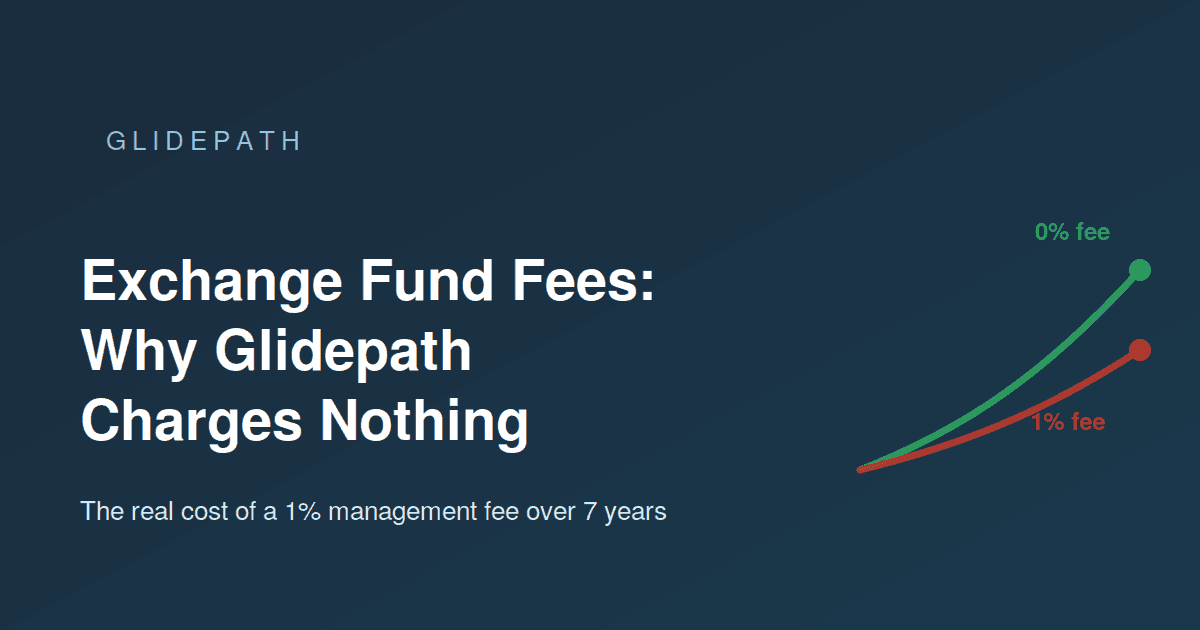
Exchange funds let you diversify a concentrated position without triggering a tax bill, so that more of your capital stays invested and compounding.
But most exchange funds charge a management fee of around 1% a year, which eats into the very compounding you just protected.
In this article, you’ll learn what exchange funds typically cost, and why Glidepath charges $0 in management fees.
How Much Does an Exchange Fund Charge in Fees?
Most exchange fund providers charge an ongoing management fee on the assets you’ve contributed, generally somewhere around 1% a year. Depending on the provider, there can also be a placement or sales load charged when you enter the fund, and sometimes a redemption fee if you exit at the end of the holding period. None of this shows up as a single upfront number. It’s a percentage taken from your position every year you’re invested.
Why a 1% Fee Matters for Your Investment
A 1% annual fee might sound small, but an exchange fund is a long-term holding, and that fee can slowly add up. Let’s run the math on a $1M contribution with an assumed 7% annual growth for seven years.
| Year | Balance | Growth (7%) | Fee (1%) | End Balance |
|---|---|---|---|---|
| 1 | $1,000,000 | $70,000 | $10,700 | $1,059,300 |
| 2 | $1,059,300 | $74,151 | $11,334 | $1,122,117 |
| 3 | $1,122,117 | $78,548 | $12,007 | $1,188,659 |
| 4 | $1,188,659 | $83,206 | $12,719 | $1,259,146 |
| 5 | $1,259,146 | $88,140 | $13,473 | $1,333,813 |
| 6 | $1,333,813 | $93,367 | $14,272 | $1,412,908 |
| 7 | $1,412,908 | $98,904 | $15,118 | $1,496,693 |
The ending balance after 7 years and a 1% fee is $1,496,693, and you’ll pay almost $90,000 in fees over the 7 years. But there’s also the opportunity cost to take into account.
Let’s run the math without the management fee:
| Year | Balance | Growth (7%) | Fee (0%) | End Balance |
|---|---|---|---|---|
| 1 | $1,000,000 | $70,000 | $0 | $1,070,000 |
| 2 | $1,070,000 | $74,900 | $0 | $1,144,900 |
| 3 | $1,144,900 | $80,143 | $0 | $1,225,043 |
| 4 | $1,225,043 | $85,753 | $0 | $1,310,796 |
| 5 | $1,310,796 | $91,756 | $0 | $1,402,552 |
| 6 | $1,402,552 | $98,179 | $0 | $1,500,730 |
| 7 | $1,500,730 | $105,051 | $0 | $1,605,781 |
The ending balance after 7 years is $1,605,781. That’s a difference of almost $110,000, made up of almost $90,000 in fees and $20,000 in opportunity cost. This opportunity cost exists because every time a management fee is paid, less of your capital stays in the fund compounding.
$1M Contribution, 7% Growth, 7 Years
Glidepath — no management feeTypical fund — 1% annual fee
What a “Small” 1% Fee Really Costs
≈$90K
paid in management fees over 7 years
≈$20K
lost compounding (opportunity cost)
=
≈$110K
kept working for you at Glidepath
Want an exchange fund that keeps more of your capital compounding for longer? See if you qualify for Glidepath.
How do exchange fund fees compare across providers?
Fee structures vary widely across providers, and so do minimums and eligibility standards. Cache, a newer entrant, charges a tiered management fee between 0.40% and 0.95% of committed capital, stepping down to 0.25% after seven years, with no separate sales or servicing fees. Fidelity’s exchange fund carries a management fee near 0.54%, plus up to 0.50% in administrative expenses, a potential 0.25% servicing fee, and a one-time placement fee around 1.5%. Older-guard providers like Eaton Vance and Goldman Sachs have reportedly charged combined annual costs near 1% (split between management and servicing fees) plus a one-time finder’s fee. These figures come from secondary reporting rather than each firm’s own disclosure, so treat them as illustrative.
| Provider | Annual fee | One-time / placement fee |
|---|---|---|
| Glidepath | 0% | None |
| Cache | 0.40%–0.95%, tiered (steps down to 0.25% after year 7) | None |
| Fidelity | ~0.54% management, plus up to 0.50% admin and up to 0.25% servicing | ~1.5%, one-time |
| Eaton Vance | Reportedly ~0.95% (0.70% management + 0.25% servicing) | Reportedly ~1%, one-time |
| Goldman Sachs | Reportedly ~0.5 percentage points above newer entrants | Not independently confirmed |
Cache’s and Fidelity’s figures are drawn from each firm’s own published materials. The Eaton Vance and Goldman Sachs figures come from secondary reporting, not either firm’s own fee disclosure, so confirm current terms directly with the provider before relying on them.
How Glidepath Charges a $0 Management Fee
Traditional exchange funds were built for a pre-software era: manual investor onboarding, bespoke paperwork, human-driven portfolio matching, and several intermediaries taking a cut. That overhead is what the management fee pays for. The fee isn’t tied to performance, since the portfolio is designed to track a benchmark rather than beat one.
Glidepath rebuilt that process in software. Eligibility checks, stock intake and matching, document workflows, and ongoing fund administration run automated end-to-end. Less manual overhead means less cost that has to be passed on to you.
That still leaves the question of how Glidepath earns anything. Every exchange fund is required to hold at least 20% of its assets in qualifying illiquid assets under Section 721. Typically, these assets are real estate, but Glidepath meets that requirement with income-producing operating assets instead. The qualifying illiquid assets generate revenue, so you don’t have to pay a management fee and you don’t face any opportunity cost.
Legacy exchange funds charge you to hold your portfolio. Glidepath earns from the asset side of the structure, so you don’t pay an annual fee.
Ready to diversify a concentrated position and defer tax? Glidepath can help.
Frequently asked questions
Are there fees besides the management fee?
Yes, at some providers. Depending on the provider, you may also see a one-time placement or finder’s fee when you enter the fund, a redemption fee at the end of the holding period, or separate administrative and servicing fees layered on top of the base management fee. Glidepath charges none of these — no management fee, no placement fee, and no redemption fee.
Are exchange fund fees worth it?
Whether a fee is worth it depends on what it buys you: tax deferral on a concentrated position, professional portfolio construction, and diversification you couldn’t otherwise access without selling. A 1% fee that costs roughly $110,000 over seven years on a $1M position, as shown above, is a real cost to weigh against the tax you’d otherwise owe on an outright sale. It’s also worth comparing that fee against $0-fee options, since the underlying mechanism doesn’t require charging one at all.
Read next
How to find the right exchange fund provider for you
A list of exchange fund providers and how they compare on minimum investment, fees, and holding period, so you can pick the right fund.
September 3, 2026 · 4 min read
Is an exchange fund the same as an ETF?
Is an exchange fund the same as an ETF? No. See how the two differ on eligibility, liquidity, and tax treatment before you invest.
August 26, 2026 · 2 min read
Exchange fund vs. selling stock: which is better for you?
See how an exchange fund vs. selling stock compares on taxes, liquidity, and control, so you know which fits your position.
August 26, 2026 · 3 min read


Charter Sales
Tell us the trip. We'll tell you the number.
Route, dates, rough timing, how many people. That is enough to start, and you get a firm price for that specific trip rather than a range.
Text us and you'll get a reply within 60 seconds, any hour.