Statistics
Empty Leg Flight Statistics: Availability, Savings & Booking Trends
Empty leg flights have long been a fairly invisible instrument of private travel. Really, they represent logistical necessity.
 Israel SlodowitzFounder & CEOUpdated October 5, 2026 · Published March 20, 2026 · 6 min read
Empty leg flights have long been a fairly invisible instrument of private travel. Really, they represent logistical necessity.
When a private chartered flight reaches its final destination, it can’t remain there. It needs to be repositioned for the next charter.
Many of these repositioning flights remain empty, save for the pilot and crew. Not only is this financially inefficient, but it’s needlessly wasteful.
Empty leg flights provide a solution. Consequently, many chartering services provide discounted tickets for repositioning flights at steeply discounted rates.
For private flyers who can be flexible, they are the most affordable way to travel privately.
Nearly 40% of All Private Jets Fly Empty
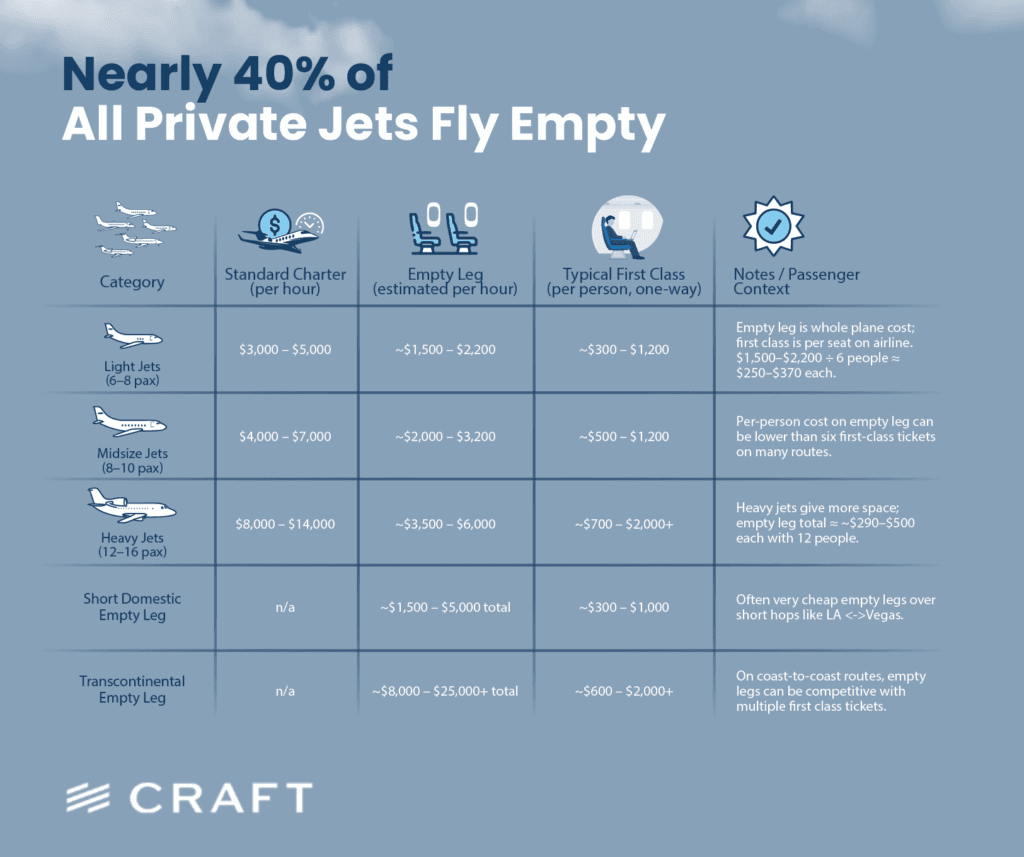
For decades, the private aviation industry operated inefficiently, with nearly half of all flights being completely empty due to repositioning requirements.
When a plane goes from New York to Miami for a charter, it then needs to get back to the East Coast for the next flight.
Prior to empty leg flights, these repositioning routes were executed at a net loss for the jet service operator.
By chartering these empty flights, private aviation companies recuperate losses or even make a slight profit on what would otherwise be a financially inefficient route.
| Category | Standard Charter (per hr) | Empty Leg (estimated per hr) | Typical First Class (per person, one-way) | Notes / Passenger Context |
| Light Jet (6–8 pax) | $3,000–$5,000 | ~$1,500–$2,200 | ~$300–$1,200 | Empty leg is whole plane cost; first class is per seat on airline. $1,500–$2,200 ÷ 6 people ≈ $250–$370 each. |
| Midsize Jet (8–10 pax) | $4,000–$7,000 | ~$2,000–$3,200 | ~$500–$1,200 | Per-person cost on empty leg can be lower than six first-class tickets on many routes. |
| Heavy Jet (12–16 pax) | $8,000–$14,000 | ~$3,500–$6,000 | ~$700–$2,000+ | Heavy jets give more space; empty leg total ≈ ~$290–$500 each with 12 people. |
| Short Domestic Empty Leg | n/a | ~$1,500–$5,000 total | ~$300–$1,000 | Often very cheap empty legs over short hops like LA↔Vegas. |
| Transcontinental Empty Leg | n/a | ~$8,000–$25,000+ total | ~$600–$2,000+ | On coast-to-coast routes, empty legs can be competitive with multiple first class tickets. |
Empty Leg Flights Allow Passengers to Save Up to 75%
- Empty leg flights are typically priced at least 50 percent below regularly chartered alternatives, with some being as much as 80 percent more affordable.
- A typical empty leg flight from New York to Miami will cost $7,000 compared to the $15,000 plus it would cost conventionally.
- Shorter, more common routes such as Los Angeles to Las Vegas are even more affordable, often costing as little as $3,000.
- Empty leg flights do still come with necessary add-ons, including fuel surcharges, catering fees, and passenger excise taxes.
- Passengers are also required to be more flexible and have little to no say over when the plane departs.
Booking Windows Can Be Very Short
- Empty leg flights can generally only be booked between 24 to 48 hours in advance.
- For this reason, travelers need to carefully monitor their options when searching for available flights.
- These short booking windows make it marginally more difficult to plan trips around empty leg flights.
- It is hard to predict what options will be available to you during your desired travel window.
Seasonality Influences Opportunity
- On the East Coast, the winter months have the highest volume for empty leg travel.
- 60% of empty leg runs on the East Coast go southbound towards Florida during winter.
- In the summer, there is a higher concentration of empty leg flights in seasonal spots like the Hamptons, Nantucket, and Martha’s Vineyard.
- During summer, Sunday evening is the most common empty leg flight opportunity window.
- On the West Coast, the highest volume of empty leg opportunities are between Los Angeles and Las Vegas.
Busiest Empty Leg Corridors in North America
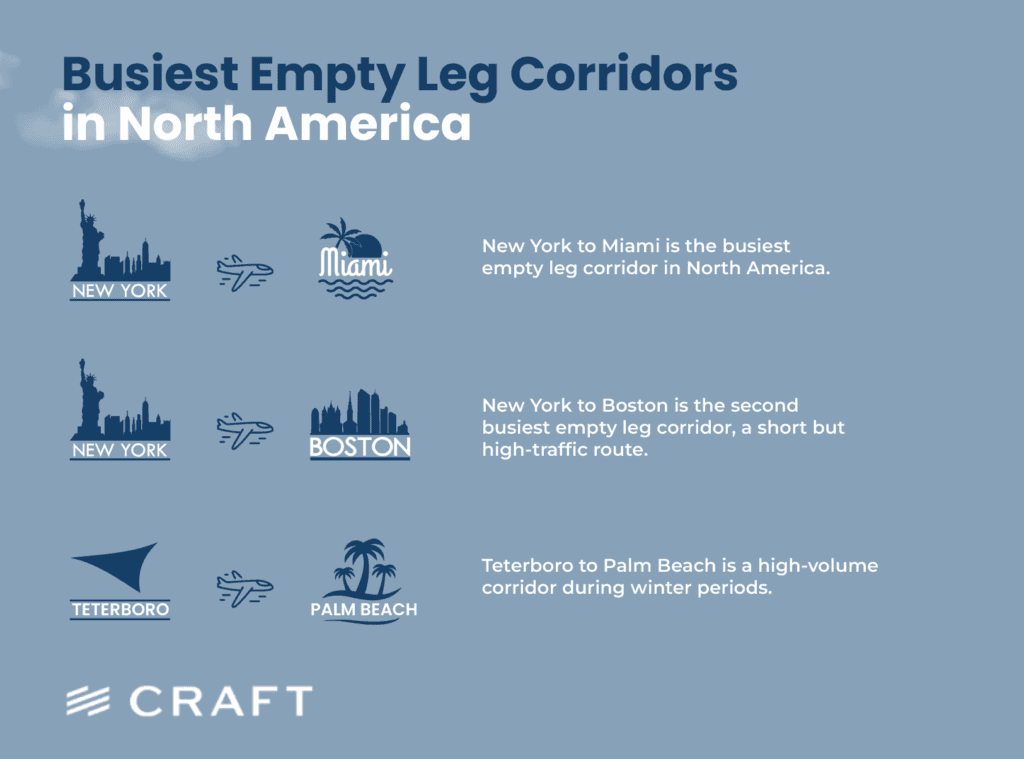
- New York to Miami is the busiest empty leg corridor in North America.
- New York to Boston is the second busiest empty leg corridor, a short but high-traffic route.
- Teterboro to Palm Beach is a high-volume corridor during winter periods.
How Often Do Empty Leg Flights Occur
- At any given moment, experts estimate there could be as many as 3,000 empty leg flights available worldwide.
- Approximately 30% of available empty leg flights go unfilled.
- Some estimates put the number of unfilled empty leg flights as high as 50%.
- Although empty leg windows are less flexible than standard charters, the opportunities are abundant enough to find options.
Who Uses Empty Leg Flights the Most
- Businesses account for nearly 50% of empty leg flight customers.
- Individual travelers are the second largest segment of empty leg customers.
- Government and public sector organizations are the third and smallest category of empty leg users.
- Government and public sector organizations use empty leg travel for emergency or diplomatic purposes.
- Individual net worth can vary dramatically for empty leg travelers.
- The primary customer demographic still trends wealthy.
- There is a wider range of economic backgrounds using empty legs due to the lower cost compared to other forms of private aviation.
Commercial First Class Comparison
- An empty leg flight from New York to Miami can cost approximately $2,000 per person, assuming 6 travelers.
- A first-class plane ticket on the same route can amount to up to $5,000 per person during peak season.
- Savings can exceed the figures described above due to the dynamic pricing structure of empty leg flights.
- Typically, the best prices are available 24 hours prior to departure when providers are eager to fill the plane.
Empty Leg Flights Are On The Rise
Surveys have shown that interest in empty leg flights has increased by 120% since 2023. Not only does this show a keen and growing interest in the post-Covid economy, but it also suggests that attention toward empty leg flights extends beyond the traditional private aviation market.
It is still a high-net-worth purchase. However, the actual costs can, for certain flights (and depending on the number of passengers boarding) be comparable to the cost of first-class plane tickets. Higher, yes, but close enough to potentially appeal to some of the same customers.
Is There a Point When Chartering When Empty Leg Flights Are Not Cost-Effective?
Arguably, the price per hour for empty leg flights is unmatched, even when scaled up to the 200 to 400 hours of travel per year that are frequently completed by private plane owners. That said, there are logistical costs that are harder to calculate in terms of numeric value.
As described above, coordinating empty leg flights requires a lot of research and flexibility, something that a business executive or just a very busy high-net-worth individual won’t necessarily be able to commit to. In cases where the effort that empty leg flights require is disproportionate to the savings, even if that congruous value is subjective, it may be worthwhile to consider other methods of private travel.
For many people, chartering options or jet cards are the next most obvious option. That said, there are other methods worth considering.
Fractional jet ownership programs are actually the fastest-growing method of private transportation. They provide high levels of access and flexibility, and they can be financially worthwhile in certain contexts as well.
Where CRAFT Fits
CRAFT is the Part 135 operator of five Challenger 300 and 350 jets. You can charter one trip at a time, or buy hours on the Fleet Jet Card at published hourly rates, fuel and FET included, without buying a share of an aircraft. What a trip costs is on private jet cost by the hour and the city pages, and how card programs compare, route by route, on the jet card providers page.
Related
Related guides
Aircraft in this guide
Routes and cities
Read next
Private Jet Ownership Statistics: Costs, Growth & Market Trends in 2026
Private aviation is on the move. In 2026, the global fleet stands at 24,270 aircraft, the market is valued at more than $26 billion, and flight activity has…
October 5, 2026 · 5 min read
Charter
Empty Leg Flights: What They Are, What They Cost and How to Book One
Empty leg flights explained: why private jets fly empty, how empty legs are priced and booked, the risks, and how they compare with charter and a jet card.
October 5, 2026 · 6 min read
Jet Cards
Jet Cards vs. Empty Leg Flights: What’s the Difference?
In the world of private aviation, there are several methods of securing access, comfort, and convenience.
March 4, 2026 · 7 min read


Charter Sales
Tell us the trip. We'll tell you the number.
Route, dates, rough timing, how many people. That is enough to start, and you get a firm price for that specific trip rather than a range.
Text us and you'll get a reply within 60 seconds, any hour.