When people ask about the cost of flying private, there's no single answer. The price isn't a fixed number but a wide spectrum. You could be looking at $5,000 an hour for an on-demand charter, or you might be considering a $10 million upfront investment to purchase your own jet, with millions more in yearly expenses.
It's a lot like real estate. You can rent a place for a weekend (that's your on-demand charter), get a long-term lease (jet card), co-own a vacation home with others (fractional ownership), or just buy the entire estate yourself (whole ownership). Each of these paths comes with a completely different financial footprint.
Beyond the Hourly Rate: Understanding Private Jet Costs
To really get a handle on private aviation costs, you have to look past the sticker price of an hourly rate. The true financial picture is a mix of the access model you choose and two very distinct types of expenses: fixed costs and variable costs. Getting this right is the key to making a smart decision that fits your financial goals, not just your travel plans.
Thinking this way turns private flying from a simple luxury expense into a strategic financial decision. It’s similar to how savvy travelers understand the true cost of a high-end trip, like knowing what to expect in the most expensive countries to visit in Europe; you have to break down the costs to see what's really going on.
Fixed vs. Variable Costs: The Two Sides of the Coin
No matter how you fly private, every model is a blend of fixed and variable expenses. The big difference is who ends up paying for them.
-
Fixed Costs: These are the predictable, always-on expenses that keep a plane ready to fly, even if it’s just sitting in the hangar. Think of them as the overhead of aircraft ownership. They include things like crew salaries, hangar fees, insurance, and scheduled maintenance.
-
Variable Costs: These expenses only pop up when the plane is actually flying. They’re the direct costs of a specific trip, like fuel (which is by far the biggest one), airport landing fees, catering, and de-icing services in the winter.
If you're chartering a jet on-demand, the operator bundles all these costs—both fixed and variable—into the quote you receive. But as you climb the ladder toward ownership, you start taking on the fixed costs directly. For a super-midsize jet, that can easily run $1 million to $2 million a year, and that's before you've even taken off.
Key Takeaway: The real difference between private aviation models isn't just the price tag; it's about who is responsible for the aircraft's substantial fixed operational costs. Grasping this is the first step toward making a sound investment.
To help visualize how these models stack up, here’s a quick comparison.
Private Aviation Models at a Glance
This table breaks down the primary ways to access private aviation, showing how the financial commitment and cost structure differ for each.
| Access Model | Upfront Cost | Ongoing Costs | Best For |
|---|---|---|---|
| On-Demand Charter | None | Pay-per-flight | Occasional flyers (under 25 hours/year) needing flexibility. |
| Jet Card | $100k – $250k | Fixed hourly rates, annual fees | Frequent flyers (25-50 hours/year) who want price predictability. |
| Fractional Ownership | $500k – $3M+ | Monthly management fees, occupied hourly rates | Consistent travelers (50-200 hours/year) seeking ownership benefits without full responsibility. |
| Whole Ownership | $3M – $70M+ | All fixed and variable costs | High-utilization flyers (200+ hours/year) who need total control and availability. |
Understanding this framework helps you see beyond a simple hourly price and evaluate each option for its true financial impact. For a closer look at how these factors shape the final price you pay, our complete guide to private jet hourly rates breaks it all down.
Comparing the Four Paths to Private Aviation
Figuring out the best way to fly private isn't just about picking a plane; it's about choosing the right financial model for your lifestyle. Think of it like getting around town. You can grab a taxi for a one-off trip, lease a car for predictable payments, co-own a vehicle with friends, or buy one yourself for total control. Each option hits your wallet and your schedule in a completely different way.
The four main avenues—On-Demand Charter, Jet Cards, Fractional Ownership, and Whole Ownership—aren't just rungs on a price ladder. They represent totally different philosophies on how you balance cost, convenience, and commitment. The right fit comes down to how you fly, your financial strategy, and how much control you want over the asset.
This diagram gives you a great visual for how these models stack up.
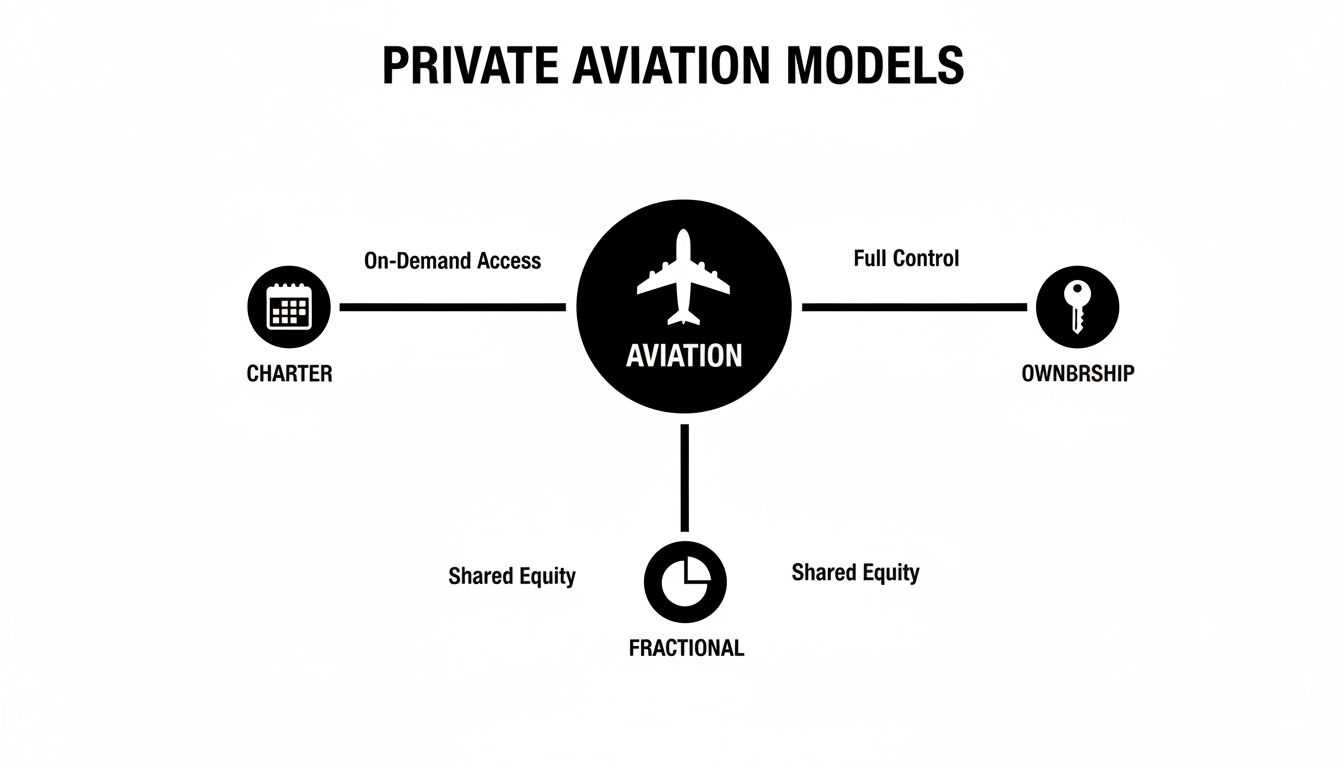
As you can see, the financial commitment ramps up quickly as you move from simply booking a trip to owning the plane yourself.
On-Demand Charter: The Pay-As-You-Go Approach
On-demand charter is the most straightforward way to get started. You book a jet for a specific trip and pay for that flight—that’s it. No big upfront investment, no long-term contracts, just maximum flexibility.
But that flexibility can come with some financial whiplash. Prices can swing wildly based on aircraft availability, seasonal demand, and your specific route. You also have to watch out for "hidden" fees that can sneak up on you and inflate the final bill.
Keep an eye out for these common variable costs on charter flights:
- Repositioning Fees: If your plane isn't already at your departure airport, you're paying for it to fly there empty.
- De-icing: In colder weather, this is a non-negotiable safety step that can add anywhere from $1,500 to $15,000 to your bill, depending on the jet’s size.
- Crew Overnight Expenses: For trips spanning multiple days, you'll be covering the crew's hotel and meals, which often adds $200 to $600 per crew member, per day.
- Daily Minimums: Most charter operators bill for a minimum flight time each day, often 2 hours. So, if your flight is only 45 minutes, you’re still paying for two hours, making quick hops feel surprisingly expensive.
This model is a perfect fit for anyone flying less than 25 hours a year who values flexibility above all else.
Jet Cards: The Subscription Model
A jet card is essentially a prepaid debit card for flight hours. You buy a block of time—usually in 25-hour increments—on a specific class of aircraft, like a light or midsize jet. The upfront buy-in typically runs from $100,000 to over $250,000.
The real draw here is predictability. You lock in a fixed hourly rate, which makes budgeting a breeze and gets rid of the surprise fees that can plague on-demand charters. Jet cards also come with guaranteed availability, often with as little as 24 hours' notice.
But there's a trade-off for that convenience. The hourly rates for jet cards are almost always higher than average charter costs. That's because the provider is taking on the risk of fuel price spikes and the logistical headache of repositioning their fleet for you.
This path makes the most sense for people and businesses flying 25 to 50 hours a year who need guaranteed access and want to know exactly what they’re spending.
Fractional Ownership: The Co-Ownership Strategy
Fractional ownership is a serious step up in both commitment and investment. Here, you're not just booking a plane—you're buying a piece of one. A typical share ranges from 1/16th to a full 1/2 of a specific aircraft. A 1/16th share, for instance, gives you 50 hours of flight time a year.
The financial breakdown has a few different layers:
- Acquisition Cost: This is your one-time capital investment to buy the share, which can be anywhere from $500,000 to over $3 million.
- Monthly Management Fee: You'll pay a fixed fee every month to cover the plane's fixed costs, like crew salaries, hangar fees, and insurance.
- Occupied Hourly Rate: This is what you pay only when you're on board. It covers the variable costs for your specific trip, like fuel and in-flight maintenance.
You get many of the perks of being an owner—like a consistent, high-quality experience and guaranteed availability—but you’re also exposed to the inevitable depreciation of the aircraft. For savvy investors looking for a smarter way to fly, it's worth exploring the new fund-based private aviation solutions that give you similar access without the dead weight of a depreciating asset on your books.
Fractional ownership is tailored for those flying 50 to 200 hours per year who want an ownership-like experience without having to manage the entire aircraft themselves.
Whole Aircraft Ownership: The Ultimate Commitment
Owning your own aircraft gives you a level of freedom and control that no other model can touch. The jet is yours, ready to go whenever and wherever you are. But this freedom comes with the highest possible financial outlay and a massive operational burden.
The upfront cost to buy a new jet, which can range from $3 million to over $70 million, is just the price of admission. From there, you're on the hook for every single fixed and variable cost, which can easily top $1 million to $2 million a year for a midsize jet. We're talking about everything from hiring and managing your crew to scheduling maintenance and staying on top of complex FAA regulations.
On top of all that, whole ownership puts you face-to-face with the harsh reality of aircraft depreciation. Your multi-million dollar asset will likely lose 5-10% of its value every single year. This path really only makes financial sense for those flying more than 200-400 hours annually—individuals and corporations for whom total control and absolute availability are non-negotiable.
The Financial Drag of Whole Aircraft Ownership
Owning a private jet is often held up as the ultimate symbol of success. For a sophisticated investor, though, it’s more accurately viewed as a major financial liability—an asset that consumes capital instead of creating it. The true cost of flying private via whole ownership goes far beyond the initial purchase price; it’s a relentless financial drain that demands a sober, clear-eyed assessment.

The acquisition cost is just the first hurdle. A pre-owned light jet might start in the $1-2 million range, while new models can easily climb from $5 million to over $30 million. For those at the top of the market, flagship aircraft like the Gulfstream G700 can command staggering price tags north of $80 million. But that monumental upfront expense is really just the ticket to entry.
The Never-Ending Operating Costs
Once you own the aircraft, the real financial commitment truly begins. The fixed operating costs are constant and substantial, hitting your balance sheet whether you fly or not. Think of it like owning a high-performance supercar; the sticker price is just the down payment. The real expense comes from the specialized garage, the dedicated mechanic, and the eye-watering insurance premiums.
For a private jet, these annual fixed costs are staggering:
- Crew Salaries and Training: A full-time, experienced crew for a midsize jet can easily run $300,000 to $500,000 per year. This includes the mandatory, ongoing training required to maintain their certifications.
- Hangar Space: You need to protect your multi-million dollar asset from the elements. A dedicated hangar can cost anywhere from $50,000 to over $150,000 annually, depending on the airport's location and demand.
- Insurance: Comprehensive liability and hull insurance is non-negotiable and typically costs $60,000 to $200,000 or more per year.
- Scheduled Maintenance and Subscriptions: This bucket includes routine inspections, software updates, and avionics database subscriptions, which can easily add another $100,000+ to the annual bill.
All in, these fixed costs for even a light or midsize jet can total $1 million to $2 million every single year—before a single gallon of fuel is burned. This is the financial anchor that operates 24/7, pulling value from your bottom line.
The Silent Killer: Depreciation
While operating costs are a constant drain, the most powerful and often underestimated force working against a jet owner is depreciation. Unlike real estate or a diversified stock portfolio, an aircraft is a fundamentally depreciating asset. From the moment it leaves the factory, it begins losing value.
A private jet typically loses 5% to 10% of its market value annually. This means a $20 million aircraft could be worth just $18 million after one year—a $2 million paper loss on top of all your operating expenses.
This erosion of capital is relentless. The market for private jets is also notoriously volatile. During the post-pandemic buying frenzy, pre-owned prices sometimes shot past new list costs due to sheer scarcity. But that bubble has burst. By mid-2025, the market had cooled significantly, with average asking prices for business jets dropping 9% year-over-year. You can get more details on the shifting trends of private jet prices on StratosJets.com. This volatility adds another significant layer of financial risk for owners.
Understanding the Opportunity Cost
This is where the concept of opportunity cost becomes absolutely critical for any high-net-worth investor. The capital tied up in a private jet—let's say $20 million for the purchase and another $1.5 million annually for operations—is capital that is not working for you.
Imagine that same $20 million was instead invested in a diversified portfolio with a conservative 7% annual return. That capital would generate $1.4 million in growth in its first year alone. In stark contrast, the jet owner not only forgoes that potential gain but also spends another $1.5 million just to maintain their depreciating asset.
The total financial swing between these two scenarios is immense. The investor sees a $1.4 million gain, while the jet owner experiences a $1.5 million cash outflow plus a $2 million depreciation loss. That’s a negative swing of $4.9 million in just one year. This is the true, hidden cost of flying private through whole ownership: it's not just what you spend, but the compounding growth you sacrifice.
Turning Aviation Expenses into an Investment Strategy
For decades, the conversation around private aviation has been framed as a pure expense—a luxury that consumes capital. But a smarter, more modern approach is flipping that equation on its head. Instead of sinking money into a depreciating asset like an aircraft, what if you could invest that capital, let it grow, and still have on-demand access to a premium jet fleet?
This strategy reframes private aviation as a component of your larger investment portfolio. It’s a shift in mindset from simply spending money on travel to strategically allocating capital in a way that preserves wealth while delivering the incredible convenience of private flight.

The Aviation Fund: A New Model
Think about how a real estate investment trust (REIT) works. You don’t buy a single building; you invest in a professionally managed fund that holds a diverse portfolio of properties. This gives you exposure to the real estate market's potential upside without the headaches of being a landlord.
An aviation fund operates on a very similar principle. You contribute capital to a professionally managed fund, and in return, you get access to a fleet of premium, modern jets. Here's the critical difference: your capital isn't spent. It’s invested. It remains your asset, working for you within the fund, while you draw upon its value to access world-class private travel.
This model fundamentally changes the cost of flying private because it separates the act of flying from the financial drag of direct ownership.
How It Differs from Fractional Ownership
At first, this might sound like a more complex version of fractional ownership, but the financial mechanics couldn't be more different. The key distinction is where your capital goes and what it does for you.
- Fractional Ownership: You buy a direct share of a specific, depreciating aircraft. Your capital is locked into a single, illiquid asset that loses value every year. You are directly exposed to its financial decay.
- Aviation Fund: You invest in a diversified fund. Your capital is put to work in a portfolio of assets, completely insulated from the depreciation of any single aircraft.
This is the core advantage: Your investment is no longer tethered to a piece of machinery that is guaranteed to lose value. Instead, your capital is placed in a structure designed for preservation and potential growth, while still unlocking the benefits of private jet access.
This structure also solves some of the other major pain points that come with ownership.
Shedding Liability and Recapturing Capital
Two of the biggest financial drags of traditional ownership—even fractional—are operational liability and the difficulty of getting your money back out. An aviation fund is designed to solve both problems.
1. Eliminating Operational Liability
When you own a share of an aircraft, you also own a share of its problems. Unexpected maintenance, regulatory compliance, and crew management all land on your balance sheet. In a fund model, the professional management team handles all of that. You have zero direct liability, freeing you to focus on your travel, not the aircraft's maintenance schedule.
2. Ensuring Capital Return
Selling a fractional share can be a slow, frustrating process, often forcing you to sell at a significant loss in a depreciated market. With a professionally managed fund, your capital isn't trapped. When you decide to exit, your initial investment is returned to you, subject to the fund's performance.
This approach transforms private aviation from a sunk cost into a strategic, liquid investment. It allows savvy individuals to enjoy the highest levels of service and access without compromising their core financial principles of capital preservation and growth.
Unlocking Tax Advantages with Modern Aviation
When we talk about the cost of flying private, it's easy to see it as just another line-item expense. But for savvy investors, the conversation is shifting. The right private aviation model can actually become a powerful tool in your overall wealth management strategy.
Think of it less as a cost and more as a strategic financial decision. Certain modern structures are built to integrate directly into a sophisticated financial plan, unlocking some pretty significant tax and accounting benefits. It's about making your capital work smarter, not just getting from point A to point B.
Two strategies, in particular, can turn what would normally be a sunk cost into a real opportunity for preserving and growing wealth: deferring taxes and using strategic deductions.
Contribute Appreciated Stock and Defer Capital Gains
For investors holding a highly appreciated asset, like stock in a company that's done incredibly well, this is a game-changer.
Let's say you're sitting on $5 million worth of stock that you originally bought for $1 million. If you sell it on the open market to fund your flights, you’ll immediately face a hefty capital gains tax on that $4 million profit. With federal rates at 20% and state taxes on top, you could easily see over $1 million vanish before you ever book a flight.
Here’s a much smarter way. By contributing that appreciated stock directly into a qualified aviation fund, you can defer the capital gains tax. This means the entire $5 million—your full, pre-tax principal—gets put to work inside the fund. You draw down flight credits as needed, all while the original investment continues to grow.
It's a fundamental principle of wealth management: deferring a tax liability allows you to keep your capital compounding for longer. This isn't just about a one-time saving; it's about maximizing your asset's power over the long haul.
This approach lets you tap into the value of your assets for travel without being forced into a taxable event. It's an incredibly efficient use of capital compared to the old-school "sell-and-spend" method.
Leverage Bonus Depreciation for Substantial Deductions
The other major financial lever is bonus depreciation. This is a powerful tax incentive that allows a business to write off a large chunk of an asset's cost in the very first year, instead of spreading it out over a long depreciation schedule.
Historically, whole aircraft owners have used this, but it comes with a massive headache. They have to prove legitimate business use to the IRS, which is a notorious audit trigger. It's a high-risk, high-compliance game. Concepts like capital allowance deductions are central to this, but the personal burden is immense.
This is where modern aviation funds offer a much cleaner path. By investing in the fund, you can access these powerful deductions without taking on the personal liability or the nightmarish compliance work of direct ownership.
Here's how it might play out:
- An investor contributes $2 million to a fund.
- The fund's structure is designed to pass through bonus depreciation benefits to the investor.
- This can generate a significant "paper loss," which can then be used to offset other active income from sources like a K-1 partnership or another operating business.
For a high-income earner, a deduction of that size can translate into hundreds of thousands of dollars in real tax savings in a single year. Suddenly, the net cost of flying private looks very different. The investment has transformed from a simple travel expense into an intelligent tool for reducing your tax burden across your entire portfolio.
To get into the nitty-gritty of how this works, check out our full guide to private jet tax advantages.
Finding the Right Private Aviation Fit for Your Portfolio
Deciding how to fly private isn't just a travel decision—it's a significant financial one that needs to mesh with your broader investment strategy. The right answer isn't a one-size-fits-all solution; it hinges entirely on your specific financial situation and what you're trying to achieve.
A tech founder sitting on a mountain of appreciated stock, for example, has a completely different set of considerations than a family office manager protecting multi-generational wealth or a CEO who needs to be in three cities in two days.
The real question isn't just "how much does it cost?" but rather, "what's the smartest way for me to fly private?" It’s about matching the model to your primary financial goal, whether that’s maximizing tax efficiency, preserving capital, or simply having predictable travel costs.
Matching the Person to the Plane
Let's look at how this plays out for a few common high-net-worth profiles. You'll quickly see how one aviation model can be a brilliant move for one person and a financial misstep for another.
-
The Tech Founder with Concentrated Equity: Imagine holding a massive position in a single, highly appreciated stock. Cashing out shares to pay for on-demand charters would trigger a painful capital gains tax bill. For this individual, an aviation fund that accepts stock contributions is a game-changer. It allows them to defer that tax event and put the full value of their equity to work for their travel.
-
The Family Office CIO: The chief investment officer of a family office has one core mandate: protect and grow wealth. The last thing they want is to tie up capital in an unproductive, rapidly depreciating asset like an aircraft. For them, whole or fractional ownership is a non-starter. A fund-based model, which shields their capital from depreciation and provides a clear exit path, is by far the more prudent financial choice.
-
The C-Suite Executive: This person needs reliable, on-demand access for business travel and, crucially, predictable costs that fit into a corporate budget. A jet card is a traditional option, but a more modern aviation fund can offer that same budget certainty without simply locking up capital as a prepaid expense. It provides a much better long-term value.
In each of these cases, the most financially savvy decision points away from traditional ownership. Newer fund structures deliver the premium access these travelers demand without the heavy financial drag and liability that comes with owning the plane yourself.
By aligning your choice with your financial big picture, your private aviation solution becomes more than just a luxury expense. It becomes a sound component of your overall wealth management strategy, supporting both your travel needs and your long-term financial health.
Answering Your Questions About Private Jet Costs
Getting into the specifics of private jet costs always brings up a few common questions. Let's tackle them head-on to give you a clearer picture and help you figure out what makes the most sense for you.
What Are the Biggest Hidden Costs in Private Aviation?
When you charter a jet, the sneakiest costs are often repositioning fees—that's when you have to pay for the plane to fly empty to pick you up. You'll also see unexpected bills for de-icing in cold climates and extra handling fees on international trips.
For those who own the whole aircraft, the real shockers come from unscheduled major maintenance events, government-mandated equipment upgrades, and the brutal reality of aircraft depreciation, which is almost always steeper than people expect.
A good rule of thumb in the industry is that full ownership only starts to pencil out if you're flying upwards of 400 hours a year. Anything less, and the crushing weight of fixed costs makes other options far more sensible.
Is It Cheaper to Charter or Buy a Jet Card?
If you fly infrequently—say, under 25 hours a year—and your schedule has some wiggle room, booking on-demand charters trip-by-trip will almost always be cheaper.
However, once you cross into the 25-50 hour range, a jet card starts to look much more attractive. You'll pay a higher rate per hour, but in return, you get guaranteed access and locked-in pricing, which offers predictability and peace of mind that chartering just can't match.
How Does Bonus Depreciation Work with Private Jets?
Bonus depreciation is a powerful tax tool that lets a business write off a huge chunk of an asset's cost in the very first year. For a private jet, this can create a massive tax deduction.
The catch? The IRS is incredibly strict about what counts as legitimate business use. For an individual owner, the paperwork and compliance needed to prove it can be an absolute nightmare.
This is where modern aviation funds really shine. They are structured specifically to help members legally qualify for these tax benefits to offset other income, but without the headache. The fund handles the complex compliance, making it a much safer and more accessible strategy for smart investors.
Ready to align your travel needs with a smarter investment strategy? With Craft Pod, you can enjoy on-demand access to a premium fleet without the financial drag of ownership. Discover how our innovative fund model preserves your capital and unlocks significant tax advantages by visiting us at https://flycraft.com.