
Ownership Cost
The Investment Value of Fractional Jet Ownership
Fractional jet ownership allows you to buy a piece of an actual plane.
 Israel SlodowitzFounder & CEOUpdated February 3, 2026 · Published January 21, 2026 · 4 min read
Fractional jet ownership allows you to buy a piece of an actual plane. Because you’re putting money into a tangible asset, your share will have value even after you’ve exhausted the terms of your agreement.
But how much value?
What is the actual financial reality of owning a fraction of a jet? Particularly in terms of return?
In this article, we take a comprehensive look at how fractional plane ownership can function as an investment as well as a luxury.
Is Fractional Jet Ownership a Sound Investment?
Short answer? It really depends. There is arguably an intangible value in the access and convenience that fractional jet ownership provides.
If you require, for example, high levels of access to rapid private transportation in a business context, the monetary value of fractional jet ownership as a tool could be very high. However, that is a subjective value that is difficult to apply in most cases.
From a more straightforward angle, does fractional jet ownership work as an investment? In other words, will the money that you put into your jet share increase with time? T
he answer to that is almost certainly no. Private planes, particularly those that are used heavily, tend to depreciate in value quite rapidly.
By the time you are ready to sell your share of a jet fraction, the value could easily have decreased by 30-40%.
Some services will allow you to sell unused airtime, which can offset some of the costs, but not to the extent that the arrangement becomes profitable.
This is particularly true when you take into account monthly maintenance fees, relocation fees, the federal excise tax, and the cost of occupied airtime, which in and of itself can cost five figures per hour.
For an investment in private aviation to truly be considered profitable, you would not only need to see the value of your share in the plane increase with time, but increase to the point that it outpaces the monthly maintenance expenses as well as the cost of airtime. That is a tall order and one that no service can quite match.
Does that mean that fractional jet ownership is not a good fit for you? Not necessarily. There are lots of reasons that people choose to buy a fraction of a plane.
In the next couple of headings, we will take a look at how the arrangement works and why it could still be a fit, even if it is not, traditionally speaking, a good way to make money.
Fractional Jet Ownership Overview
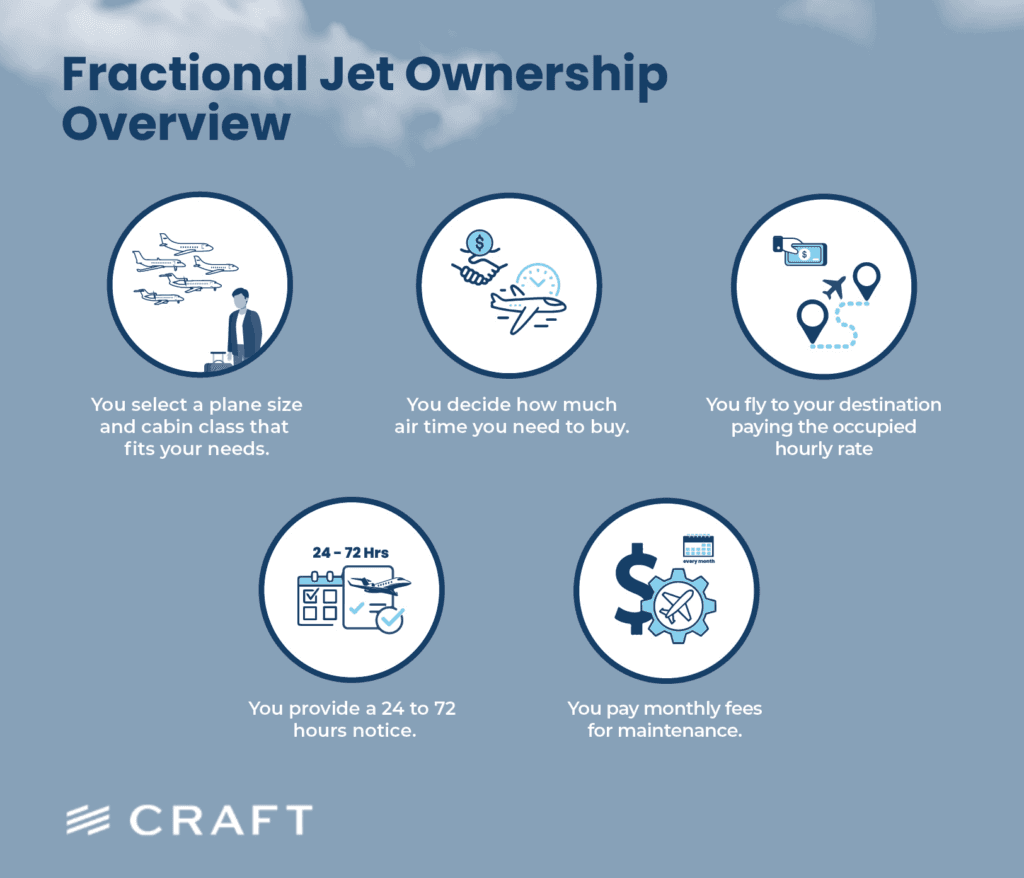
The way most fractional jet ownership programs work is this:
- You select a plane size and cabin class that fits your needs.
- You decide how much time you need in the air and buy a fraction of a plane proportionate to that number. For example, 1/16th of a share for 50 hours, 1/8th of a share for 100 hours, and so on.
- You buy into the plane with an initial deposit and pay monthly fees for maintenance. That includes plane upkeep, hangar upkeep, storage costs, crew training, and so on.
- You provide notice, typically of 24 to 72 hours for when you wish to use the plane.
- You fly to your destination paying the occupied hourly rate, which is typically proportionate to the make and model of the plane. Bigger planes cost more to fly.
Even though you are buying into a single plane, you’ll most likely use many different ones during the course of your five-year agreement.
This is because most fractional jet ownership providers have a large fleet and they prioritize access to the nearest plane, cutting back on relocation time and lead time requirements. The plane that you receive will be identical to the one you bought into and may even feature the same pilot and crew.
The Best Way to Fly Privately
Traditional fractional jet ownership programs are convenient and possibly superior to buying a jet card or chartering flights on an individual basis.
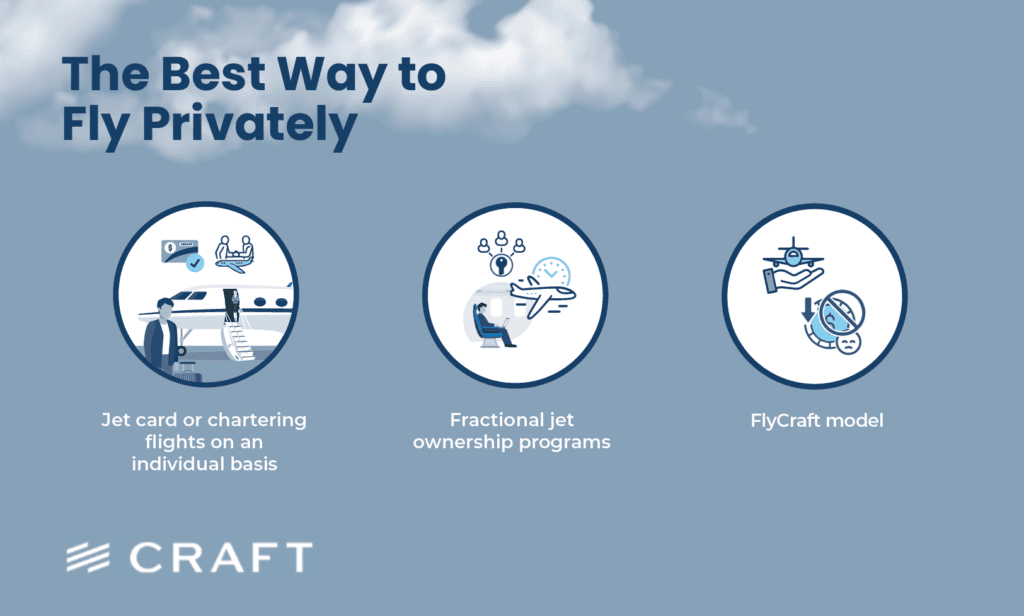
That will depend on your utilization needs. If you fly for 50 hours a year or more privately, a fractional ownership arrangement most likely is advantageous.
That said, the legacy model of fractional ownership is less efficient than it could be as a financial instrument. At Craft, we’ve changed up the model to provide the same level of convenience and access without the downside, with less risk for a significant economic downside.
How Craft Works
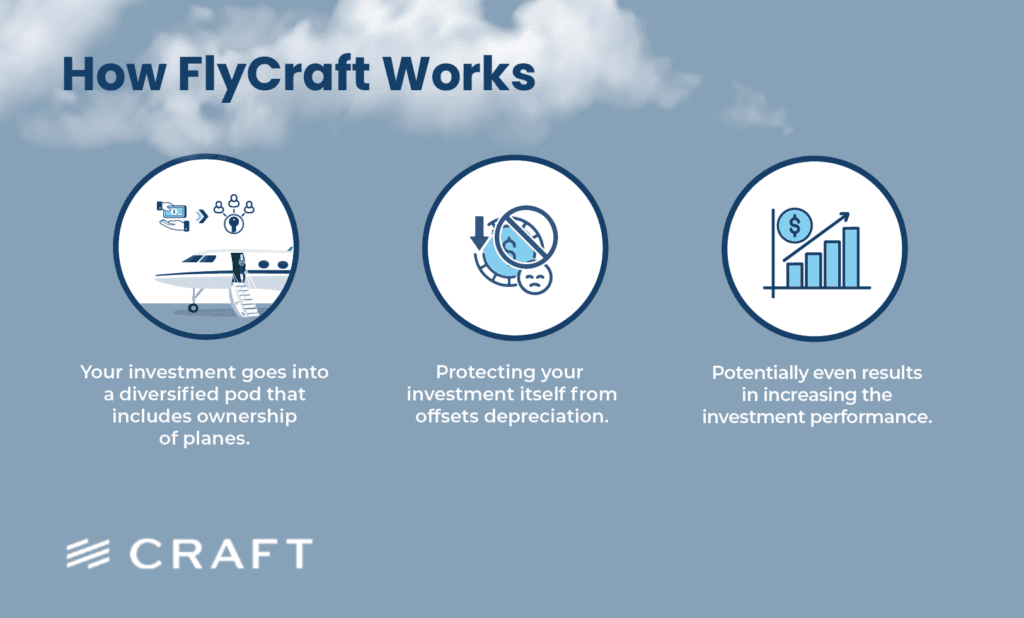
At Craft, we put your investment into a diversified pod that includes ownership of planes, along with other financial products that have the potential to increase in value.
The diversification of your investment itself offsets depreciation and potentially even results in an upside depending on the investment performance.
This unique structure takes some of the financial risk out of fractional ownership, while providing what typically equates to the same experience for most people.
If you’re interested in learning more about how Craft has improved upon the fractional jet ownership model, book a call with us today.
Not only will we explain in greater detail how the investment pod works, but we’ll also answer any questions you have about our fleet, our cabin class, our lead times, our fee structure, our booking requirements, and more.
Frequently asked questions
What is the investment value of fractional jet ownership?
Fractional jet ownership allows multiple owners to share aircraft ownership, resulting in lower upfront costs compared to full aircraft ownership or outright ownership. While the asset value of a fractional jet typically declines over time, the ownership model provides guaranteed access to private aviation with significant cost savings versus sole ownership. The value is often realized through access, efficiency, and predictable operating costs rather than appreciation.
Is fractional jet ownership cheaper than private jet ownership?
Fractional ownership programs generally have a lower initial purchase price and lower upfront investment than full jet ownership. Fixed costs like the monthly management fee are shared among fractional owners, reducing the full cost of private jet travel. However, variable costs such as fuel costs, landing fees, and occupied hourly fees still apply.
How do operating costs affect the investment?
Ongoing expenses include monthly management fees, hangar fees, crew salaries, maintenance programs, fuel surcharges, and other operational expenses. These operating costs mean fractional aircraft ownership is not designed to generate profit or increase market value over time. Instead, the investment trades appreciation for predictable private aviation services and access.
How many flight hours make fractional ownership worthwhile?
Fractional jet ownership is best suited for aircraft owners who fly frequently, typically 40–50 flight hours or more per year. For fewer hours, jet cards or jet card programs may offer better cost savings and flexibility. The number of flight hours is one of the key factors that influence whether fractional shares make financial sense.
Does fractional jet ownership hold its market value?
Most fractional jets depreciate, meaning the market value of the aircraft declines over time regardless of aircraft type or aircraft model. While unused hours or empty leg flights can sometimes offset costs, they rarely reverse depreciation. As an asset, fractional jet ownership prioritizes access over long-term asset growth.
How does fractional ownership compare to alternative solutions?
Compared to jet cards, charter flights, or private aviation memberships, fractional programs offer guaranteed access to a same aircraft type with fewer scheduling conflicts. They provide more consistency than on-demand charters without the complete control and high operational burden of whole jet ownership. For private travelers who value flying privately with predictable costs, fractional ownership remains a strong middle-ground option.
Related
Related guides
- Fractional Shares Explained: Choosing the Right Shares for Your Annual Flight Hours
- Fractional Ownership vs. Long-Term Leasing: Comparing Commitment and Financial Risk
- What is Fractional Jet Ownership?
- A Guide to Private Jet Fractional Ownership Costs
- Fractional Ownership vs. Whole Plane Ownership: Which Offers the Most Control?
Read next
NetJets Fractional Ownership: Costs, Fleet, Pros & Cons (2026 Guide)
Complete guide to NetJets fractional ownership — pricing from 1/16 shares to jet cards, fleet details, management fees, hourly rates, and how it compares to…
April 10, 2026 · 5 min read
Fractional Jet Ownership Companies Compared
The main fractional jet ownership companies, how their shares, monthly fees and hourly rates work, what each one publishes about its jet cards, and how to compare them.
October 4, 2026 · 9 min read
The Ultimate Private Aviation Comparison: Fractional, Charter, Jet Card, and Whole Ownership
There are lots of ways to fly privately. All of them come at different price points while also providing different levels of access, convenience, and required…
February 3, 2026 · 6 min read


Charter Sales
Tell us the trip. We'll tell you the number.
Route, dates, rough timing, how many people. That is enough to start, and you get a firm price for that specific trip rather than a range.
Text us and you'll get a reply within 60 seconds, any hour.