
Ownership Cost
Fractional Shares Explained: Choosing the Right Shares for Your Annual Flight Hours
Fractional jet ownership programs are an elegant solution to the travel requirements of a certain class of flyer—people who prioritize access, convenience…
 Israel SlodowitzFounder & CEOUpdated February 3, 2026 · Published January 21, 2026 · 4 min read
Fractional jet ownership programs are an elegant solution to the travel requirements of a certain class of flyer—people who prioritize access, convenience, and comfort when making travel arrangements. If you fly private regularly, fractional ownership is often a more financially sensible and practically convenient way to get around than chartering individual flights.
Once you decide on fractional ownership as a solution to your travel requirements, there are still many other considerations that require your attention. What level of ownership is appropriate for you? In this article, we take a look at how fractional ownership agreements work and what steps you should take to select the ownership tier that is appropriate for your needs.
Fractional Ownership Overview
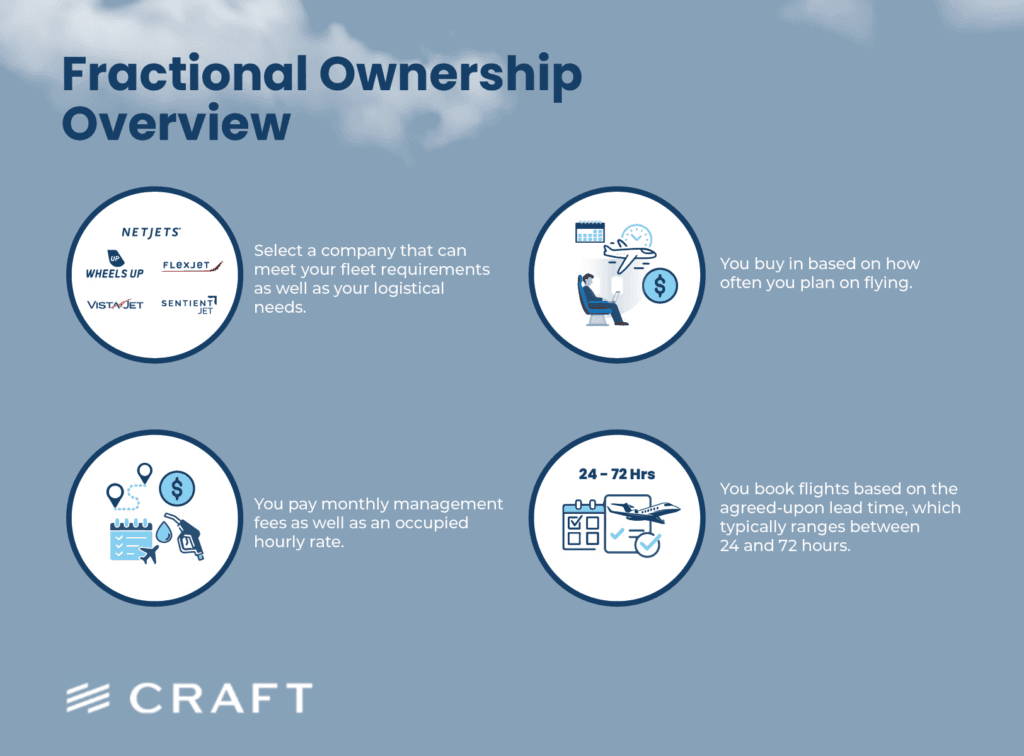
Before we get into how the hourly allotments work, here’s an overview of how fractional ownership programs function:
- You review your provider options and select a company that can meet your fleet requirements as well as your logistical needs.
- You buy in based on how often you plan on flying.
- You pay monthly management fees as well as an occupied hourly rate.
- You book flights based on the agreed-upon lead time, which typically ranges between 24 and 72 hours, though it can fluctuate.
Fractional ownership agreements typically have a contract length of five years. After that point, you can renew your agreement and continue with the program or sell your share of the plane for the price you paid minus the depreciation that occurred over the previous five years.
It’s important to keep in mind that even though you are buying into a specific plane, you’re not actually going to use the same vehicle every time you fly. The vast majority of fractional jet providers maintain a large fleet of similar aircraft. Rather than sending you your specific plane, they send one of the cabin class that you bought into that is located nearest to you. This allows providers to minimize repositioning costs and get you to your destination as quickly as possible.
Some services will allow you to request specific catering, crew, or even a familiar pilot, though your ability to make these requests will vary based on the service and availability.
Who Are Fractional Ownership Programs Right For?
The type of traveler who considers fractional ownership programs is typically deciding between several exclusive methods of transportation:
- Fractional ownership
- Jet card programs
- Chartering a flight
- Buying a plane outright
Of these choices, the ideal fit will depend on how often you fly and how turnkey you want your experience to be. If you fly only one or two times per year, chartering a plane is the most sensible way to manage your travels. If you fly between 10 to 30 hours a year, a jet card will be similarly advantageous. In this case, you’re essentially subscribing to a chartering service, guaranteeing your rate and your accessibility when you need it.
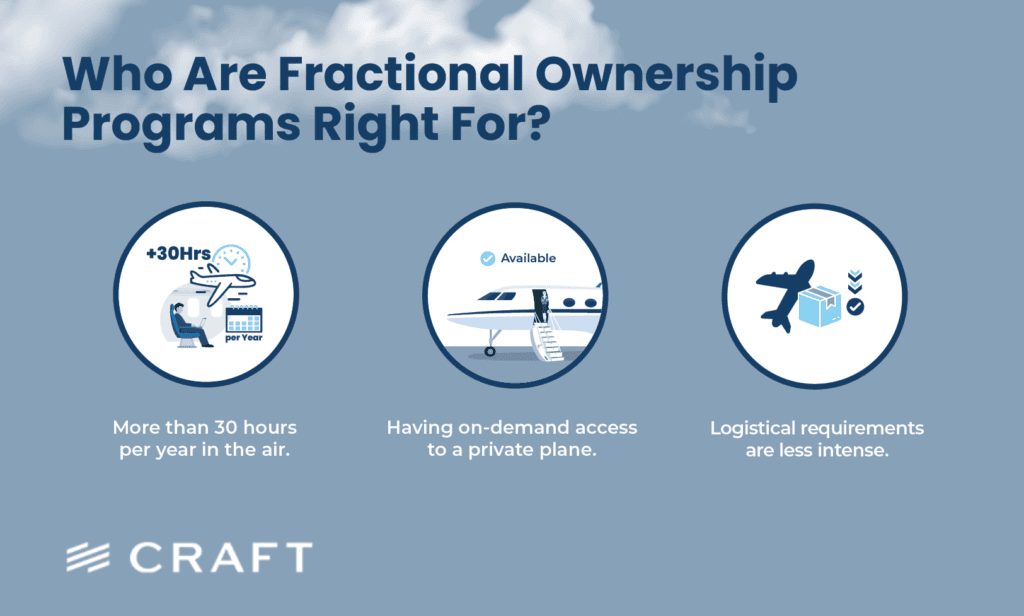
Once you get past 30 hours per year in the air, your choices begin to get a little more complicated. At this tier of travel, fractional or complete ownership is going to be your best bet.
Exclusive plane ownership is ideal for people who need unrestrained access to their plane, sometimes with as little as a few hours’ notice. A business executive who regularly takes high-value meetings across the country at a moment’s notice is a good example. Though exclusive plane ownership can be a good fit for anyone who wants easy, convenient travel, fractional ownership is a comparable but less financially intensive alternative.
Through a fractional ownership program, you still have on-demand access to a private plane that belongs at least in part to you. However, you’re not completely financially responsible for it. The costs are lower, and the logistical requirements are less intense. At this stage, your primary objective is simply to determine how much of a plane you need to own.
Deciding on Your Fractional Ownership Share
Fractional ownership shares typically begin at 1/16 of a plane and can be doubled from that point. A 1/16 share can range in price from several hundred thousand to several million dollars, depending on your cabin class.
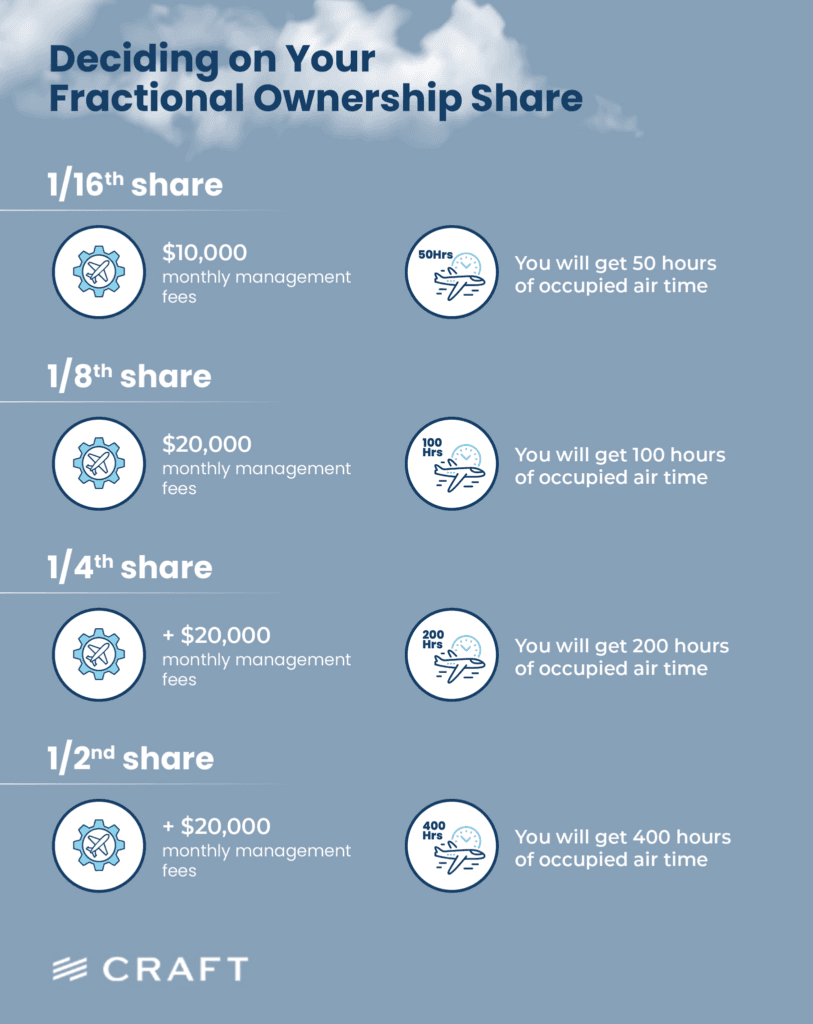
In most cases, a 1/16 share purchases you 50 occupied air hours—that is, time spent in the plane itself. Occupied hourly allotments are not usually diminished by repositioning requirements. A 1/16 share is typically adequate for people using their jet for private travel or to move between properties, allowing for approximately 10 round-trip domestic flights per year. It’s a fairly comprehensive solution for most casual travelers.
If you’re using your plane for business or for more expansive travel, you may consider a 1/8, 1/4, or even 1/2 share of a plane. Each tier of ownership doubles your allotment of hours. For example, a 1/8 share gives you 100 occupied hours, a 1/4 share gives you 200 occupied hours, and a 1/2 share gives you 400 occupied hours.
Larger shares not only come with a higher buy-in cost but also increase your monthly management fees. At the 1/16 ownership tier, monthly management fees might be around $10,000. At the 1/8 tier, however, they rise to about $20,000, and so on.
Can You Sell Unused Hours?
The ability to sell unused hours varies from provider to provider. Some fractional ownership programs, like Flexjet, are noted for an internal user-based marketplace through which you can put your hours up for sale.
Typically, the sale price is not enough to make ownership profitable, but it may help offset the expense of buying more hours than you require. Certainly, the ability to sell unused hours can provide a bit more flexibility and leeway. That said, from a financial perspective, it’s generally best to buy approximately the same amount of hours that you plan on using.
Frequently asked questions
Related
Related guides
- The Investment Value of Fractional Jet Ownership
- What is Fractional Jet Ownership?
- The Ultimate Private Aviation Comparison: Fractional, Charter, Jet Card, and Whole Ownership
- Fractional Ownership vs. Whole Plane Ownership: Which Offers the Most Control?
- Fractional Ownership vs. Long-Term Leasing: Comparing Commitment and Financial Risk
Read next
Jet Cards
Flexjet vs Craft: Fractional Shares vs a Fixed-Rate Card
Between FlexJet and Craft, both private aviation services, there are actually three distinct models of transportation.
February 3, 2026 · 5 min read
NetJets Fractional Ownership: Costs, Fleet, Pros & Cons (2026 Guide)
Complete guide to NetJets fractional ownership — pricing from 1/16 shares to jet cards, fleet details, management fees, hourly rates, and how it compares to…
April 10, 2026 · 5 min read
Fractional Jet Ownership Companies Compared
The main fractional jet ownership companies, how their shares, monthly fees and hourly rates work, what each one publishes about its jet cards, and how to compare them.
October 4, 2026 · 9 min read


Charter Sales
Tell us the trip. We'll tell you the number.
Route, dates, rough timing, how many people. That is enough to start, and you get a firm price for that specific trip rather than a range.
Text us and you'll get a reply within 60 seconds, any hour.