
Jet Cards
Finding the Best Private Jet Membership Programs in 2026
Discover the best private jet membership programs. Compare jet cards, fractional ownership, and modern investment models to find the perfect fit for your needs.
 BenedictPrivate Aviation ConsultantUpdated January 21, 2026 · Published January 9, 2026 · 17 min read
When you start looking for the best way to fly private, you quickly realize it's about much more than just convenience. It’s a serious financial decision. The best programs aren't just about luxury; they're about capital efficiency, tax strategy, and protecting your assets. It’s less about paying for a flight and more about making a smart investment that fits into your overall wealth management.
A Modern Guide to Private Aviation
The world of private aviation has changed a lot. It used to be a simple choice: charter a plane or buy one. Now, you’ve got a whole menu of options, each built for different financial situations and travel needs. Savvy flyers aren’t just buying hours in the air anymore; they’re making complex financial choices where the hourly rate is just one piece of the puzzle.
You have to look at the entire financial picture. This means thinking about the initial cash you’ll put down, how much you're exposed to the jet’s depreciation, and what your operational liabilities are. The goal is to find a program that truly fits, whether you fly 25 hours a year or over 200.
This evolution has created a clear spectrum of choices:
- On-Demand Charter: The most straightforward option. You pay as you go, with no upfront commitment.
- Jet Cards: You prepay for a block of flight hours, which gives you guaranteed rates and availability.
- Fractional Ownership: You buy an equity share in an aircraft, getting some of the benefits of ownership, including potential tax advantages.
- Full Ownership: You have total control, but also full responsibility, for an aircraft.
- Exchange-Fund Models: A new, investment-first approach that offers tax efficiency and asset diversification.
These models have turned private jet access from a simple luxury into a significant asset class. The global market for jet card memberships alone was valued at around USD 10.2 billion in 2024. It’s expected to more than double to USD 21.4 billion by 2033, growing at a compound annual growth rate of 8.7%. North America is at the heart of this growth, driven by a high concentration of corporate travelers and wealthy individuals looking for smarter aviation solutions. You can find more insights on the jet card market's growth on dataintelo.com.
The table below gives you a quick snapshot to frame your thinking before we dive into the details of each model.
| Access Model | Capital Efficiency | Tax Implications | Flexibility |
|---|---|---|---|
| On-Demand Charter | High (Pay-per-flight) | Limited | High |
| Jet Cards | Medium (Upfront deposit) | Generally limited | Medium |
| Fractional Ownership | Low (Significant capital) | Potential for depreciation | Low |
| Exchange-Fund | High (Investment-focused) | Significant tax deferral | High |
Comparing Private Jet Access Models
Choosing how to fly private is a major decision. Each access model strikes a different balance between cost, control, and complexity, and the best programs are rarely a one-size-fits-all solution. To find the right fit, you have to look past the flashy hourly rates and really dig into the underlying financial structure of each option.
This comparison goes beyond a simple pros-and-cons list. We'll evaluate each model based on the criteria that matter most to a sophisticated buyer: the initial capital outlay, exposure to operational liability, potential for tax efficiency, and the risk of asset depreciation. Getting these details right is the key to making a smart decision that complements your broader wealth strategy.
On-Demand Charter: The Pay-As-You-Go Approach
On-demand charter is the most straightforward entry point into private aviation. It works like an airborne Uber—you book a specific plane for a specific trip with no long-term commitment or upfront investment. This approach gives you ultimate flexibility, letting you choose the perfect aircraft for each mission, whether it's a quick hop in a light jet or a transatlantic flight in a heavy one.
But that flexibility comes with a price. Charter rates are tied to market demand, so costs can skyrocket during peak seasons or for last-minute bookings. You also give up consistency. Since you're booking from a wide-open market of operators, the quality of the aircraft, crew, and service can vary significantly from one flight to the next.
Jet Cards: Guaranteed Access, Prepaid
Jet cards are a step up in commitment, offering a more predictable and reliable experience. You prepay for a block of flight hours—typically 25 or 50—at a fixed or capped hourly rate. This locks in your pricing and guarantees you'll have an aircraft ready, often with as little as 24-48 hours' notice.
While jet cards eliminate the price volatility of the charter market, they require a hefty upfront deposit, often starting around $150,000. It's important to remember that this money is a prepaid expense, not an investment, and it offers almost no tax advantages. This model is a great fit for those who fly 25-50 hours a year and value budget certainty above all else.
Fractional Ownership: The Equity Model
Fractional ownership demands a much larger commitment because you're actually buying an equity share in a specific jet. This purchase entitles you to a certain number of flight hours each year, usually starting at 50 hours for a 1/16th share. As a part-owner, you unlock some of the benefits of whole ownership, including potential tax advantages like bonus depreciation.
The catch? A massive capital outlay that can easily exceed $1 million, plus ongoing monthly management fees to cover the crew, maintenance, and insurance. On top of that, you're directly exposed to the aircraft's depreciation, which can be a significant financial drain over time.
Full Ownership: Ultimate Control, Ultimate Responsibility
Owning your aircraft outright gives you total control and unparalleled freedom. The jet is yours to use whenever and however you see fit, with complete say over its interior, crew, and operations. For those flying more than 200-300 hours per year, it can even become the most economical option on a per-hour basis.
However, the financial and operational burdens are immense. The purchase price is just the beginning. You're on the hook for all fixed and variable costs—crew salaries, hangar space, insurance, and constant maintenance. Full ownership means shouldering 100% of the asset's depreciation risk and the headaches of managing a complex aviation operation.
As the industry has matured, the conversation around private aviation has shifted. It's no longer just about convenience; it's a strategic financial decision.
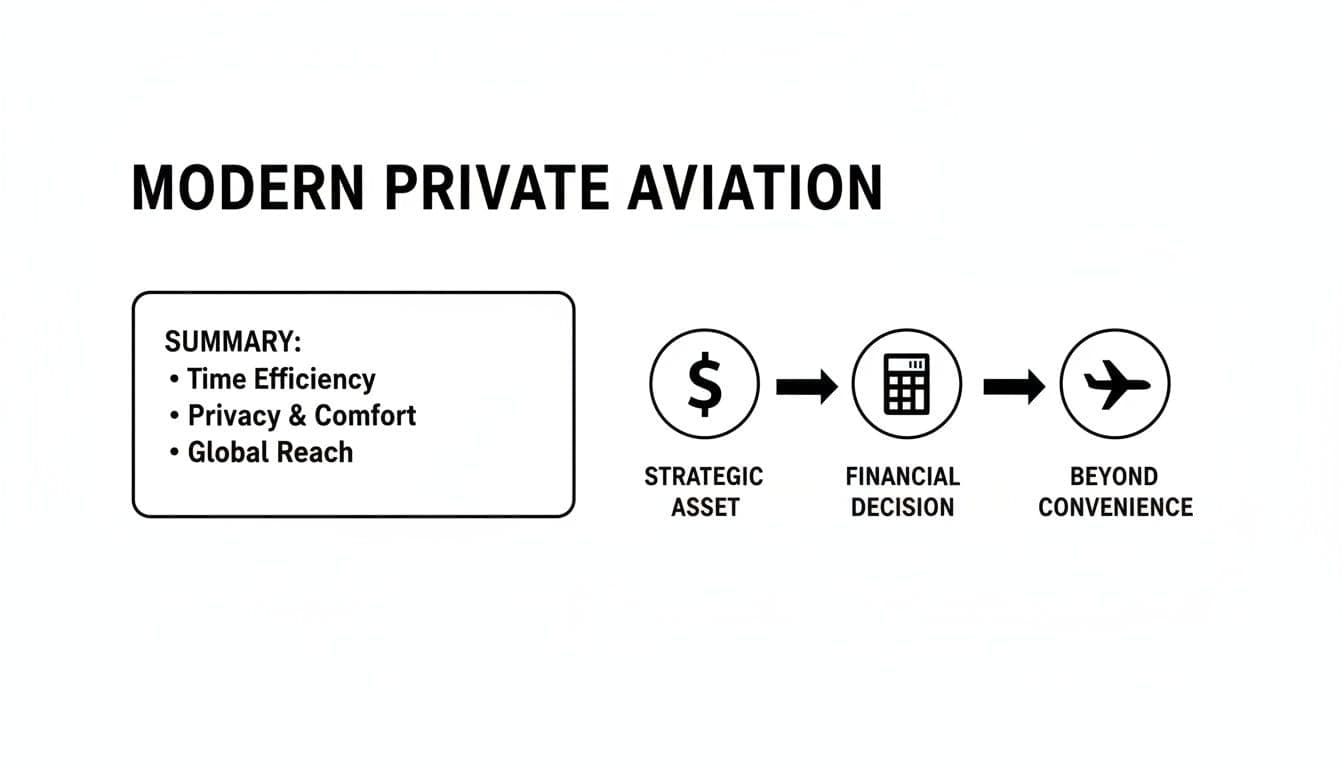
This evolution demands a closer look at programs as strategic assets, weighing their financial implications just as heavily as their travel perks.
The Exchange-Fund Model: An Investment-First Alternative
A newer model completely reframes the question of private jet access, treating it as an investment rather than a sunk cost. With an exchange-fund, members contribute capital or appreciated securities into a diversified fund that holds a portfolio of assets, including stakes in private aircraft. The entire structure is built for tax efficiency and asset preservation.
For example, by contributing highly appreciated stock, members can often defer the capital gains taxes they would have otherwise paid, allowing their full principal to be put to work. Flight access is based on the size of the contribution, but the member is shielded from direct aircraft depreciation and operational liability. Their capital remains in a professionally managed fund and is returned when they exit the program. You can explore how this investment-focused model works to see how it benefits tax-sensitive flyers.
This approach is a powerful fit for high-net-worth individuals, tech founders with concentrated stock positions, and family offices looking for a smarter way to fold private travel into their wealth management strategy. It marries the on-demand access of a top-tier flight program with the financial discipline of a sophisticated investment vehicle.
At-a-Glance Comparison of Private Aviation Models
To make these distinctions clearer, the table below summarizes the core financial and operational differences between the primary ways to access private aviation.
| Access Model | Typical Capital Outlay | Exposure to Depreciation | Tax Efficiency Potential | Operational Liability |
|---|---|---|---|---|
| On-Demand Charter | $0 | None | Very Low | None |
| Jet Card | $150k – $500k+ | None | Low | None |
| Fractional Ownership | $1M+ | High | High (e.g., bonus depreciation) | Shared |
| Full Ownership | $5M – $70M+ | Very High | Very High | Full |
| Exchange-Fund | $1M+ | None (Indirect) | High (e.g., tax deferral) | None |
This summary highlights the trade-offs at the heart of the decision. As you move from left to right across the models, the upfront capital and financial exposure increase, but so do the potential control and tax benefits. The key is finding the model that best aligns with your specific flight needs and financial situation.
Understanding the True Cost of Each Program
When you're comparing private jet programs, the advertised hourly rate is just the tip of the iceberg. It’s the starting point, not the destination. The real cost is a much more complex puzzle involving membership fees, taxes, and a whole slew of variable charges that can dramatically inflate your final bill. Getting this wrong can lead to some very expensive surprises, so a proper financial deep-dive is non-negotiable.
Let's put this into perspective with a real-world scenario. Picture a frequent flyer who needs 100 hours of flight time a year on a super-midsize jet. This is a pretty common profile for business leaders and high-net-worth families, and it puts them right at the crossroads of several access models, each with its own confusing and often opaque cost structure.
Unpacking the All-In Costs by Program
Once you start looking past the marketing brochures and into the fine print, that shiny hourly rate quickly gets buried under a pile of other fees. These hidden costs add up fast, and what initially looked like a good deal can easily become the most expensive option.
A typical jet card for that super-midsize jet might be advertised at $12,000 per hour. For 100 hours, simple math suggests a $1.2 million price tag. But not so fast. That price rarely includes the mandatory 7.5% Federal Excise Tax (FET), which immediately tacks on another $90,000. Then you have fuel surcharges, which can swing wildly with the market. It’s not uncommon for those to add another $100,000 or more, pushing your real-world cost closer to $1.4 million.
Now, let's look at fractional ownership for the same aircraft. This route demands a huge upfront capital investment—think $2 million for a 1/8th share. On top of that, you're on the hook for monthly management fees, which could be $20,000 or more, totaling $240,000 a year before you even step on the plane. Add the occupied hourly fee of around $6,000, and your 100 hours cost another $600,000. All in, your annual cash outflow is almost $850,000, and that doesn't even touch the initial capital you tied up in a depreciating asset.
Tax Implications A Major Differentiator
The financial picture gets even more interesting when you bring taxes into the equation. This is often the single biggest factor in the total cost of ownership, and the tax treatment from one model to the next couldn't be more different. This is where you can find either massive savings or no benefits at all.
For the most part, payments for jet cards and on-demand charters are treated like any other travel expense. You can write them off if they are for legitimate business use, but that’s where the advantages end. You're just paying for a service.
Fractional and whole ownership, on the other hand, unlock some powerful tax strategies. Because you physically own a piece of the asset, you may be able to use bonus depreciation. This allows you to deduct a huge chunk of the aircraft's purchase price in the very first year, creating a substantial paper loss that can offset other taxable income. For a high-income individual, this deduction can easily be worth hundreds of thousands of dollars, effectively slashing the net cost of your share.
Modern Models and Tax-Efficient Strategies
The private aviation world has been evolving, and new models have emerged specifically for the tax-sensitive flyer. These programs get that for many high-net-worth individuals, smart capital management and tax planning are just as crucial as the convenience of flying private.
The market has clearly shifted in this direction. In the United States alone, the charter flights industry is expected to pull in USD 40.3 billion in revenue in 2025, which shows just how many people are moving away from the headaches of ownership. As Ken Research highlights, providers are increasingly focused on clients who want to pay for flight time without being saddled with maintenance bills and depreciation.
Innovative exchange-fund models are a game-changer here because they tackle tax liabilities head-on. For example, some programs allow you to contribute highly appreciated assets, like stock from a business you just sold, directly into a fund. This move can defer the capital gains tax you would have otherwise paid, letting the full, pre-tax value of your asset work for you. Suddenly, private aviation access isn't just an expense—it's an integrated piece of a sophisticated wealth strategy. To see how these numbers play out for you, a good private jet cost calculator can help you model different scenarios.
By blending the ease of on-demand flying with the financial discipline of an investment vehicle, these modern programs offer a seriously compelling solution. You get all the luxury and convenience you expect from private travel, but without the direct financial drag of owning a depreciating asset.
Matching the Right Program to Your Flight Profile

When it comes to private aviation, there's no single "best" program. The right choice is deeply personal and depends entirely on your financial picture and how you travel. What works perfectly for a corporate road warrior with a predictable schedule is almost certainly the wrong fit for a tech founder whose wealth is tied up in company stock.
By walking through a few real-world scenarios, we can see how these different access models play out. This isn't just an abstract comparison; it's about connecting the dots between a program's structure and your specific goals to make the decision tangible.
The Tech Founder with Appreciated Stock
Imagine a founder fresh off an IPO or a major funding round. Their net worth is concentrated in highly appreciated stock, and they now need 75-100 hours of flight time a year for board meetings, investor roadshows, and personal trips. The problem? Selling a huge block of stock to buy a jet card or a fractional share would trigger a massive capital gains tax bill.
- Primary Goal: Get access to premium private travel without triggering a taxable event and eroding their core investment.
- Risk Tolerance: Very little appetite for owning a depreciating asset or taking on direct operational liabilities.
- Best Fit: The exchange-fund model was practically designed for this exact situation. Instead of selling stock, the founder can contribute their appreciated securities directly to the fund, deferring the capital gains. This puts the full, pre-tax value of their asset to work, giving them immediate access to flight hours while their capital stays invested in a diversified portfolio. It completely sidesteps the inefficient, taxable liquidation that traditional models would require.
The Family Office Managing Diversified Assets
Now, let's look at a family office that manages wealth across multiple generations. The principals fly about 150 hours annually for business and leisure and demand absolute reliability. Their core mission is capital preservation and long-term, stable growth. They need the consistency that on-demand charter can't promise but are wary of the headaches and risks that come with full ownership.
They're sophisticated investors who want any available tax advantages but view private travel as a necessary tool, not a passion investment.
Fractional ownership has long been the go-to here, as it can offer tax benefits like bonus depreciation. However, the exchange-fund model offers a compelling modern alternative. It delivers the same reliable access and potential tax advantages without locking up millions in a single, depreciating asset. This aligns perfectly with the office's mission of diversified wealth preservation.
The Corporate Executive with Frequent Business Trips
Our final persona is a C-suite executive at a Fortune 500 company. Their travel is constant but often unpredictable, clocking 50-75 hours a year for crucial meetings and client visits, sometimes with only a few hours' notice. The key here is guaranteed availability and predictable costs that can be easily budgeted as a departmental expense.
- Primary Goal: Guaranteed, safe, and consistent aircraft access with fixed costs for straightforward budgeting.
- Key Consideration: The company has zero interest in asset ownership or complex financial engineering. This is purely an operating expense.
- Best Fit: A premium jet card is the clear winner. It provides fixed or capped hourly rates, which takes the volatility of the charter market out of the equation and makes budgeting a breeze. With guaranteed availability on short notice, the executive knows a jet will be ready whenever an urgent need pops up. The significant upfront cost isn't a hurdle; it’s simply a prepaid expense for an essential business tool.
Why Super-Midsize Jets Are the Industry Sweet Spot

When you're looking at private jet access, the aircraft itself is just as crucial as the program's financial model. Heavy jets can circle the globe and light jets are perfect for quick regional hops, but for most flyers, the real magic happens in the super-midsize jet category. This is where capability, comfort, and smart economics truly converge.
Aircraft like the Bombardier Challenger 300 and 350 have become the undeniable workhorses of the premium charter and fractional worlds. There's a good reason for that. They deliver a powerful mix of features that solves the puzzle for the vast majority of private travel needs, making them the most versatile and sought-after jets on the market.
The Perfect Balance of Range and Comfort
The core appeal of a super-midsize jet is its incredible balance. These aircraft offer true coast-to-coast range, effortlessly connecting hubs like New York and Los Angeles without a fuel stop. That single feature covers the most common long-haul domestic routes for both business and personal travel.
At the same time, you get a full stand-up cabin—a massive leap in comfort from the often-cramped feel of smaller jets. This creates a much more relaxed and productive space for up to eight or nine passengers, turning a long flight into a pleasant experience. You get all this without jumping to the much higher operating costs of a heavy jet.
Unmatched Market Demand and Versatility
The numbers don't lie. Market data consistently shows just how dominant this aircraft class is. In 2025 alone, super-midsize jets clocked nearly 575,000 departures, growing by 7% year-over-year to become the most popular category in the fractional and charter sectors. This isn't just a trend; it's a testament to their utility and value.
This immense popularity ensures that the best private jet programs have deep, liquid fleets of these aircraft. That versatility is key. A super-midsize jet can handle a cross-country business trip, a family vacation to the Caribbean, or a quick multi-city tour with equal poise and exceptional performance.
Why Top Programs Center on This Category
The leading private aviation programs build their fleets around models like the Challenger 350 for one simple reason: they meet the needs of the broadest segment of the market. By focusing on this sweet spot, providers can deliver a consistent, high-quality experience that gives most clients exactly what they want.
This strategic focus leads to operational excellence. It means better crew scheduling, streamlined maintenance, and, most importantly, greater availability for members. For the discerning flyer, a program built on this foundation offers the ideal blend of luxury, performance, and practical economics.
How to Choose the Right Private Jet Program for You
Picking a private aviation program is about more than just flight hours and cabin size. It’s a major financial decision that needs to fit into your broader wealth strategy. To get it right, you need to look at your personal needs through four critical lenses.
This isn't about finding some universally "best" program. It's about finding the one that aligns with your specific financial fingerprint. A little honest self-assessment here will shift your thinking from treating private flight as a simple travel expense to viewing it as a strategic asset allocation.
The Four Pillars of Your Decision
- Capital Allocation Strategy: Are you looking to treat private travel as a simple operating expense, or are you comfortable with it being a capital investment? Jet cards and charters are pure expense plays. Fractional ownership and exchange-funds, on the other hand, treat your funds as an asset with real financial consequences.
- Tax Situation: How much do taxes factor into your financial planning? If you're sitting on significant capital gains or need business deductions to offset income, programs offering tax deferral or bonus depreciation suddenly become much more attractive than a simple prepaid flight card.
- Usage Profile: What does your typical travel year look like? If you’re consistently flying over 100 hours with a predictable schedule, the commitment of fractional ownership might make perfect sense. But if your travel is sporadic or last-minute, you’ll be better served by the flexibility of on-demand charter or a high-end jet card.
- Risk Tolerance: How do you feel about being directly exposed to a depreciating asset and sharing in operational liability? If that sounds like a headache you don't need, traditional ownership models are probably a bad fit. Newer alternatives are built from the ground up to shield you from these exact financial and operational risks.
For many sophisticated flyers, this framework naturally points toward modern, fee-less structures like an exchange-fund. By reframing private aviation as a component of an investment portfolio, these programs offer a compelling path for those who demand guaranteed access without the financial drag and liability of direct ownership.
Ultimately, the best choice treats private flight not as an isolated luxury, but as an intelligent, integrated part of your financial life.
Frequently asked questions
Jet Cards Versus Fractional Ownership
The real difference boils down to one word: equity. A jet card is essentially a high-end debit card for flight time. You prepay for a block of hours on a specific type of jet, but you never own a piece of the metal. It’s a pure service agreement with no asset risk.
Fractional ownership, on the other hand, means you are buying an actual share of a specific aircraft. You get a title and a deeded interest, which means you’re directly exposed to that jet’s market value—including its depreciation. This ownership stake is also what opens the door to certain tax advantages unavailable to cardholders.
Think of a jet card as a sophisticated rental agreement. Fractional ownership is like buying a timeshare in a multi-million dollar asset. That fundamental difference is what shapes the entire financial and tax picture for each.
How an Exchange Fund Model Is Different
The exchange-fund model, like the one we pioneered at Craft, completely changes the conversation from a travel expense to a strategic investment. Instead of paying for hours or buying a piece of one plane, you contribute capital to a managed fund that holds a diversified portfolio of aircraft interests.
This structure is built from the ground up for capital preservation and tax efficiency. Here’s what sets it apart:
Tax Deferral: You can often contribute appreciated assets (like stocks) to the fund, potentially deferring the capital gains tax you would have otherwise paid. • Risk Mitigation: The fund structure insulates you from the direct depreciation and operational liabilities of a single aircraft. Your investment isn't tied to the fate of just one jet. • Fee-less Flying: Unlike fractional programs that layer on monthly management fees, this model is designed to provide access without those ongoing costs.
Are There Hidden Costs in Memberships?
Almost always, yes. The advertised hourly rate is rarely your final, all-in cost. Digging into the fine print of any contract is absolutely essential to understand your true financial commitment before you sign.
Be on the lookout for common add-ons like the 7.5% Federal Excise Tax (FET), fluctuating fuel surcharges, international landing fees, de-icing charges in winter, and premium catering. The most reputable programs are upfront about these costs, but it’s on you to ask the right questions and confirm exactly what’s included.
---
Ready to align your travel needs with a smarter financial strategy? Discover how Craft's innovative exchange-fund model provides fee-less, on-demand access while preserving and growing your capital. Explore a better way to fly.
Related
Related guides
- Fixed Rate Versus Dynamic Pricing Jet Cards: Which Model Saves You More Money?
- Private Jet Membership Comparison: A Closer Look at Why It Matters
- How a Jet Card Works: Predictable Costs and Guaranteed Private Jet Access
- VistaJet vs Craft: Global Access and Hourly Rates
- What is a Private Jet Card Membership?
Aircraft in this guide
Routes and cities
Read next
Best Jet Cards of 2026: Jet Card Prices and Programs Compared
Jet card prices from 19 companies by cabin size, and NetJets, Flexjet, VistaJet, Sentient Jet, Wheels Up and CRAFT compared on callout, peak days and fees.
September 29, 2026 · 10 min read
Ownership Cost
NetJets Alternatives: The 5 Best Options in 2026 (Compared)
NetJets alternatives and competitors compared: Flexjet, Wheels Up, VistaJet, jet cards such as Sentient, and the CRAFT Fleet Jet Card, on cost, fleet, commitment and fit.
October 4, 2026 · 7 min read
Ownership Cost
Wheels Up Alternatives: The 5 Best Options in 2026 (Compared)
Wheels Up alternatives compared: Sentient Jet, the NetJets Card, Flexjet, VistaJet and the CRAFT Fleet Jet Card, with published terms and who each one fits.
October 4, 2026 · 6 min read


Charter Sales
Tell us the trip. We'll tell you the number.
Route, dates, rough timing, how many people. That is enough to start, and you get a firm price for that specific trip rather than a range.
Text us and you'll get a reply within 60 seconds, any hour.